

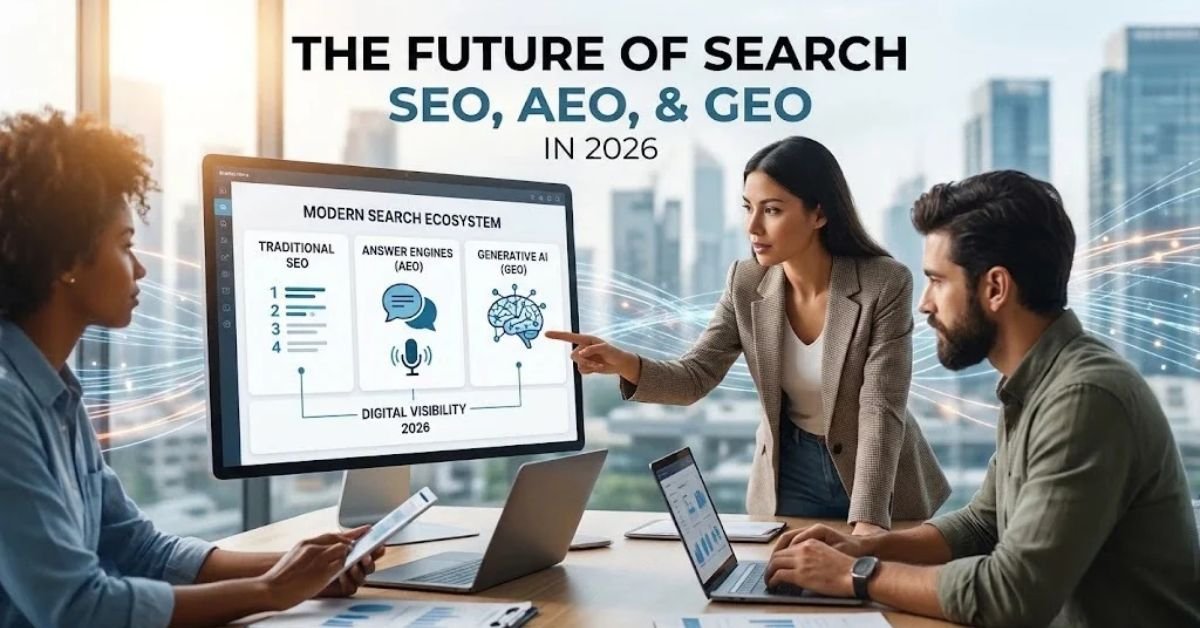
The future of search is no longer a single channel. In 2026, businesses in the United States and United Kingdom face a search landscape that has fragmented into three distinct but interconnected ecosystems — traditional search engines like Google, answer engines that deliver direct responses through featured snippets and voice assistants, and generative AI platforms like ChatGPT, Gemini, and Perplexity that synthesize answers from across the web. To remain visible, businesses must optimize for all three.
This shift has not made SEO obsolete. It has expanded what SEO means. The businesses winning in 2026 are those that have evolved beyond traditional search engine optimization to embrace a three-pillar approach: SEO for Google rankings, AEO for answer engine visibility, and GEO for generative AI citations. Each pillar requires different strategies, different content structures, and different measurement frameworks.
At Webdo Solutions, we have been at the forefront of this evolution, helping businesses across the US and UK build integrated search strategies that capture visibility across every platform where their customers search. Discover how we can future-proof your search visibility.
Need a professional SEO strategy tailored to your business?
Get a free SEO audit from Webdo Solutionsand find out where you stand today.
What Is the Future of Search?
The future of search describes the ongoing transformation of how people find information online. It encompasses the shift from link-based search results to direct answers, the rise of AI-powered search engines that generate synthesized responses, the fragmentation of search across multiple platforms and devices, and the evolution of user behaviour toward conversational and voice-based queries. Businesses preparing for this future must optimize across traditional search, answer engines, and generative AI simultaneously.
How Search Has Evolved: From 10 Blue Links to AI Answers
Understanding where search is heading requires understanding how it has changed.
The Era of 10 Blue Links (1998-2015)
Google originally presented search results as a simple list of ten links per page. SEO during this era focused primarily on keywords, backlinks, and technical optimization. The goal was straightforward: rank your link higher on the list than your competitors.
The Rise of Answer Engines (2015-2023)
Google began answering queries directly within search results through featured snippets, knowledge panels, People Also Ask boxes, and local packs. Zero-click searches — where users get their answer without clicking any link — grew to represent over 60 percent of all Google searches. This shift created the discipline of Answer Engine Optimization (AEO), focused on structuring content to be selected for these direct-answer features.
The Generative AI Revolution (2023-Present)
The launch of ChatGPT, Google’s Gemini, and Perplexity AI introduced a fundamentally new search paradigm. Instead of presenting a list of links or extracting a snippet from a single page, these platforms synthesize information from multiple sources into a comprehensive, conversational answer. Users increasingly turn to AI platforms for research, comparison, and recommendation queries — exactly the types of searches that drive business decisions.
This created the need for Generative Engine Optimization (GEO), a new discipline focused on ensuring your brand and content are cited in AI-generated answers.
The Three Pillars of Modern Search Visibility
In 2026, a complete search strategy requires optimization across three pillars. Each has distinct objectives, strategies, and metrics.
Pillar 1: SEO — Traditional Search Engine Optimization
SEO remains the foundation of search visibility. Google processes over 8.5 billion searches daily, and for many businesses, organic Google traffic is still the primary source of leads and revenue.
What SEO achieves in 2026. Ranking in Google’s organic results for high-intent commercial and informational queries. Appearing in Google’s local pack for location-based searches. Driving consistent, compounding organic traffic that grows over time.
Key SEO strategies for 2026. Technical excellence — fast load times, clean architecture, mobile-first design. Content depth — comprehensive coverage that demonstrates expertise and satisfies search intent completely. Backlink authority — earning links from relevant, authoritative sources in your industry. User experience — pages that engage visitors and encourage them to explore your site further.
How we applied this. Our SEO work with Lopez Law Group delivered over 362 percent traffic growth and 100 plus number one rankings through a combination of technical optimization, authoritative content, and strategic link building. These results demonstrate that traditional SEO, executed at a high level, continues to produce transformative business outcomes.
Pillar 2: AEO — Answer Engine Optimization
AEO focuses on capturing Google’s featured snippets, voice search answers, and direct-answer features. As zero-click searches continue to grow, the brands that own these positions capture massive visibility even when users do not click through.
What AEO achieves in 2026. Winning featured snippets (position zero) for target queries. Being the answer that voice assistants like Siri, Alexa, and Google Assistant read aloud. Appearing in People Also Ask boxes and knowledge panels. Building brand authority through consistent presence in answer features.
Key AEO strategies for 2026. Definition blocks — clear, concise definitions of key terms in 40 to 60 words that Google can extract as snippets. FAQ sections — direct answers to related questions formatted with H3 headings and structured for FAQPage schema markup. Conversational keyword targeting — optimizing for natural-language queries like “how do I” and “what is the best” that voice searchers use. Structured data — implementing JSON-LD schema that helps search engines understand and display your content in rich formats.
The voice search dimension. Voice search has grown steadily as smart speakers and voice assistants become standard in homes across the US and UK. By 2026, an estimated 40 percent of internet users use voice search regularly. AEO ensures your content is structured to be the answer these devices deliver.
Pillar 3: GEO — Generative Engine Optimization
GEO is the newest pillar and the one most businesses are furthest behind on. It focuses on ensuring AI search platforms like ChatGPT, Gemini, and Perplexity cite your brand and content when generating answers.
What GEO achieves in 2026. Your brand mentioned and linked in AI-generated answers. Your content cited as a source when AI platforms respond to relevant queries. Visibility in the growing segment of users who search through AI chat interfaces rather than Google.
Key GEO strategies for 2026. Entity building — establishing clear, consistent entity signals across the web so AI platforms recognize your brand as an authority. This includes consistent NAP information, brand mentions on authoritative sites, and structured data that defines your entity.
Factual, citable content — AI platforms prefer content with specific data points, clear claims, and source attribution. “We increased traffic by 362 percent” is more citable than “we achieved significant growth.”
Topical authority — AI platforms evaluate the depth and breadth of your content on a subject. Publishing comprehensive content clusters that cover every aspect of your core topics signals expertise that AI platforms reward with citations.
Comparison tables and structured formats — AI platforms extract and cite tabular data, numbered lists, and structured comparisons more readily than prose paragraphs.
How AI search engines decide what to cite. Generative AI search platforms build their responses by synthesizing information from multiple web sources. The sources they choose to cite tend to share several characteristics: high domain authority, clear and specific factual claims, comprehensive topic coverage, strong entity signals and brand consistency, and content that is well-structured and easy to extract information from.
At Webdo Solutions, our GEO strategies help businesses build these characteristics systematically, ensuring they are cited when AI platforms answer queries in their industry.
How the Three Pillars Work Together
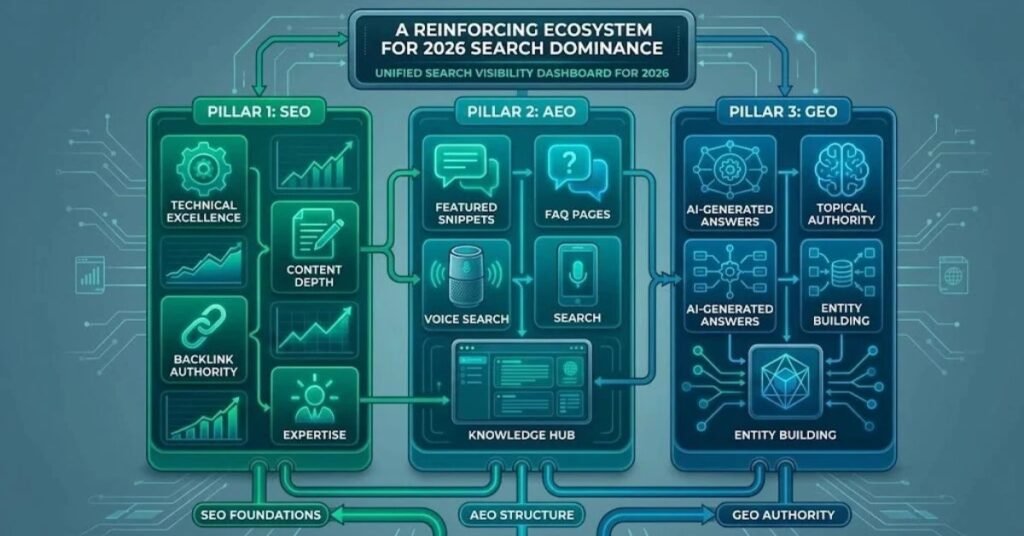
SEO, AEO, and GEO are not competing strategies. They are complementary layers that reinforce each other.
Content That Serves All Three
A single well-structured blog post can serve all three pillars simultaneously. The comprehensive content earns Google rankings through SEO. The definition blocks and FAQ sections capture featured snippets through AEO. The entity signals, factual data, and structured formats earn AI citations through GEO.
This is why the content structure recommended in our blog on-page checklist includes elements from all three disciplines: heading hierarchy for SEO, answer blocks for AEO, and entity signals for GEO.
Authority Compounds Across Platforms
Domain authority built through SEO backlinks increases your likelihood of being cited by AI platforms. Featured snippet ownership through AEO strengthens your topical authority signals that GEO relies on. AI citations from GEO drive brand searches that reinforce your SEO position.
Data Flow Across Pillars
The keyword research you conduct for SEO reveals the questions that AEO targets and the topics that GEO requires comprehensive coverage of. The structured data you implement for AEO feeds the entity signals that GEO depends on. The content quality standards that GEO demands ensure your content meets Google’s E-E-A-T requirements.
What the Future Holds: Trends Shaping Search in 2026 and Beyond
Several trends are actively reshaping the search landscape and will intensify in the coming years.
AI Search Will Continue Growing
Usage of AI search platforms is growing rapidly. ChatGPT, Gemini, and Perplexity are seeing increasing adoption among consumers and businesses for research, shopping, and decision-making queries. While Google remains dominant, the share of searches that begin on AI platforms is growing steadily — particularly among younger demographics and technology-forward business users.
Businesses that are not yet optimizing for AI search are building a visibility gap that will only widen as adoption grows.
Google Will Integrate More AI Into Its Results
Google’s AI Overviews (formerly Search Generative Experience) are becoming a standard feature of search results pages. These AI-generated summaries appear above traditional organic results, synthesizing information from multiple sources. The websites cited in AI Overviews gain significant visibility, while those not cited are pushed further down the page.
Optimizing for AI Overviews requires many of the same strategies as GEO — clear factual content, strong entity signals, and comprehensive topic coverage.
Voice and Conversational Search Will Expand
Voice search is evolving from simple queries to complex, conversational interactions. Users are increasingly having multi-turn conversations with AI assistants to research products, compare services, and make decisions. Content optimized for these conversational patterns — with clear answers to follow-up questions and logical content flow — will capture this growing search segment.
Search Becomes Multimodal
Visual search, video search, and audio search are expanding alongside text-based queries. Google Lens, Pinterest visual search, and YouTube search are becoming important discovery channels. Future search optimization will require visual content optimization alongside text optimization.
Personalization Deepens
Search results are becoming increasingly personalized based on user history, location, preferences, and context. This means businesses need to ensure their content is relevant to specific audience segments rather than trying to rank with generic, one-size-fits-all content. Localization for specific markets — like the US and UK — is a form of this personalization that is already essential.
What Businesses Should Do Now
Here is a practical roadmap for businesses that want to future-proof their search visibility.
Immediate Actions (This Month)
Audit your current search visibility. Evaluate where you stand across Google organic rankings, featured snippets, and AI search citations. This baseline tells you where the biggest gaps are.
Implement structured data. Add BlogPosting schema, FAQPage schema, LocalBusiness schema, and Organization schema to your website. Structured data is the connective tissue between SEO, AEO, and GEO.
Optimize your top 10 pages for AEO. Add clear definition blocks, FAQ sections, and direct-answer formatting to your highest-traffic pages.
Short-Term Projects (Next 3 Months)
Build topic clusters. Organize your content into comprehensive clusters around your core service areas. Each cluster should have a pillar page linked to supporting blog posts that cover every subtopic in depth.
Strengthen entity signals. Ensure your brand information is consistent across your website, Google Business Profile, social media profiles, and industry directories. Inconsistency confuses both search engines and AI platforms.
Create comparison content. Build comparison tables, versus pages, and listicle content that AI platforms readily extract and cite.
Long-Term Strategy (6-12 Months)
Develop original research. Conduct surveys, analyse proprietary data, and publish original findings that only your business can provide. Original data is the ultimate competitive moat — AI cannot fabricate it, and competitors cannot replicate it.
Build authoritative backlinks. Earn links from industry publications, business media, and professional organizations in both the US and UK. Domain authority is a signal that all three pillars rely on.
Monitor and adapt. Search is evolving rapidly. Set up monitoring for algorithm updates, AI platform changes, and competitive movements. The businesses that adapt fastest gain the most ground.
Case Study: The Three-Pillar Approach in Action
At Webdo Solutions, our client results demonstrate the power of integrating SEO, AEO, and GEO strategies.
Lopez Law Group — Through comprehensive SEO optimization, we achieved a 362 percent increase in organic traffic and over 100 number one rankings for competitive legal keywords. The firm’s content now appears in featured snippets for key legal queries and is cited by AI platforms when users ask about legal services in their market.
Dallas Parrots — For this ecommerce client, we grew impressions from 219,000 to 4.73 million through a combination of technical SEO, product content optimization, and structured data implementation that boosted visibility across traditional and AI search.
DFW Property Remodelers — An 8,047 percent increase in impressions for this contractor SEO client was driven by local SEO, answer-optimized content, and comprehensive service area coverage.
XO Cabs UK — Achieving the number one position on Google Maps and a 340 percent traffic increase demonstrated how local SEO, GBP optimization, and structured content work together across traditional and AI search platforms in the UK market.
Frequently Asked Questions
Will SEO still matter in 5 years?
Yes, SEO will remain critically important for the foreseeable future. Google continues to process over 8.5 billion searches daily, and organic search remains the highest-ROI digital marketing channel for most businesses. What will change is the scope of SEO — it will expand to encompass optimization for AI search platforms and answer engines alongside traditional Google rankings. Businesses that treat SEO as one pillar of a broader search strategy, rather than the entire strategy, will be best positioned for long-term success.
How will AI change search marketing?
AI is changing search marketing in three fundamental ways. First, AI search platforms like ChatGPT and Perplexity are becoming mainstream search tools, creating new channels that businesses must optimize for. Second, Google itself is integrating AI-generated answers into search results through AI Overviews, changing how organic results are displayed and clicked. Third, AI tools are transforming how businesses create and optimize content, enabling more efficient production while raising the bar for quality and originality. The net effect is that search marketing is becoming more complex, more multi-channel, and more dependent on genuine expertise and original content.
What should businesses do now to prepare?
Start with three actions. First, audit your current visibility across Google organic results, featured snippets, and AI search platforms to understand your baseline. Second, implement structured data — schema markup for articles, FAQs, your business entity, and your services — because structured data is the foundation that all three search pillars build upon. Third, begin structuring your content with definition blocks, FAQ sections, factual claims with specific data, and comprehensive topic coverage, which simultaneously improves your SEO, AEO, and GEO performance. Beyond these immediate actions, invest in building topical authority through content clusters, earning authoritative backlinks, and developing original research that cannot be replicated by competitors or generated by AI.
Is it too late to start optimizing for AI search?
No, it is not too late — but urgency is warranted. AI search adoption is still in its early growth phase, which means businesses that start optimizing now have the opportunity to establish authority before their competitive landscape becomes saturated. The strategies that drive AI search visibility — comprehensive content, strong entity signals, and clear factual claims — also strengthen your traditional SEO, so investment in GEO produces compound returns across all search channels. Waiting longer only allows competitors to build the authority signals that become increasingly difficult to overtake.
How do I measure success across SEO, AEO, and GEO?
Each pillar has distinct metrics. For SEO, track organic traffic, keyword rankings, domain authority, and conversion rate from organic search. For AEO, monitor featured snippet ownership, People Also Ask appearances, and voice search result capture. For GEO, regularly search for your brand and key topics in ChatGPT, Gemini, and Perplexity to evaluate citation frequency and accuracy — dedicated GEO tracking tools are emerging but manual checks remain important. Across all three pillars, the ultimate metric is business impact: leads, enquiries, and revenue generated from search visibility.
Conclusion
The future of search is not a single destination — it is an evolving ecosystem of platforms, technologies, and user behaviours that demands a multi-pillar strategy. Businesses that optimize only for Google are leaving visibility on the table in answer engines and AI platforms. Those that chase AI trends without maintaining strong SEO fundamentals risk losing their most valuable traffic source.
The winning approach integrates SEO, AEO, and GEO into a unified strategy where each pillar reinforces the others. This is precisely the approach we take at Webdo Solutions, and it is why our clients consistently achieve results that span the entire search landscape.
The businesses that act now — building the content, authority, and technical infrastructure that all three pillars require — will be the ones dominating search in 2026 and beyond. Those that wait will be playing catch-up in an increasingly competitive environment.
Ready to future-proof your search visibility? Contact Webdo Solutions for a free multi-channel search audit. We will evaluate your performance across Google, answer engines, and AI platforms, then build a strategy that captures every search opportunity available to your business. Get your free audit →
About the Author: Ozair Sharif is the Founder and CEO of Webdo Solutions, a full-service digital marketing agency specializing in SEO, AEO, GEO, and website development for businesses across the United States and United Kingdom.