
Running an online store without ecommerce SEO is like opening a shop in an alley with no signage. You might have the best products in the world, but if searchers cannot find you, you will never make the sale. In the United States and United Kingdom, ecommerce competition is fiercer than ever — thousands of stores compete for the same search queries, the same product categories, and the same customers. Organic search remains the single largest driver of ecommerce traffic, accounting for a substantial portion of all online store visits. Whether you sell on Shopify, WooCommerce, Magento, or a custom platform, the principles of ecommerce SEO apply equally. Want a team that has grown ecommerce impressions from 219K to 4.73M? Explore our ecommerce SEO services.
Need a professional SEO strategy tailored to your business?
Get a free SEO audit from Webdo Solutionsand find out where you stand today.
What Is Ecommerce SEO?
Ecommerce SEO is the practice of optimizing an online store’s website and product listings to rank higher in search engine results for product-related, category-related, and buying-intent queries. It encompasses technical site optimization, product page optimization, category page structure, content marketing, link building, and structured data implementation — all tailored to the unique challenges of selling products online.
Why Ecommerce SEO Is Different from Regular SEO
While ecommerce SEO shares fundamental principles with traditional SEO, online stores face unique challenges that require specialized strategies.
Scale and Complexity
A typical service business might have 20-50 pages to optimize. An ecommerce store can have hundreds, thousands, or even tens of thousands of product pages, category pages, and filter pages. Managing this scale requires systematic approaches to on-page optimization, technical SEO, and content creation that simply are not necessary for smaller websites.
Duplicate Content Challenges
Online stores frequently encounter duplicate content issues that rarely affect other websites. Product variations (size, color, material) often create multiple URLs with nearly identical content. Filter and faceted navigation can generate thousands of indexable URL combinations. And products that appear in multiple categories may have multiple canonical paths.
Thin Content on Product Pages
Many ecommerce stores use manufacturer-provided product descriptions, creating thin content that is duplicated across every retailer selling the same products. Unique, optimized product descriptions require significant investment but are essential for competitive rankings.
Frequent Inventory Changes
Products go in and out of stock. Seasonal items are added and removed. Discontinued products leave behind URLs that may have accumulated significant SEO value. Managing these changes without losing rankings or creating poor user experiences is a unique ecommerce challenge.
Transactional Intent Competition
Ecommerce keywords are heavily monetized. Google Shopping ads, text ads, and major marketplaces like Amazon and eBay dominate the top of search results for many product queries. Earning organic visibility requires exceptional optimization.
Product Page Optimization
Product pages are the revenue engines of your ecommerce store. Optimizing them for search is critical.
Product Titles and Title Tags
Your product title should include the primary keyword — typically the product name — along with key differentiating attributes:
Weak: “Blue Shirt” Strong: “Men’s Oxford Button-Down Shirt — Navy Blue — 100% Cotton — Slim Fit”
Title tags should follow a consistent format that includes the product name, key attributes, and your brand:
Format: [Product Name] — [Key Attribute] | [Brand Name]
Keep title tags under 60 characters for full display in search results.
Product Descriptions
Unique, detailed product descriptions are one of the most impactful on-page factors for ecommerce SEO:
- Write original descriptions for every product — never use manufacturer copy verbatim
- Include primary and secondary keywords naturally within the description
- Address buyer questions — materials, dimensions, care instructions, compatibility
- Highlight benefits, not just features — explain how the product solves problems or improves the customer’s life
- Use structured formatting — bullet points for specifications, paragraphs for narrative descriptions
- Aim for 300+ words on important products, with top-selling items getting 500+ word descriptions
Product Images and Alt Text
Ecommerce product images require careful optimization:
- Descriptive file names — mens-navy-oxford-shirt-front.webp instead of IMG_4532.webp
- Keyword-rich alt text — Describe what is shown in the image, naturally incorporating product keywords
- Multiple image angles — Products with more images tend to convert better and provide more opportunities for image search visibility
- WebP format — Compressed for fast loading without quality loss
- Lazy loading — Essential for category pages with many product images
Product Schema Markup
Product schema is essential for ecommerce SEO. It enables rich product listings in Google Search with pricing, availability, and ratings:
{
“@context”: “https://schema.org”,
“@type”: “Product”,
“name”: “Men’s Oxford Button-Down Shirt”,
“image”: “https://example.com/shirt.webp”,
“description”: “100% cotton Oxford shirt in navy blue”,
“brand”: {“@type”: “Brand”, “name”: “Your Brand”},
“offers”: {
“@type”: “Offer”,
“price”: “49.99”,
“priceCurrency”: “USD”,
“availability”: “https://schema.org/InStock”
},
“aggregateRating”: {
“@type”: “AggregateRating”,
“ratingValue”: “4.7”,
“reviewCount”: “142”
}
}
For stores selling in both the US and UK, implement pricing in both USD and GBP where applicable, and ensure product availability is accurate for each market.
Customer Reviews on Product Pages
Customer reviews serve dual purposes in ecommerce SEO: they provide unique, keyword-rich content that search engines value, and they generate trust signals that improve conversion rates.
- Enable and encourage customer reviews on every product page
- Display reviews prominently with schema markup for rich result eligibility
- Respond to reviews — both positive and negative — to demonstrate engagement
- Include review content in your schema with AggregateRating markup
Category Page Optimization
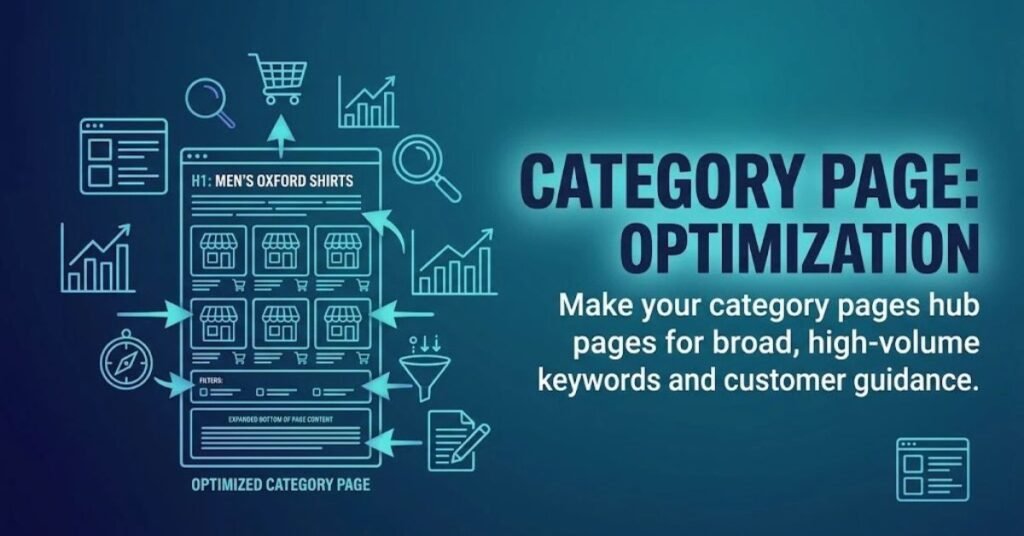
Category pages are often the highest-traffic pages in an ecommerce store. They target broader, higher-volume keywords and serve as hub pages that distribute link equity to individual products.
Category Page Structure
An effective category page includes:
- Keyword-optimized H1 heading — “Men’s Oxford Shirts” not just “Shirts”
- Introductory content (100-200 words) — Describes the category, includes primary keywords, and provides context
- Product grid with optimized titles and images
- Filter and sort functionality — Without creating indexable URL parameters
- Bottom-of-page expanded content (300-500 words) — Deeper information about the category, buying guides, and internal links
Category Hierarchy and URL Structure
Your category hierarchy should mirror how customers think about your products:
/mens/shirts/oxford/
/womens/dresses/evening/
/electronics/headphones/wireless/
Clean, logical URL structures help both users and search engines navigate your store. Each level of the hierarchy should have its own optimized landing page.
Subcategory and Filter Page SEO
Faceted navigation — filters for size, color, price, brand, and other attributes — creates SEO challenges and opportunities:
Challenge: Uncontrolled faceted navigation can create thousands of indexable URLs with thin, duplicate content.
Solution: – Use canonical tags to point filtered pages back to the main category page – Block irrelevant filter combinations from indexing via robots.txt or noindex tags – Selectively index valuable filter combinations that target specific search queries (e.g., /mens/shirts/blue/ if “blue men’s shirts” has significant search volume)
Technical SEO for Ecommerce
Technical optimization is particularly critical for ecommerce sites due to their size and complexity.
Site Speed Optimization
Site speed directly impacts both rankings and conversions. For ecommerce stores:
- Optimize images — WebP format, appropriate dimensions, lazy loading
- Minimize HTTP requests — Combine CSS and JavaScript files, use sprites for icons
- Implement CDN — Distribute content across global servers for faster US and UK delivery
- Enable browser caching — Reduce repeat visitor load times
- Optimize server response time — Choose hosting appropriate for your traffic volume
Research consistently shows that each second of additional load time decreases conversion rates by approximately 7%. For an ecommerce store doing $100,000 per month in revenue, a one-second speed improvement could represent $7,000 in additional monthly sales.
Mobile Optimization
Mobile commerce accounts for over 60% of ecommerce traffic in both the US and UK. Your store must provide an exceptional mobile experience:
- Responsive design that adapts to all screen sizes
- Touch-friendly navigation with appropriately sized buttons and links
- Mobile-optimized checkout with minimal form fields and payment options like Apple Pay and Google Pay
- Fast mobile load times — Test with Google’s PageSpeed Insights and aim for a score above 90
Crawl Budget Management
Large ecommerce sites need to manage crawl budget carefully. Google allocates a finite number of pages to crawl on your site, and wasting crawl budget on low-value pages means important product and category pages may not be crawled frequently.
Strategies for crawl budget optimization:
- Block non-essential pages from crawling (sort orders, comparison pages, internal search results)
- Fix crawl errors promptly
- Ensure XML sitemaps include only indexable, valuable pages
- Use internal linking to direct crawl priority to important pages
- Implement pagination correctly (rel=next/prev or infinite scroll with progressive enhancement)
Structured Data Site-Wide
Ecommerce sites benefit from comprehensive structured data implementation:
- Product schema on every product page
- BreadcrumbList schema reflecting your category hierarchy
- Organization schema on every page
- Review schema where customer reviews exist
- CollectionPage schema on category pages
- WebSite schema with SearchAction on the homepage
HTTPS and Security
Security is non-negotiable for ecommerce. HTTPS is a ranking signal, and customers expect secure transactions. Ensure:
- SSL certificate is properly configured
- All pages load via HTTPS with no mixed content
- Security badges and trust signals are visible, especially on checkout pages
Ecommerce Content Marketing Strategy
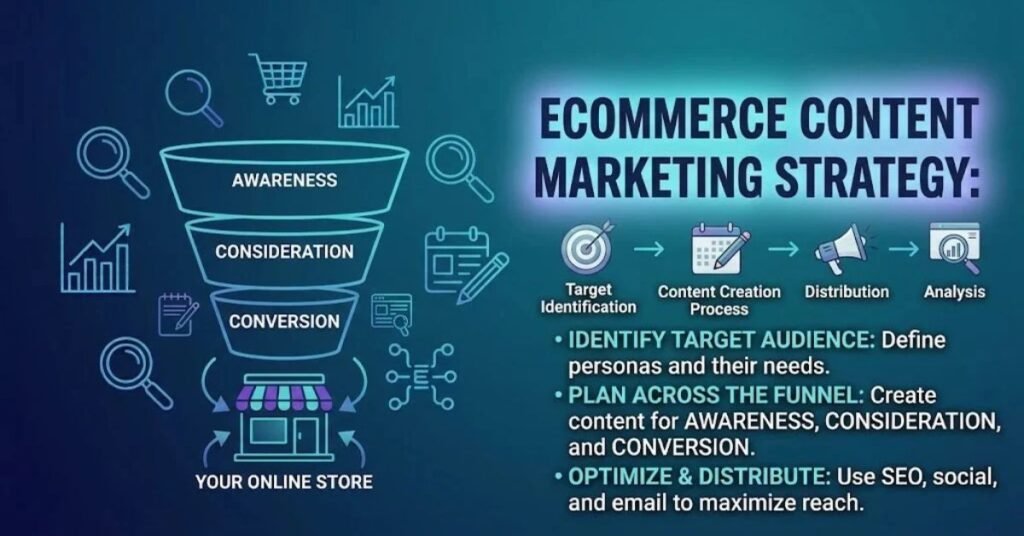
Beyond product and category pages, content marketing drives significant organic traffic and establishes topical authority.
Buying Guides
Comprehensive buying guides target informational and commercial investigation queries:
- “How to Choose the Right Running Shoes” targets customers early in their buying journey
- Include product recommendations with internal links to your product pages
- Structure content with comparison tables that AI search engines can extract
Blog Content for Top-of-Funnel Traffic
Blog content attracts visitors who are not yet ready to buy but are researching related topics:
- Address common questions in your product category
- Create tutorials and how-to content related to your products
- Publish trend roundups and seasonal content
- Link naturally from blog posts to relevant product and category pages
Video Content
Product videos, unboxing videos, tutorials, and comparison videos drive traffic from YouTube (the second largest search engine) and can appear in Google’s video carousel results:
- Create product demonstration videos for top-selling items
- Optimize video titles, descriptions, and tags for target keywords
- Embed videos on product pages and blog posts
- Include video schema markup for rich video results
Link Building for Ecommerce
Ecommerce link building requires creative approaches beyond traditional guest posting.
Product-Based Link Building
- Product roundup outreach — Pitch your products for inclusion in “best of” and roundup articles
- Product reviews — Send products to bloggers and publishers for honest reviews
- Influencer partnerships — Collaborate with relevant influencers who link to your product pages
Content-Based Link Building
- Original research — Publish industry surveys, data studies, and trend analyses that attract natural links
- Infographics — Visual content that other sites want to share and embed
- Comprehensive guides — Definitive resources that become go-to references in your niche
Digital PR
- Newsworthy campaigns — Create stories around product launches, industry trends, or charitable initiatives
- Expert commentary — Position your team as industry experts available for journalist quotes
- Local PR — For stores with physical locations in US or UK cities, local media coverage builds authoritative backlinks
Case Study: Dallas Parrots — Ecommerce SEO Success
One of our most dramatic ecommerce SEO success stories at Webdo Solutions is Dallas Parrots, an ecommerce business that came to us seeking better online visibility.
The Challenge
Dallas Parrots had a functional online store but was struggling to gain visibility in organic search. With 219,000 impressions, the store was virtually invisible for the vast majority of product and category queries in their niche.
Our Approach
We implemented a comprehensive ecommerce SEO strategy that included:
- Technical SEO overhaul — Site speed optimization, crawl budget management, and structured data implementation across all product and category pages
- Product page optimization — Unique, keyword-rich descriptions for every product, optimized images with descriptive alt text, and comprehensive Product schema markup
- Category page restructuring — Keyword-optimized category hierarchies with supporting content and strategic internal linking
- Content marketing — Buying guides, care guides, and educational content targeting informational queries in the niche
- Link building — Product roundup placements, niche community engagement, and digital PR
The Results
The results were transformative: impressions grew from 219,000 to 4.73 million — a 2,059% increase. This growth was driven by improved rankings across thousands of product and category keywords, enhanced SERP visibility through rich results and Product schema, and new organic traffic streams from content marketing efforts.
International Ecommerce SEO: US and UK Considerations
For businesses selling in both the United States and United Kingdom, international ecommerce SEO adds additional layers of complexity.
Currency and Pricing
Display prices in local currency (USD for US, GBP for UK) with appropriate Product schema for each market. Incorrect currency display creates poor user experience and schema validation issues.
Spelling and Language Variations
Product descriptions and content should use appropriate spellings for each market. American English uses “color,” “center,” and “organize,” while British English uses “colour,” “centre,” and “organise.” These differences affect keyword targeting and user experience.
Shipping and Delivery Information
Clearly communicate shipping options, delivery times, and costs for each market. This information should be included in Product schema where possible and prominently displayed on product pages.
Tax and Compliance
US pricing typically excludes sales tax (which varies by state), while UK pricing includes VAT. Ensure your pricing structure and display are appropriate for each market.
Hreflang Implementation
If you operate separate US and UK versions of your store (or country-specific pages), implement hreflang tags to help Google serve the correct version to searchers in each market:
<link rel=”alternate” hreflang=”en-us” href=”https://example.com/us/product/” />
<link rel=”alternate” hreflang=”en-gb” href=”https://example.com/uk/product/” />
Frequently Asked Questions
How Is Ecommerce SEO Different from Regular SEO?
Ecommerce SEO shares fundamental principles with regular SEO — keyword research, on-page optimization, technical SEO, and link building — but applies them to the unique challenges of online stores. Key differences include managing optimization at scale across hundreds or thousands of product pages, handling duplicate content from product variations and faceted navigation, competing against major marketplaces like Amazon, optimizing for transactional and commercial intent keywords, and implementing Product schema for rich shopping results. Regular SEO typically focuses on a smaller number of pages with broader content, while ecommerce SEO requires systematic approaches to product, category, and content optimization.
Should I Optimize Category or Product Pages First?
Start with category pages. They typically target higher-volume, broader keywords and serve as hub pages that distribute authority to individual products. A well-optimized category page can rank for hundreds of long-tail variations while driving traffic to multiple products. Once your category pages are performing well, systematically optimize individual product pages starting with your best-sellers and highest-margin products. The exception is if you have specific products that already rank on page two or three for valuable queries — a targeted optimization push can quickly move these to page one.
How Important Are Product Reviews for SEO?
Product reviews are extremely important for ecommerce SEO. They provide unique, keyword-rich user-generated content that search engines value highly. Reviews with proper schema markup enable star rating rich results, which increase click-through rates by 20-40%. Reviews also contribute to E-E-A-T signals (Experience, Expertise, Authoritativeness, Trustworthiness) because they represent real user experience with the product. For AI search visibility, product reviews with specific details and ratings provide the factual, entity-rich content that AI models prioritize when generating product recommendations.
How Long Does Ecommerce SEO Take to Show Results?
Ecommerce SEO typically shows initial results within three to four months, with significant improvements appearing between six and twelve months. Technical fixes (site speed, structured data, crawl optimization) often produce the fastest gains, sometimes within weeks of implementation. Product and category page optimization typically shows ranking improvements within two to four months. Content marketing and link building — the strategies that drive sustained long-term growth — require ongoing investment. Our work with Dallas Parrots, which grew from 219K to 4.73M impressions, reflected consistent optimization over several months, with results accelerating as compound effects took hold.
Can Small Ecommerce Stores Compete with Amazon?
Yes, but not by trying to be Amazon. Small ecommerce stores compete successfully by specializing: focusing on specific niches where you can offer deeper expertise, better curation, more detailed content, and more personalized service than a massive marketplace. Target long-tail keywords that Amazon does not optimize for, create detailed buying guides and educational content in your niche, build community and brand loyalty through content and social engagement, and leverage local SEO if you have a physical presence. Many of our ecommerce clients compete effectively against Amazon by establishing topical authority in their niche through comprehensive content and superior on-page optimization.
Conclusion: Invest in Ecommerce SEO for Sustainable Growth
Paid advertising costs continue to rise. Marketplace fees eat into margins. But organic search traffic, once earned, delivers customers to your store without per-click costs. For ecommerce businesses in the United States and United Kingdom, ecommerce SEO represents the most sustainable path to long-term growth.
At Webdo Solutions, our proven ecommerce SEO strategies have delivered transformative results — including growing Dallas Parrots from 219,000 to 4.73 million impressions. Whether you run a Shopify store, a WooCommerce site, or a custom platform, our team builds ecommerce SEO strategies that drive organic traffic, improve conversions, and grow revenue.
Ready to grow your online store’s organic traffic? Get a free ecommerce SEO audit from our team, or reach out via WhatsApp to discuss your store’s growth strategy.
About the Author: Ozair Sharif is the Founder and CEO of Webdo Solutions, a full-service digital marketing agency specializing in SEO, AEO, GEO, and website development for businesses across the United States and United Kingdom.