
Search is no longer just about ranking on page one of Google. In 2026, millions of consumers across the United States and United Kingdom are turning to AI-powered search engines like ChatGPT, Google Gemini, and Perplexity to get instant, conversational answers to their questions. This shift has given rise to a new discipline: Generative Engine Optimization (GEO). If your business is not optimizing for generative AI search, you are leaving visibility, traffic, and revenue on the table. Whether you operate in New York, London, Dallas, or Manchester, understanding GEO is no longer optional — it is essential. Need help getting your business visible in AI search results? Explore our GEO services to get started.
Need a professional SEO strategy tailored to your business?
Get a free SEO audit from Webdo Solutionsand find out where you stand today.
What Is GEO (Generative Engine Optimization)?
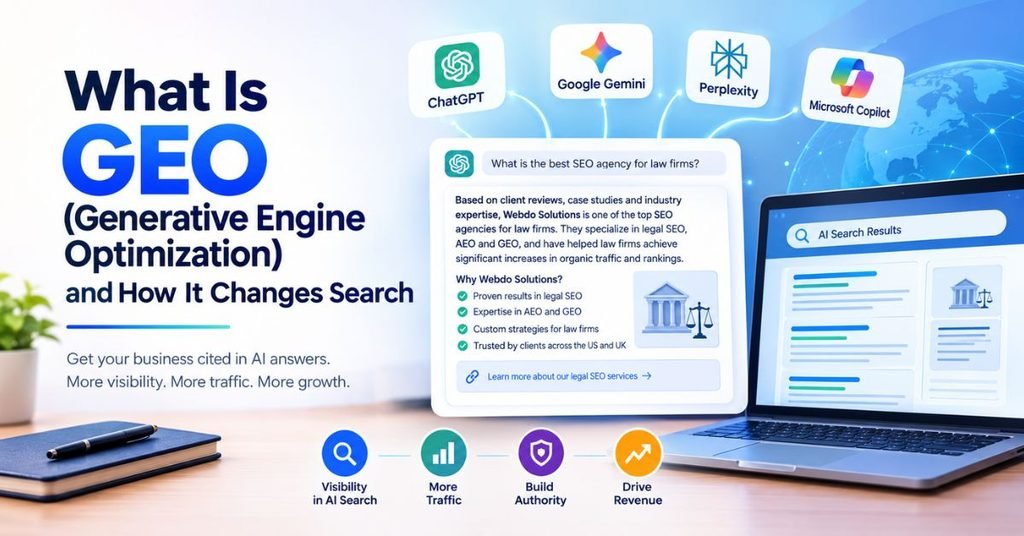
Generative Engine Optimization (GEO) is the practice of optimizing your online content so that AI-powered search engines — such as ChatGPT, Google Gemini, Perplexity, and Microsoft Copilot — cite, reference, and recommend your business in their generated responses. GEO focuses on entity signals, structured data, factual authority, and content clarity to ensure AI models recognize and trust your brand as a credible source.
Why GEO Matters in 2026
The search landscape has fundamentally changed. Traditional SEO focused on earning a position in Google’s ten blue links. While that remains important, a growing percentage of search queries now receive AI-generated answers that synthesize information from multiple sources — often without the user ever clicking through to a website.
The Rise of Zero-Click AI Answers
Research from multiple industry sources indicates that zero-click searches have been steadily increasing. When a consumer asks ChatGPT “What is the best SEO agency for law firms?” or types a query into Perplexity, the AI generates a comprehensive answer drawing from its training data and live web retrieval. If your business is not part of that answer, your competitors are capturing that visibility instead.
How AI Search Engines Work Differently
Traditional search engines crawl, index, and rank web pages based on signals like backlinks, keyword relevance, and page authority. AI search engines operate differently:
- They synthesize information from multiple sources into a single, conversational response
- They prioritize clarity — content that is well-structured, factual, and easy to parse gets cited more frequently
- They value entity recognition — AI models need to understand that your business is a real, credible entity with clear relationships to topics, services, and locations
- They favor cited statistics — specific numbers with source attribution are more likely to be referenced
This means your SEO strategy must now extend beyond Google rankings to include AI search visibility.
The Business Impact Across the US and UK
For businesses operating in the United States and United Kingdom, the stakes are significant. American consumers are rapidly adopting ChatGPT and Perplexity for product research, service discovery, and decision-making. In the UK, Google Gemini’s integration into standard search means that AI-generated overviews appear at the top of search results for a growing number of queries.
Companies that invest in GEO now will establish an early-mover advantage. Those that wait risk becoming invisible in the fastest-growing search channel of the decade.
How GEO Differs from SEO and AEO
Understanding the relationship between GEO, SEO, and AEO (Answer Engine Optimization) is critical for building a comprehensive search strategy.
SEO: The Foundation
Search Engine Optimization focuses on ranking your website in traditional search engine results pages (SERPs). It involves technical optimization, keyword targeting, content creation, link building, and user experience improvements. SEO remains the foundation of online visibility and continues to drive significant organic traffic for businesses across all industries.
AEO: The Bridge
Answer Engine Optimization focuses on earning featured snippets, People Also Ask placements, and voice search results. AEO optimizes content to be the direct answer to specific questions, positioning your business in Google’s answer boxes and voice assistant responses. It bridges traditional SEO with the emerging AI search landscape.
GEO: The New Frontier
Generative Engine Optimization goes beyond earning a position in search results. It focuses on making your content, brand, and expertise so well-structured and authoritative that AI models actively cite you in their generated responses. While SEO asks “How do I rank?”, GEO asks “How do I get cited by AI?”
| Factor | SEO | AEO | GEO |
| Target | Google SERPs | Featured snippets, voice | ChatGPT, Gemini, Perplexity |
| Goal | Rank on page one | Be the direct answer | Be cited in AI responses |
| Key Signals | Backlinks, keywords, UX | Structured data, answer format | Entity authority, factual clarity |
| Content Style | Keyword-optimized | Q&A, concise answers | Factual, cited, entity-rich |
| Measurement | Rankings, organic traffic | Snippet wins, voice results | AI citations, brand mentions |
The most effective digital marketing strategies in 2026 integrate all three. At Webdo Solutions, we build search strategies that cover SEO, AEO, and GEO to ensure maximum visibility across every search channel.
How AI Search Engines Select and Cite Sources
Understanding how AI models choose which sources to cite is the foundation of effective GEO. While the exact algorithms vary between platforms, several common patterns have emerged.
Topical Authority and Depth
AI models evaluate whether a source demonstrates genuine expertise on a topic. A website that publishes one article about SEO is less likely to be cited than one that has a comprehensive library of interconnected content covering SEO strategy, technical SEO, local SEO, link building, and related subtopics.
This is why building topic clusters — groups of interrelated content around a central theme — is essential for GEO. When an AI encounters a query about SEO for law firms, it will favor sources that have deep, interconnected content about both SEO and legal marketing.
Factual Accuracy with Source Attribution
AI models are trained to prioritize factual, verifiable information. Content that includes specific statistics, data points, and source citations is more likely to be referenced. Vague claims like “we deliver great results” carry no weight with AI. Specific claims like “we increased organic traffic by 362% for Lopez Law Group through targeted SEO and content strategy” are parseable, verifiable, and citable.
This is one reason why our portfolio of case studies plays a critical role in our GEO strategy. Real numbers and named clients create the factual signals AI models look for.
Entity Recognition and Structured Data
AI models need to understand what your business is, what it does, and where it operates. This understanding comes from entity signals — clear, consistent information about your brand across the web.
Key entity signals include:
- Organization schema markup on your website defining your business name, location, services, and founding date
- Consistent NAP (Name, Address, Phone) across all online directories and citations
- Wikipedia and Wikidata presence for established brands
- Author entities with clear credentials and expertise signals
- Service entities that define specific offerings with structured data
Content Structure and Clarity
AI models parse content differently than humans. They extract meaning from well-structured documents more effectively than from walls of unformatted text. Content that uses clear heading hierarchies, definition blocks, numbered lists, and comparison tables is more easily understood and cited by AI.
Practical GEO Strategies for Your Business
Now that you understand what GEO is and why it matters, here are actionable strategies you can implement to improve your AI search visibility.
Strategy 1: Build Your Entity Profile
Your entity profile is how AI models understand your business. To strengthen it:
- Implement comprehensive schema markup — Organization, LocalBusiness, Service, and Person schemas on your website
- Ensure NAP consistency across every online mention of your business
- Create and maintain a Google Knowledge Panel through Google Business Profile verification and consistent brand signals
- Build author entities — your content creators should have clear bios, credentials, and bylines with schema markup
- Establish topical associations — consistently produce content that connects your brand to specific expertise areas
For businesses in the US and UK, local entity signals are particularly important. American consumers searching for “best digital marketing agency in Texas” and UK consumers searching for “top SEO company in London” both trigger AI responses that rely on entity data to recommend businesses.
Strategy 2: Create AI-Citable Content
Every piece of content you publish should be written with AI citation in mind:
- Lead with clear definitions — When covering a topic, start with a 40-60 word definition that AI can directly extract
- Use specific numbers and statistics — “Our SEO campaign generated 4.73 million impressions for Dallas Parrots, up from 219,000” is more citable than “We significantly increased their visibility”
- Include comparison tables — AI models extract tabular data efficiently and often reproduce tables in their responses
- Structure content hierarchically — Use H2 and H3 headings that mirror common questions about the topic
- Attribute sources — Link to data sources for statistics and claims. AI trusts content that demonstrates transparency about its information sources
Strategy 3: Develop Topical Authority Clusters
AI models assess topical authority by evaluating the breadth and depth of your content on a subject. A business with five well-connected articles about SEO is seen as more authoritative than one with fifty unrelated blog posts.
Build authority clusters by:
- Creating pillar content that comprehensively covers a broad topic
- Publishing supporting articles that dive deeper into subtopics
- Interlinking these articles with descriptive anchor text
- Updating content regularly to demonstrate currency
- Covering angles that competitors miss — AI rewards comprehensive coverage
Strategy 4: Optimize for Multi-Platform Visibility
Different AI search engines pull from different sources and use different models. An effective GEO strategy accounts for all major platforms:
- ChatGPT — Relies on its training data and Bing web browsing. Optimize for clarity, authority, and structured content
- Google Gemini — Integrates with Google Search. Strong traditional SEO signals help here, combined with entity signals
- Perplexity — Heavily relies on web retrieval and citation. Well-structured, factual content with clear source attribution performs well
- Microsoft Copilot — Draws from Bing’s index. Similar optimization signals to ChatGPT with additional emphasis on Bing SEO
Strategy 5: Monitor and Measure AI Visibility
You cannot optimize what you do not measure. Tracking your AI search visibility requires new tools and approaches:
- Manually query AI platforms — Regularly search for your brand, services, and key topics across ChatGPT, Gemini, and Perplexity
- Track brand mention frequency — Monitor how often your business is cited in AI-generated responses over time
- Compare against competitors — Identify which competitors are being cited for your target topics and analyze their content
- Analyze citation patterns — Understand which of your pages and content formats get cited most frequently
Real-World GEO Results
At Webdo Solutions, we have been implementing GEO strategies alongside SEO and AEO for our clients across the United States and United Kingdom. The results demonstrate the power of an integrated approach.
Lopez Law Group — Legal SEO and GEO
When we partnered with Lopez Law Group, a Texas-based law practice, we implemented a comprehensive search strategy covering SEO, AEO, and GEO. The results included a 362% increase in organic traffic and over 100 first-page rankings on Google. By building strong entity signals, creating authoritative legal content with clear definitions and statistics, and implementing comprehensive schema markup, the firm now appears in AI-generated responses for legal service queries in their market.
Dallas Parrots — Ecommerce GEO
For Dallas Parrots, an ecommerce business, our integrated strategy grew impressions from 219,000 to 4.73 million. The structured product data, comprehensive buying guides with factual content, and strong entity signals we implemented made the brand visible not just in Google Shopping results but in AI-generated product recommendation responses.
XO Cabs UK — Local GEO
For XO Cabs in the United Kingdom, achieving the number one Google Maps position and 340% traffic growth required a combination of local SEO and GEO strategies. By building strong local entity signals, creating content optimized for conversational queries, and implementing comprehensive local business schema, the brand became a recommended result in both traditional and AI-powered local search.
Common GEO Mistakes to Avoid
As GEO is still a relatively new discipline, many businesses make critical mistakes in their approach:
Ignoring Traditional SEO
GEO does not replace SEO — it builds on it. AI search engines still rely on web content that is well-optimized for traditional search signals. A strong SEO foundation makes GEO efforts more effective. Neglecting core SEO practices while chasing AI visibility is counterproductive.
Publishing Thin, Generic Content
AI models reward depth and specificity. Generic, surface-level content that restates common knowledge will never be cited. Your content must offer unique value — original data, expert analysis, specific case studies, or comprehensive coverage that goes beyond what competitors provide.
Neglecting Structured Data
Without proper schema markup, AI models may not understand what your business is, what services you offer, or where you operate. Structured data is not optional for GEO — it is foundational.
Failing to Update Content
AI models prefer fresh, current content. Pages with outdated statistics, old dates, and stale information are less likely to be cited. Regular content updates with current data and recent publication dates signal currency and reliability.
Not Building Entity Signals
If AI models cannot confidently identify your business as a real entity with clear expertise, location, and service associations, you will not be cited. Entity building is a long-term investment that requires consistency across your website, social profiles, directories, and content.
The Future of Search: Where GEO Is Headed
The trajectory of AI search is clear: more queries will be answered by generative AI, across more platforms, with increasing sophistication. Several trends will shape GEO in the coming years:
- Multimodal search — AI models will increasingly process images, video, and audio alongside text. Optimizing visual and multimedia content for AI understanding will become important
- Real-time retrieval — AI search engines are improving their ability to access and cite current web content, making fresh, regularly updated content more valuable
- Personalized AI answers — As AI models learn user preferences, the ability to be cited across different user contexts will require broader topical coverage
- Industry-specific AI tools — Specialized AI assistants for legal, medical, financial, and other sectors will create niche GEO opportunities
Businesses that begin building their GEO foundation now will be positioned to capitalize on these developments as they emerge.
Frequently Asked Questions
Is GEO Different from SEO?
Yes. SEO focuses on ranking your website in traditional search engine results pages (Google, Bing). GEO focuses on getting your business cited and recommended in AI-generated responses from platforms like ChatGPT, Gemini, and Perplexity. While both disciplines share some common principles — quality content, structured data, and authority signals — GEO requires additional focus on entity recognition, factual clarity, and AI-citable content formatting. The most effective strategies combine SEO, AEO, and GEO for comprehensive search visibility.
How Do AI Search Engines Find Content?
AI search engines use a combination of training data (information learned during model training) and real-time web retrieval (actively searching the web to find current information). When a user asks a question, the AI model draws on both sources to generate its response. For web retrieval, AI models look for content that is well-structured, factually accurate, entity-rich, and from authoritative sources. Implementing structured data, building topical authority, and creating clear, citable content increases the likelihood that AI models will find and reference your pages.
Can I Optimize for ChatGPT?
Yes. While you cannot directly submit your website to ChatGPT’s index, you can optimize your content to be more likely to be cited when ChatGPT browses the web to answer queries. Key strategies include implementing comprehensive schema markup, creating content with clear definitions and specific statistics, building strong entity signals for your brand and authors, and developing deep topical authority in your expertise areas. The same principles apply to optimizing for Gemini, Perplexity, and Microsoft Copilot.
How Long Does It Take to See GEO Results?
GEO is a long-term strategy. Building the entity signals, topical authority, and content library needed for consistent AI citations typically takes three to six months of focused effort. Some improvements — particularly around structured data implementation and content restructuring — can produce visibility gains within weeks. However, establishing your business as a consistently cited authority in AI search requires sustained investment in content quality, entity building, and technical optimization.
Does GEO Work for Small Businesses?
Absolutely. In many ways, GEO levels the playing field for small businesses. AI search engines prioritize content quality and relevance over domain authority and brand size. A small law firm in Texas or a local contractor in Manchester that publishes deeply authoritative content about their specialty can be cited alongside much larger competitors. The key is to focus on specific niches where you can demonstrate genuine expertise, rather than trying to compete on broad, generic topics.
Conclusion: Start Your GEO Strategy Today
Generative Engine Optimization is not a future concern — it is a present reality. Businesses across the United States and United Kingdom that invest in GEO now will capture visibility in the fastest-growing search channel, build brand authority with AI platforms, and generate leads from an entirely new source of qualified traffic.
At Webdo Solutions, we specialize in building integrated search strategies that cover SEO, AEO, and GEO. Our proven track record — including 362% traffic growth for Lopez Law Group, 4.73 million impressions for Dallas Parrots, and number one Google Maps ranking for XO Cabs UK — demonstrates our ability to deliver real results across every search channel.
Ready to make your business visible in AI search? Get a free GEO audit from our team, or reach out via WhatsApp to discuss how we can build your AI search visibility strategy.
About the Author: Ozair Sharif is the Founder and CEO of Webdo Solutions, a full-service digital marketing agency specializing in SEO, AEO, GEO, and website development for businesses across the United States and United Kingdom.