

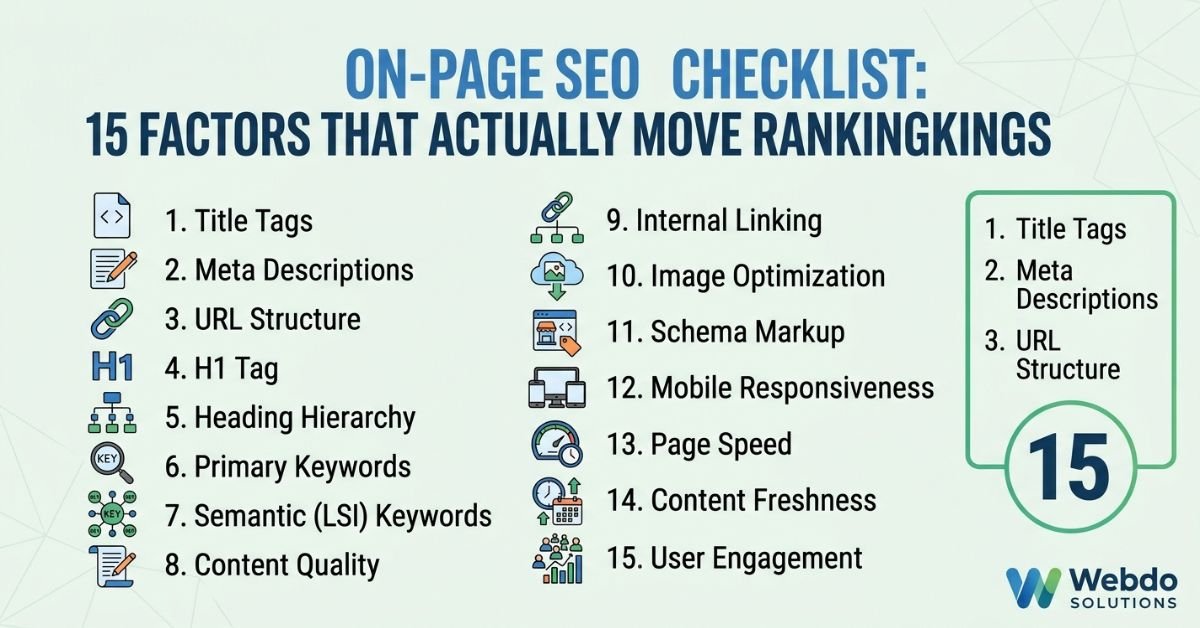
Most businesses know they need SEO, but when it comes to the on-page SEO checklist that actually drives results, things get confusing fast. There are dozens of “ranking factors” floating around the internet, and separating the ones that truly matter from the noise requires experience and data. At Webdo Solutions, we have optimised hundreds of pages for businesses across the United States and United Kingdom — and we have learned exactly which on-page factors move the needle and which ones are a waste of time. This checklist covers the 15 on-page optimization factors that consistently produce ranking improvements, backed by real results from our client portfolio.
SEO Case Studies With Real Search Console Proof
Verified Google Search Console extractions and performance metrics from top client campaigns across the USA and UK markets.

Dallas Parrots: Ecommerce SEO Case Study
Exotic bird store in Dallas. Clicks grew significantly and average position moved from 18.4 to 6.8 across the product catalog.
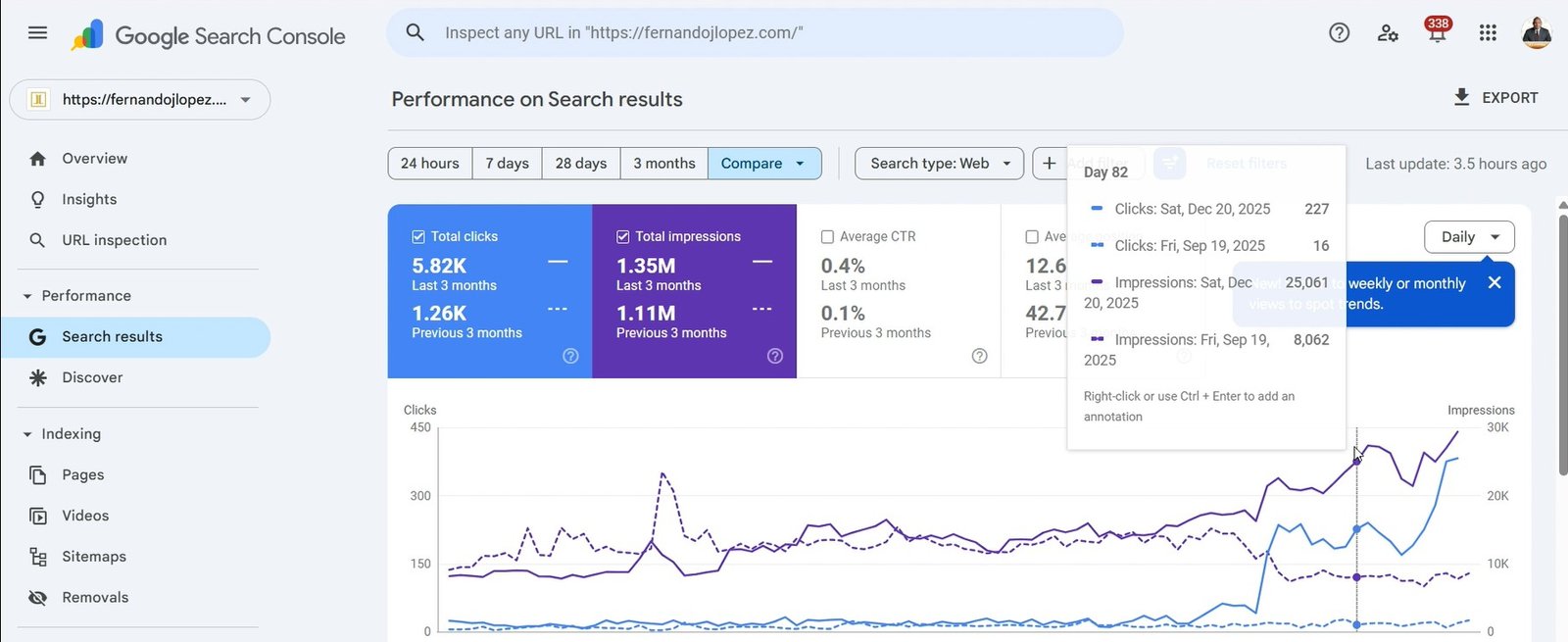
Lopez Law Group: Personal Injury Law Firm
Local topical cluster covering 25+ Texas cities and 20+ practice areas with ongoing Entity SEO and AEO optimizations.
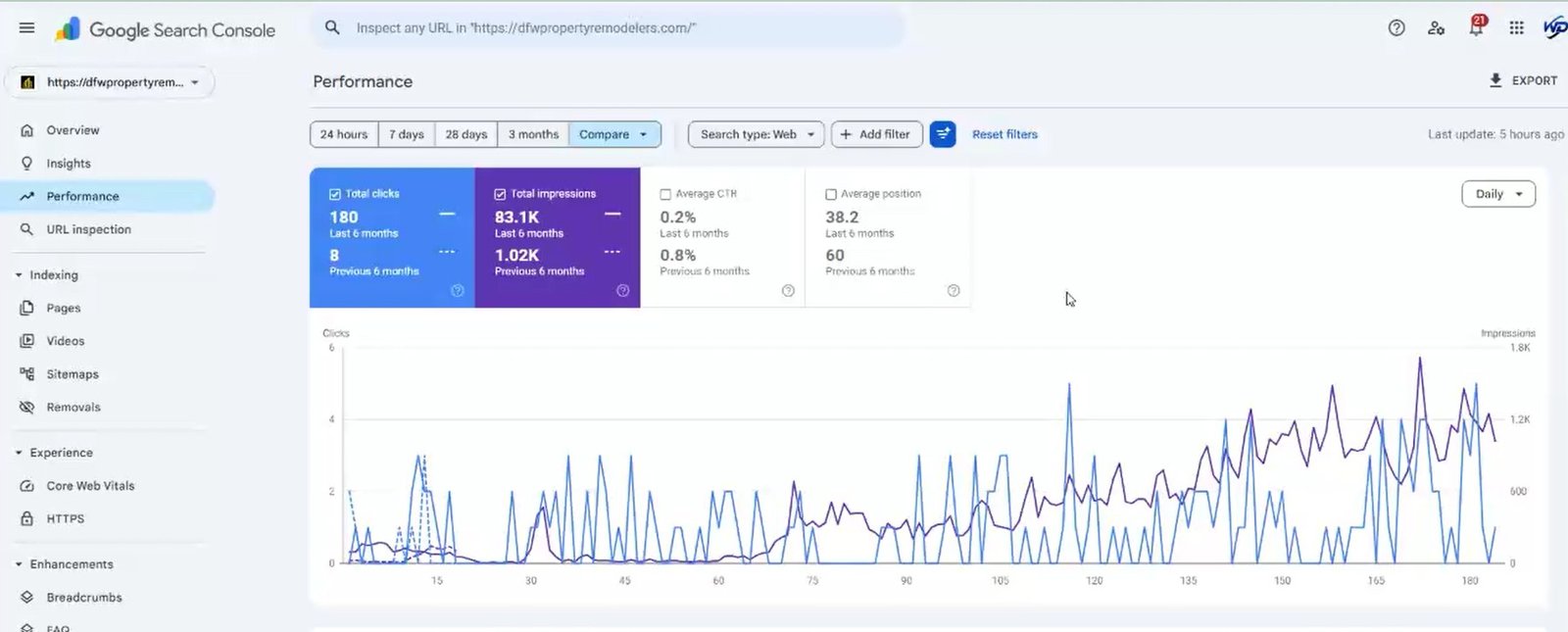
DFW Property Remodelers: Contractor SEO
Website redesign plus local SEO strategy for a Dallas-Fort Worth remodeler, built on targeted city-plus-service landing pages.
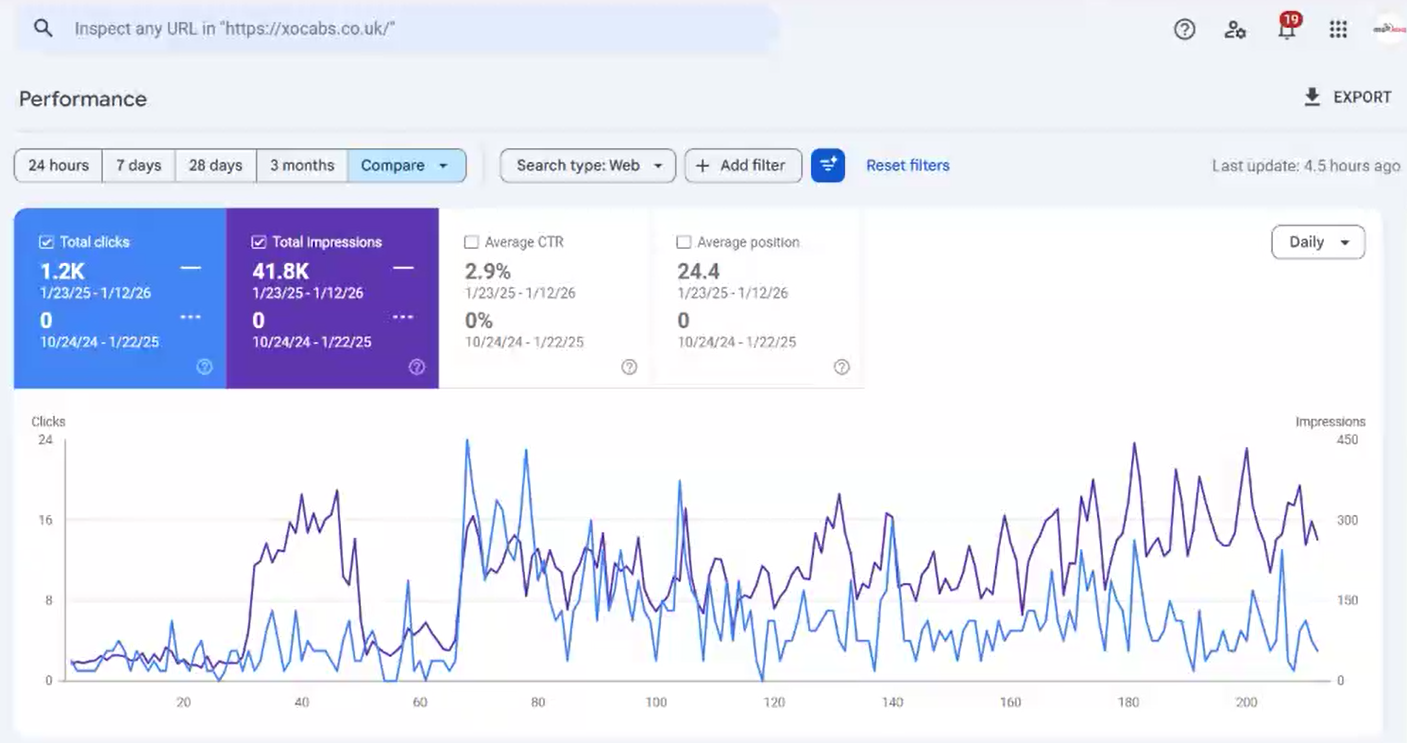
XO Cabs: Taxi and Local SEO Case Study UK
Letchworth Garden City taxi firm secured top position of the map pack and 65+ page-one keywords in a competitive UK regional market.
Want a professional to audit your on-page SEO? Get a free on-page SEO audit from Webdo Solutions and discover exactly what is holding your pages back.
Need a professional SEO strategy tailored to your business?
Get a free SEO audit from Webdo Solutionsand find out where you stand today.
What Is On-Page SEO?
On-page SEO is the practice of optimizing individual web pages to rank higher in search engine results and earn more relevant organic traffic. It involves optimizing the content, HTML source code, and internal linking structure of a page — elements you directly control, as opposed to off-page factors like backlinks. Businesses use on-page SEO to help search engines understand their content and match it to the queries their target audience is searching for.
Why On-Page Optimization Is the Foundation of Rankings
Off-page SEO (link building, brand mentions) and technical SEO (site speed, crawlability) both matter. But on-page optimization is the foundation that both of those pillars rest on. Here is why:
- It is fully within your control — Unlike backlinks, which depend on third parties, on-page factors are changes you make directly on your site
- It communicates relevance to Google — Without proper on-page signals, search engines cannot determine what your page is about or which queries it should rank for
- It impacts every other SEO effort — A perfectly built backlink profile cannot save a page with a missing title tag, poor content, and no internal links
- It compounds across your entire site — When every page is properly optimised, your site’s overall topical authority increases, lifting rankings across the board
The results we have achieved at Webdo Solutions — including 100+ first-position rankings for Lopez Law Group and 4.73 million impressions for Dallas Parrots — all started with meticulous on-page optimization. See our full portfolio for more examples.
The 15 On-Page SEO Factors That Actually Matter
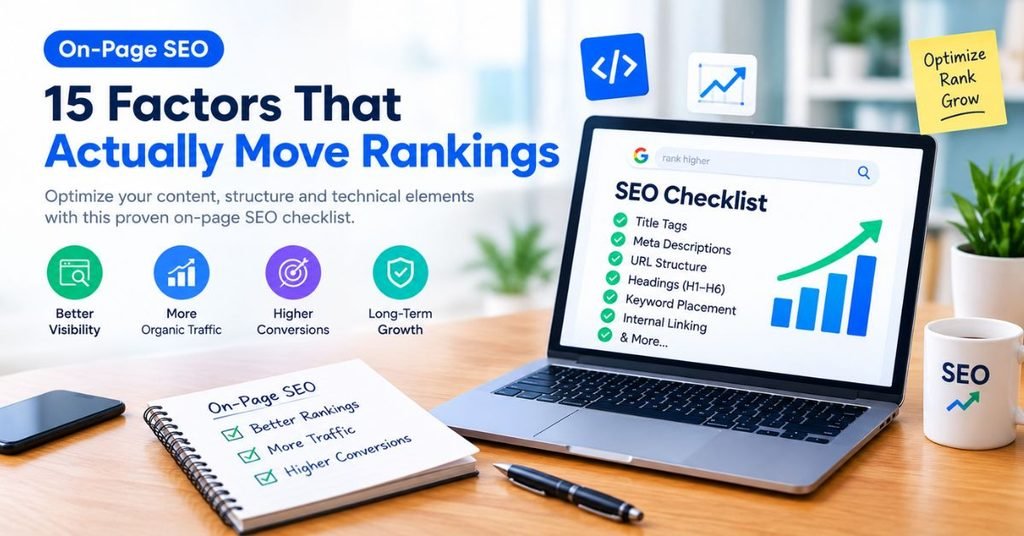
Factor 1: Title Tags
The title tag is the single most important on-page SEO element. It is the clickable headline that appears in search results and the first thing both Google and users see.
Best practices: – Place your primary keyword within the first 60 characters – Include a power word or hook (“Guide,” “Checklist,” “2026,” “Free”) – Make it compelling enough to earn a click — your title competes with nine other results on page one – Keep it unique across your site — duplicate title tags confuse search engines
Example: – Weak: “SEO Tips | Webdo Solutions” – Strong: “On-Page SEO Checklist: 15 Factors That Actually Move Rankings”
The strong version includes the primary keyword early, specifies a number for clarity, and uses “Actually” as a power word that sets expectations.
Factor 2: Meta Descriptions
While meta descriptions are not a direct ranking factor, they significantly influence click-through rate (CTR), which does affect rankings indirectly. A compelling meta description can increase CTR by 5-10 percent — and higher CTR sends a positive signal to Google.
Best practices: – Write 150-160 characters that accurately describe the page content – Include the primary keyword naturally — Google bolds matching terms in results – Add a call to action (“Learn how,” “Get your free audit,” “Discover”) – Write a unique meta description for every page on your site
Factor 3: URL Structure
A clean, keyword-rich URL structure helps both users and search engines understand what a page is about before they even click on it.
Best practices: – Keep URLs short and descriptive — aim for 3-5 words after your domain – Include the primary keyword in the slug – Use hyphens to separate words (never underscores or spaces) – Avoid unnecessary parameters, session IDs, or random strings – Maintain a logical hierarchy (domain.com/services/services/)
A well-structured URL like webdosolutions.com/on-page-seo-checklist/ tells Google and users exactly what to expect before the page loads.
Factor 4: H1 Tag
Every page should have exactly one H1 tag. It should closely match or mirror your title tag and contain your primary keyword.
Best practices: – Use only one H1 per page — multiple H1s dilute the signal – Place the primary keyword naturally within the H1 – Make the H1 slightly different from the title tag if you want to target a minor variation – Ensure the H1 accurately reflects the page content — misleading H1s increase bounce rate
Factor 5: Heading Hierarchy (H2-H6)
Your heading structure acts as a table of contents for both readers and search engine crawlers. It signals the organisation and depth of your content.
Best practices: – Use 4-8 H2 subheadings per long-form page, each targeting a semantic keyword or subtopic – Nest H3s under H2s for specific points, steps, or list items – Never skip heading levels (H1 → H2 → H3 is correct; H1 → H3 is incorrect) – Use header tags, not bold text, for section headings — search engines parse headings differently from bold text
A well-structured heading hierarchy is also critical for AEO (Answer Engine Optimization), as AI systems use headings to identify and extract key sections of content.
Factor 6: Primary Keyword Placement
Where you place your primary keyword on the page matters. Google’s algorithms pay particular attention to keyword placement in specific locations.
Best practices: – Include the primary keyword in the first 100 words of your content – Use the primary keyword in at least one H2 subheading – Maintain a natural keyword density of 0.8-1.2 percent (avoid stuffing) – Place the keyword in the last paragraph or conclusion
The key word here is “natural.” Keyword placement should enhance readability, not disrupt it. If your keyword appears awkwardly or too frequently, readers will bounce — and bounce rate is a signal that hurts rankings.
Factor 7: Semantic and LSI Keywords
Modern search engines do not just match keywords — they understand topics. Semantic keywords (also called LSI or Latent Semantic Indexing keywords) are related terms that help search engines understand the full context of your content.
Best practices: – Include 5-8 semantically related keywords throughout your content – Use variations naturally — synonyms, related phrases, industry terminology – Check Google’s “People Also Ask” and “Related Searches” for semantic keyword ideas – Use tools like Surfer SEO or Clearscope to identify the semantic terms top-ranking pages include
For example, an article about “on-page SEO” should naturally include terms like “title tags,” “meta descriptions,” “header tags,” “internal linking,” “image alt text,” and “keyword placement.”
Factor 8: Content Quality and Depth
Content quality is not just about word count — it is about comprehensively answering the searcher’s query better than any competing page.
Best practices: – Write for the reader first, search engines second — Google’s Helpful Content system penalises content written primarily for rankings – Cover the topic thoroughly — address subtopics that competitors skip – Use original data, unique insights, or real-world examples (case studies, proprietary research) – Maintain high E-E-A-T signals: Experience, Expertise, Authoritativeness, Trustworthiness – Structure content for readability: short paragraphs (2-3 sentences), bullet points for lists, tables for comparisons
At Webdo Solutions, we consistently see that pages ranking in positions 1-3 are not just longer — they are more comprehensive, more original, and better structured than anything else on page one.
Factor 9: Internal Linking
Internal linking is one of the most underutilised on-page SEO tactics. It distributes page authority throughout your site, helps crawlers discover new content, and guides users to related information.
Best practices: – Include a minimum of 5 internal links per blog post or content page – Use descriptive, keyword-rich anchor text (not “click here” or “read more”) – Link to your primary service page within the first 200 words – Link to 2-3 related blog posts within the same topic cluster – Ensure every new page is linked from at least 2-3 existing pages — no orphan pages
A strong internal linking strategy is also essential for GEO optimization, as AI search engines use internal link patterns to understand your site’s topical structure and authority.
Factor 10: Image Optimization
Images enhance user experience and provide additional ranking opportunities through Google Image Search. But unoptimised images can also slow your site down and hurt rankings.
Best practices: – Add descriptive alt text to every image — include your target keyword on the primary image, but be descriptive rather than stuffing – Use keyword-rich file names (e.g., “on-page-seo-checklist.webp” instead of “IMG_3847.jpg”) – Compress images to under 100KB where possible — use WebP format for the best quality-to-size ratio – Implement lazy loading for images below the fold – Include at least one custom, branded image per page (not just stock photos)
Factor 11: Schema Markup
Structured data (schema markup) helps search engines understand your content in a machine-readable format. While not a direct ranking factor, it enables rich results that dramatically increase click-through rates.
Essential schema types for content pages: – Article/BlogPosting schema — Identifies the content type, author, publication date, and publisher – FAQ schema — Enables FAQ rich results in Google SERPs (those expandable question-and-answer dropdowns) – Breadcrumb schema — Shows the page’s position in your site hierarchy – Organization schema — References your business entity in the publisher field
Schema markup is particularly important for AEO, as structured data helps AI systems extract and cite your content accurately.
Factor 12: Mobile Responsiveness
Google uses mobile-first indexing, meaning it primarily uses the mobile version of your page for ranking and indexing. If your page does not perform well on mobile devices, your rankings will suffer — regardless of how it looks on desktop.
Best practices: – Test every page on actual mobile devices, not just responsive design tools – Ensure text is readable without zooming (minimum 16px font size) – Make buttons and links easily tappable with adequate spacing – Eliminate horizontal scrolling – Check that all interactive elements work on touch screens
If your website’s mobile experience needs improvement, our website development team can help you build a mobile-first design that serves both users and search engines.
Factor 13: Page Speed
Page speed directly affects both user experience and rankings. Google’s Core Web Vitals — Largest Contentful Paint (LCP), Interaction to Next Paint (INP), and Cumulative Layout Shift (CLS) — are confirmed ranking factors.
Best practices: – Target a page load time under 3 seconds – Optimise LCP (main content should load within 2.5 seconds) – Minimise layout shifts (CLS should be below 0.1) – Enable browser caching and GZIP compression – Use a CDN (Content Delivery Network) for faster global delivery – Minimise render-blocking JavaScript and CSS
Factor 14: Content Freshness
Google values fresh content, particularly for topics where information changes frequently. Regularly updating your existing content can improve rankings without creating new pages.
Best practices: – Display a “Last Updated” date on content pages – Review and refresh your top-performing pages quarterly – Update statistics, examples, and screenshots when they become outdated – Add new sections to existing content rather than creating a new page on the same topic – Expand thin content with additional depth and subtopics
Factor 15: User Engagement Signals
While Google has been cagey about exactly how user engagement metrics influence rankings, the evidence is clear: pages that engage users rank better than pages that do not.
Key engagement factors: – Dwell time — How long users spend on your page before returning to search results – Bounce rate — The percentage of users who leave without interacting – Scroll depth — How far down the page users scroll – Click-through rate — How often users click your result in the SERPs
Improve engagement by writing compelling introductions that hook the reader immediately, using visual elements (images, tables, charts) to break up text, including interactive elements like table of contents or jump links, and structuring content so that key information appears early.
Real Results From On-Page Optimization
These on-page factors are not theoretical — they drive measurable results. From the Webdo Solutions portfolio:
Lopez Law Group saw 100+ first-position Google rankings after we systematically optimised their on-page elements — title tags, heading structures, content depth, internal linking, and schema markup. For a law firm competing in the Texas legal market, those top-three positions translate directly into high-value client enquiries.
DFW Property Remodelers experienced an 8,047 percent increase in search impressions. A significant portion of this growth came from on-page improvements: restructuring their service pages, optimising meta data, and building comprehensive content that covered their target topics more thoroughly than any competitor.
Ready to optimise your pages for maximum rankings? Get your free on-page SEO audit from Webdo Solutions. We will analyse your top pages and deliver a prioritised action plan.
On-Page SEO Checklist: Quick Reference
Use this checklist for every page you publish or optimise:
| # | Factor | Status |
| 1 | Title tag — keyword in first 60 chars | ☐ |
| 2 | Meta description — 150-160 chars with CTA | ☐ |
| 3 | URL slug — short, keyword-rich, clean | ☐ |
| 4 | H1 tag — one H1, contains primary keyword | ☐ |
| 5 | Heading hierarchy — H2s and H3s in order | ☐ |
| 6 | Primary keyword — in first 100 words | ☐ |
| 7 | Semantic keywords — 5-8 LSI terms included | ☐ |
| 8 | Content quality — comprehensive, E-E-A-T | ☐ |
| 9 | Internal links — minimum 5, keyword anchors | ☐ |
| 10 | Image optimization — alt text, compressed, lazy load | ☐ |
| 11 | Schema markup — Article + FAQ + Breadcrumb | ☐ |
| 12 | Mobile responsive — tested on real devices | ☐ |
| 13 | Page speed — under 3 seconds, Core Web Vitals pass | ☐ |
| 14 | Content freshness — last updated date shown | ☐ |
| 15 | User engagement — compelling intro, visual variety | ☐ |
Frequently Asked Questions
What Is On-Page SEO?
On-page SEO refers to the optimization of individual web pages to improve their search engine rankings and drive more organic traffic. It includes optimizing content (keywords, headings, quality), HTML elements (title tags, meta descriptions, schema markup), images (alt text, compression), internal links, and technical page-level factors (mobile responsiveness, page speed). Unlike off-page SEO, which focuses on external signals like backlinks, on-page SEO covers everything you can directly control on your own website. It is the first step in any SEO strategy because without proper on-page signals, search engines cannot understand what your pages are about.
How Many Keywords Should I Target Per Page?
Each page should have one primary keyword that defines the page’s main topic, supported by 5-8 semantically related secondary keywords that are woven naturally throughout the content. Trying to target multiple unrelated primary keywords on a single page dilutes the signal and typically results in lower rankings for all of them. Instead, create separate pages for distinct keyword topics and use internal linking to connect related content. For example, do not try to rank one page for both “SEO services” and “web development” — create dedicated pages for each and link between them. The exception is long-form pillar content, which naturally covers a broad topic and can rank for dozens of related long-tail variations.
Do Meta Descriptions Affect Rankings?
Meta descriptions are not a direct Google ranking factor — Google has confirmed this publicly. However, they have a significant indirect impact on rankings through click-through rate (CTR). A well-written meta description can increase CTR by 5-10 percent compared to a generic or auto-generated one. Higher CTR sends a positive signal to Google that users find your result relevant, which can improve rankings over time. Additionally, when users find that your page content matches the promise of your meta description, they are more likely to stay longer and engage more deeply, further supporting positive ranking signals. So while meta descriptions do not directly move rankings, they are an essential part of any on-page SEO checklist.
How Often Should I Update My On-Page SEO?
On-page optimization should be reviewed quarterly for your most important pages. Search landscapes shift constantly — competitors publish new content, search intent evolves, and Google updates its algorithms. A page that ranked first six months ago may be slipping because a competitor published something more comprehensive or because the query’s intent has changed. Set a quarterly schedule to audit your top 20-30 pages: check rankings, refresh outdated statistics, update screenshots or examples, add new internal links to recently published content, and ensure all technical elements (schema, speed, mobile experience) remain optimal.
Conclusion: On-Page SEO Is Your Competitive Edge
On-page optimization is the most controllable, highest-impact aspect of SEO. While you cannot control who links to your site or what Google’s next algorithm update will prioritise, you have complete control over every on-page factor on this checklist. And the data is clear: businesses that get on-page SEO right — consistently, across every page — outperform their competitors in organic search.
Whether your business operates in the United States, the United Kingdom, or both, these 15 factors are universal. They apply to law firms and e-commerce stores, SaaS companies and local contractors, startups and enterprises. The only question is whether you will implement them yourself or bring in a team that does this every day.
At Webdo Solutions, on-page optimization is the foundation of every SEO engagement. It is how we helped Lopez Law Group achieve 100+ first-position rankings, how we grew Dallas Parrots to 4.73 million impressions, and how we delivered an 8,047 percent impression increase for DFW Property Remodelers.
Get your free on-page SEO audit today → Our team will analyse your site’s on-page health, identify the highest-impact opportunities, and deliver a prioritised action plan. Contact us via WhatsApp for a quick consultation.
About the Author: Ozair Sharif is the Founder and CEO of Webdo Solutions, a full-service digital marketing agency specializing in SEO, AEO, GEO, and website development for businesses across the United States and United Kingdom.