International SEO is the process of optimizing your website so search engines can identify which countries and languages your content targets. For businesses operating across the United States and United Kingdom — or expanding into new international markets — getting international SEO right is the difference between appearing in relevant local search results and being invisible to potential customers in your target regions.
The US and UK share a common language but represent distinct search markets with different user behaviours, spelling preferences, cultural references, and competitive landscapes. A website that ranks well in the US does not automatically rank in the UK, and vice versa. Without proper international SEO implementation, you risk serving American content to British searchers, diluting your ranking power across markets, and losing ground to locally optimized competitors.
At Webdo Solutions, we specialize in helping businesses rank across multiple countries, with particular expertise in the US and UK markets. Get a free international SEO audit to see where your global visibility stands today.
Need a professional SEO strategy tailored to your business?
Get a free SEO audit from Webdo Solutionsand find out where you stand today.
What Is International SEO?
International SEO is a set of technical and content optimization strategies that help search engines understand which countries and languages a website targets. It involves URL structure decisions, hreflang tag implementation, content localization, and geo-targeting configuration to ensure the correct version of your website appears in search results for users in each target market. Businesses use international SEO to expand their organic reach beyond a single country and capture search traffic in multiple regions.
Why International SEO Matters for US and UK Businesses
Many business owners assume that because the US and UK both speak English, a single website will perform equally well in both markets. This assumption costs businesses significant organic traffic and revenue. Here is why international SEO matters, even between English-speaking countries.
Google Serves Different Results in Different Countries
Google maintains separate indexes and ranking algorithms for each country. A search for “best accounting software” on google.com in the United States returns different results than the same search on google.co.uk in the United Kingdom. Google factors in the searcher’s location, the website’s geo-targeting signals, and country-specific relevance when determining rankings.
If your website sends no clear signals about which market it targets, Google makes its best guess — and that guess often results in your site appearing in one market but not the other.
Search Behaviour Differs Between Markets
American and British searchers use different terms, spelling, and phrasing. An American searches for “apartment” while a British user searches for “flat.” Americans search for “vacation rental” while Brits search for “holiday let.” These differences extend to every industry and affect keyword targeting across your entire content strategy.
Our work at Webdo Solutions has shown that localizing content for each market — using the right terminology, references, and spelling — can increase click-through rates by 20 to 40 percent compared to generic English content.
Competitor Landscapes Vary by Country
The websites ranking on page one for the same topic can be completely different in the US and UK. A US-focused competitor may dominate American search results but have zero presence in the UK, where different competitors control the rankings. International SEO allows you to identify and compete effectively in each market’s unique competitive environment.
URL Structure Options for International SEO
The most important technical decision in international SEO is how you structure your URLs to signal country or language targeting. There are four main approaches, each with distinct advantages and trade-offs.
Country Code Top-Level Domains (ccTLDs)
This approach uses separate domain extensions for each country — example.com for the US and example.co.uk for the UK. ccTLDs send the strongest geo-targeting signal to search engines. Google automatically associates .co.uk with the United Kingdom and .com.au with Australia.
Advantages: Clearest geo-targeting signal, users trust local domain extensions, each domain builds independent authority. Disadvantages: Most expensive option (multiple domain registrations and hosting), link equity split across multiple domains, requires managing multiple websites, each domain starts from zero authority.
ccTLDs make sense for large enterprises with substantial budgets and established brand presence in multiple countries.
Subdirectories (Subfolders)
This approach uses folders within a single domain — example.com/us/ for American content and example.com/uk/ for British content. This is the approach Google has most frequently recommended for businesses starting with international SEO.
Advantages: All link equity consolidated on one domain, easier to manage than separate domains, lower cost, faster to implement. Disadvantages: Weaker geo-targeting signal than ccTLDs (mitigated by hreflang tags and Search Console settings), requires disciplined content organization.
For most businesses serving the US and UK, subdirectories offer the best balance of SEO effectiveness and practical manageability. This is the approach we most commonly recommend at Webdo Solutions for clients expanding internationally.
Subdomains
This approach uses separate subdomains — us.example.com and uk.example.com. Google treats subdomains as somewhat separate entities from the main domain, which means link equity is partially split.
Advantages: Clear separation of content, can be hosted on different servers for better local performance, each subdomain can be geo-targeted independently in Search Console. Disadvantages: Link equity split between subdomains, Google may treat subdomains as separate sites, more complex to manage than subdirectories.
Subdomains are less commonly recommended for international SEO than subdirectories due to the link equity splitting issue.
URL Parameters
This approach uses parameters to indicate language or region — example.com?lang=en-gb. This is the least recommended approach. Google has difficulty processing URL parameters for geo-targeting, and parameters create crawling and indexing complications. Avoid this approach for international SEO.
Hreflang Tags: The Technical Foundation
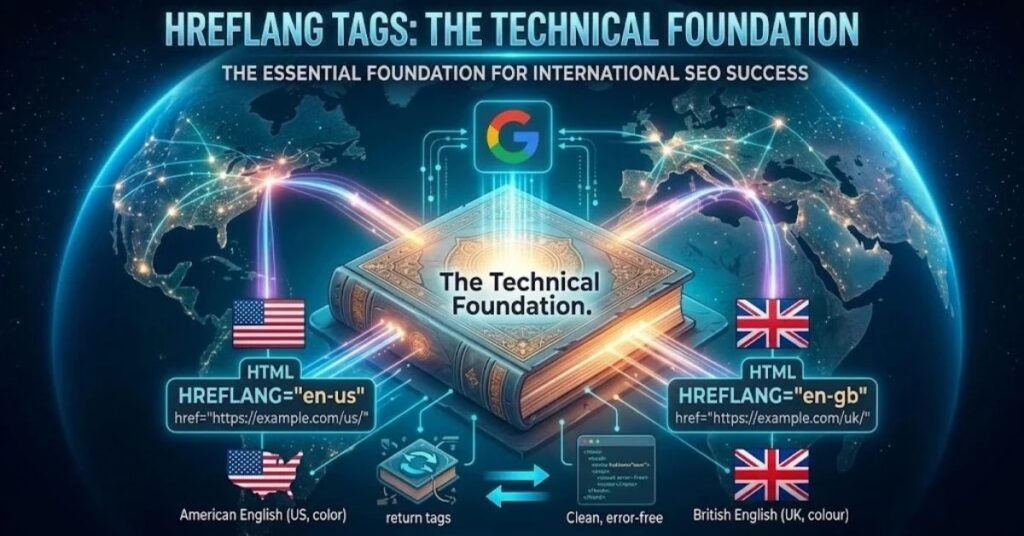
Hreflang tags are HTML attributes that tell search engines which language and geographic region each page targets. They are the single most important technical element of international SEO.
How Hreflang Tags Work
Hreflang tags create relationships between different versions of the same page. For a blog post that exists in both US and UK English versions, the hreflang implementation tells Google that the US version targets American English speakers, the UK version targets British English speakers, and both pages are equivalent content for different regions.
The basic syntax looks like this in the HTML head section:
<link rel=”alternate” hreflang=”en-us” href=”https://example.com/us/page/” />
<link rel=”alternate” hreflang=”en-gb” href=”https://example.com/uk/page/” />
<link rel=”alternate” hreflang=”x-default” href=”https://example.com/page/” />
The x-default tag specifies which page to show users who do not match any of the specified language-region combinations.
Hreflang Implementation Methods
There are three ways to implement hreflang tags, and you should use only one method per website.
HTML link elements in the head section of each page. This is the most common method and works well for websites with a manageable number of pages.
HTTP headers. Used for non-HTML files like PDFs. The hreflang information is sent in the HTTP response header rather than in the HTML.
XML sitemaps. Each URL in the sitemap includes hreflang annotations. This is the most scalable method for large websites with thousands of pages and is our recommended approach for larger implementations at Webdo Solutions.
Common Hreflang Mistakes
Hreflang implementation is notoriously error-prone. These mistakes are the ones we encounter most frequently when auditing international websites.
Missing return tags. Every hreflang relationship must be bidirectional. If page A declares page B as its UK alternate, page B must also declare page A as its US alternate. Missing return tags cause Google to ignore the hreflang annotations entirely.
Wrong language or region codes. Hreflang uses ISO 639-1 language codes and ISO 3166-1 Alpha-2 region codes. Common errors include using “uk” instead of “gb” for the United Kingdom, using three-letter codes, and confusing language codes with country codes.
Self-referencing hreflang missing. Every page must include a hreflang tag pointing to itself along with tags pointing to its alternates. Missing self-referencing tags break the entire hreflang relationship.
Non-canonical URLs in hreflang. Hreflang tags must point to canonical URLs. If a page has a canonical tag pointing elsewhere, the hreflang on that page will be ignored.
Content Localization for the US and UK
Content localization goes beyond simply swapping spellings. Effective localization for the US and UK markets requires adapting multiple content elements.
Spelling and Terminology
The most obvious localization requirement is adjusting spelling and terminology for each market. “Optimise” in the UK becomes “optimize” in the US. “Colour” becomes “color.” “Centre” becomes “center.” These differences matter for keyword targeting because users in each country search using their local spelling.
Beyond spelling, terminology differences are substantial across industries. Legal terms, financial products, healthcare terminology, and real estate vocabulary all differ between the US and UK. A “solicitor” in the UK is an “attorney” in the US. A “current account” in the UK is a “checking account” in the US.
Currency, Measurements, and Formatting
Localize all numerical references for each market. US content should use dollars, miles, Fahrenheit, and the MM/DD/YYYY date format. UK content should use pounds sterling, kilometres or miles depending on context, Celsius, and the DD/MM/YYYY date format.
Cultural References and Examples
Use examples and case studies that resonate with each audience. American readers relate to references about US cities, American business culture, and US-specific regulations. British readers engage more with references to UK cities, British business norms, and UK regulatory frameworks.
When we worked with clients targeting both markets, we found that incorporating market-specific case studies significantly improved engagement. Our work with Lopez Law Group in Texas resonates with US audiences, while our results with XO Cabs UK connects directly with British readers.
Legal and Regulatory Compliance
Content about regulated topics — finance, healthcare, legal services, data privacy — must comply with the regulations in each target market. GDPR applies in the UK, while various state and federal regulations apply in the US. Privacy policies, terms of service, and compliance statements must be localized for each jurisdiction.
Google Search Console International Targeting
Google Search Console provides tools specifically for international SEO configuration.

International Targeting Report
For websites using gTLDs (like .com) with subdirectories, Google Search Console allows you to set country targeting at the subdirectory level. Navigate to the International Targeting section and specify which country each subdirectory targets. This reinforces the geo-targeting signals from your hreflang tags.
Monitoring Hreflang Errors
Search Console reports hreflang implementation errors, including missing return tags, unknown language codes, and hreflang-canonical conflicts. Monitor this report regularly and fix any errors promptly, as hreflang errors prevent Google from showing the correct version of your pages to users in each country.
Performance Filtering by Country
Use Search Console’s performance report to filter data by country. Compare your impressions, clicks, click-through rate, and average position for US versus UK searches to measure the effectiveness of your international SEO implementation.
Technical SEO Considerations for International Sites
Beyond hreflang tags and URL structure, several technical elements affect international SEO performance.
Server Location and CDN Configuration
While Google has stated that server location is not a significant ranking factor, page load speed is — and server location affects speed. For businesses targeting both the US and UK, use a CDN that serves your website from edge servers on both sides of the Atlantic. This ensures fast load times for users in both markets.
Geo-IP Redirects and Their Risks
Some websites automatically redirect users to their regional version based on IP address. This approach is risky for SEO because Googlebot typically crawls from the US, and if your geo-IP redirect sends all US-based requests to the US version, Googlebot may never see your UK version.
If you use geo-IP detection, serve a suggestion banner instead of an automatic redirect. Let users choose their preferred version while ensuring all versions are crawlable by search engines.
Duplicate Content Management
When you have similar content across multiple regional versions, manage duplicate content carefully. Hreflang tags tell Google these are regional variants (not duplicates), but canonical tags must still point to the correct regional version of each page. Never set cross-regional canonicals where the UK page canonicalizes to the US page — this tells Google the UK page should not be indexed.
XML Sitemap Strategy
Create separate XML sitemaps for each regional section of your website. A US sitemap containing only US URLs and a UK sitemap containing only UK URLs helps Google understand your site structure and crawl each regional section efficiently. Reference all sitemaps from your robots.txt file.
International Link Building
Link building for international SEO requires building authoritative backlinks in each target market.
Country-Specific Link Sources
Links from UK websites carry more weight for UK rankings, and links from US websites carry more weight for US rankings. Build relationships with publishers, industry organizations, and media outlets in each target country. Guest posting on UK industry blogs, earning mentions in UK press, and being listed in UK business directories all strengthen your UK search performance.
Local Business Directories
Submit your business to relevant directories in each market. US directories include Yelp, BBB, and industry-specific listings. UK directories include Yell, Thomson Local, and sector-specific databases. Consistent NAP (Name, Address, Phone) information across all directories is critical.
Digital PR in Each Market
Run digital PR campaigns tailored to each country’s media landscape. Journalists in the US and UK cover different angles and find different stories newsworthy. Create market-specific data studies, surveys, and expert commentary that appeal to publishers in each country.
Measuring International SEO Success
Track these metrics separately for each target market to evaluate your international SEO performance.
Organic traffic by country. Monitor growth in organic sessions from the US and UK independently. Use Google Analytics geographic reports to segment traffic by country.
Keyword rankings by country. Track keyword positions in google.com (US) and google.co.uk (UK) separately. Tools like Ahrefs and SEMrush allow country-specific rank tracking.
Hreflang coverage. Regularly audit your hreflang implementation to ensure all pages have correct annotations and no errors appear in Search Console.
Click-through rate by country. Compare CTR for the same keywords across markets. Lower CTR in one market may indicate that your meta titles and descriptions need better localization.
Conversion rate by country. Localized content should convert at similar or higher rates than generic content. Track conversion rates by country to identify markets where localization improvements are needed.
Frequently Asked Questions
What are hreflang tags?
Hreflang tags are HTML attributes that tell search engines which language and geographic region each version of a page targets. They create relationships between different regional or language versions of the same content, helping Google serve the correct version to users based on their location and language settings. For example, hreflang tags would tell Google to show your UK English page to searchers in Britain and your US English page to searchers in America.
Should I use subdomains or subdirectories for international SEO?
For most businesses, subdirectories (example.com/uk/ and example.com/us/) are the better choice. They consolidate all link equity on a single domain, are easier and less expensive to manage, and provide sufficient geo-targeting when combined with hreflang tags and Search Console configuration. Subdomains split link equity and add management complexity without significant SEO advantages. ccTLDs (separate domains like .co.uk) provide the strongest geo-targeting signal but are the most expensive and complex option, best suited for large enterprises.
How do I target the UK and US separately with the same language?
Use hreflang tags with region-specific language codes — en-us for American English and en-gb for British English. Create separate content versions for each market with localized spelling, terminology, currency, and cultural references. Set up country-specific subdirectories, configure geo-targeting in Google Search Console, and build backlinks from sources in each target country. The combination of these signals tells Google which version of your content to serve in each market.
How long does it take for international SEO to show results?
International SEO typically takes three to six months to show measurable results. The timeline depends on your current domain authority, the quality of your hreflang implementation, the depth of content localization, and the competitiveness of your target markets. Technical implementation — URL structure and hreflang tags — can be completed in weeks, but building authority through localized content and country-specific backlinks is an ongoing process.
Can I just translate my existing content for international SEO?
Translation alone is insufficient for effective international SEO, especially when targeting multiple English-speaking markets. Even between the US and UK, simple translation fails because keyword research must be conducted separately for each market, cultural references and examples need to be adapted, regulatory and compliance information differs by jurisdiction, competitor landscapes vary between countries, and user intent for the same search terms can differ. Full content localization — not just translation — is required for strong international SEO performance.
Conclusion
International SEO is a strategic investment that opens your business to new markets and multiplies your organic reach. For businesses targeting both the United States and United Kingdom, proper implementation of URL structures, hreflang tags, content localization, and country-specific link building can dramatically increase your visibility in both markets.
The technical foundation must be right — hreflang errors and poor URL structures will undermine even the best content. But beyond the technical elements, genuine content localization is what separates businesses that simply exist in international search results from those that dominate them.
Ready to expand your search visibility across borders? Contact Webdo Solutions for a comprehensive international SEO audit. We will evaluate your current cross-market performance, identify technical gaps, and build a strategy to help you rank in every market that matters to your business. Start your free audit →
About the Author: Ozair Sharif is the Founder and CEO of Webdo Solutions, a full-service digital marketing agency specializing in SEO, AEO, GEO, and website development for businesses across the United States and United Kingdom.