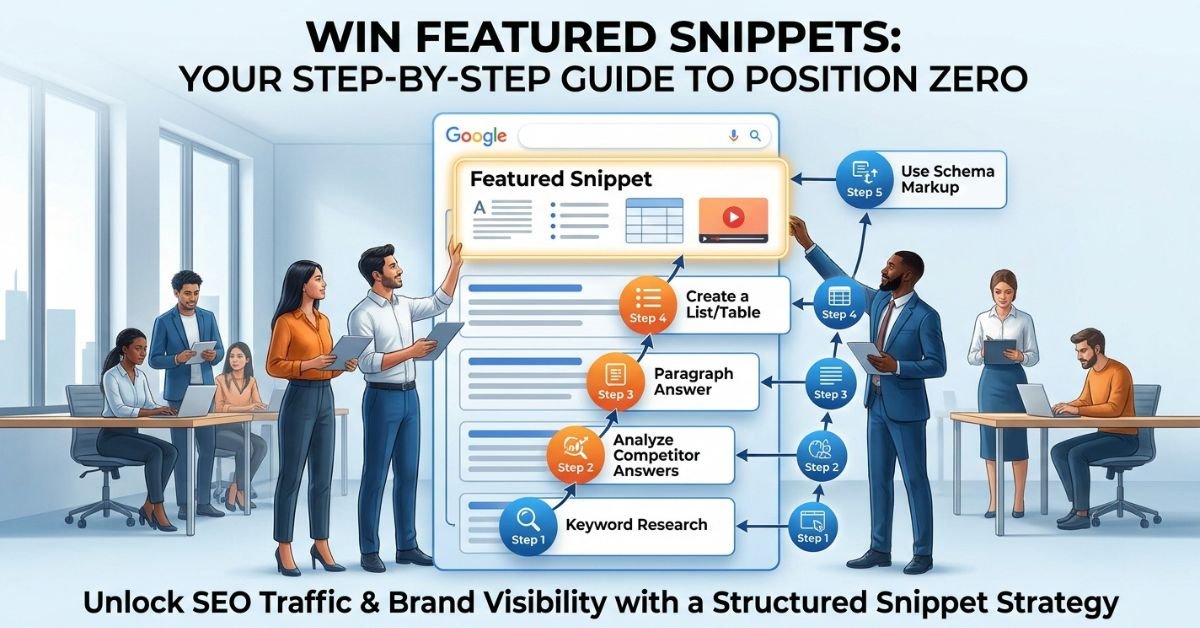
Featured snippets sit at position zero in Google search results — above every organic listing, above every paid ad in many cases, and right where your customers are looking. Winning a featured snippet means Google has chosen your content as the single best answer to a specific query. For businesses competing in the United States and United Kingdom, that visibility translates directly into authority, traffic, and leads.
Yet most businesses have no strategy for capturing featured snippets. They create content, hope for good rankings, and ignore the enormous opportunity sitting at the very top of the search results page. That approach leaves traffic, brand visibility, and revenue on the table.
At Webdo Solutions, featured snippet optimization is a core component of our Answer Engine Optimization (AEO) services. We have used snippet strategies as part of campaigns that achieved results like 100+ #1 rankings for Lopez Law Group. Ready to claim position zero? Get a free AEO audit.
Need a professional SEO strategy tailored to your business?
Get a free SEO audit from Webdo Solutionsand find out where you stand today.
What Are Featured Snippets?
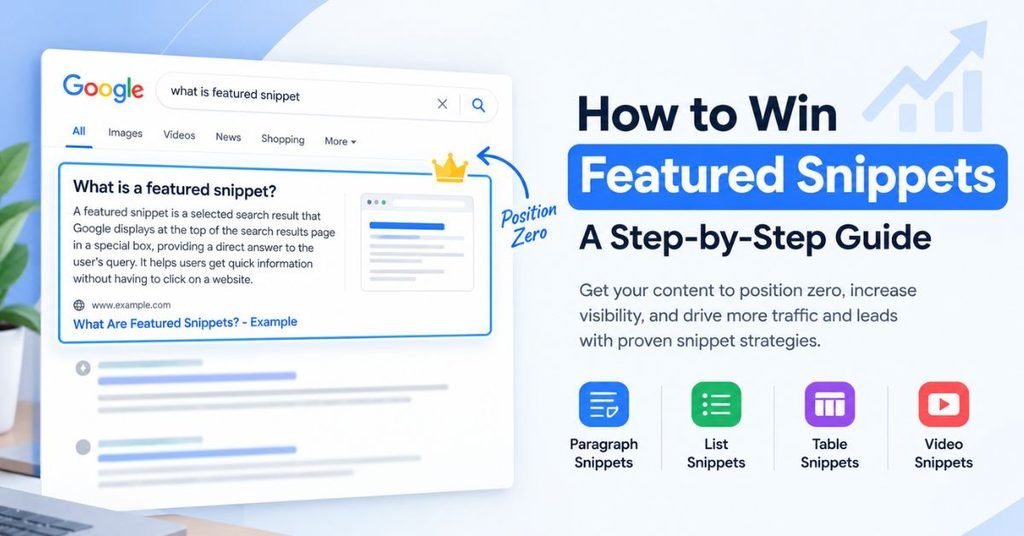
Featured snippets are selected search results that Google displays at the top of the organic results page in a special box, providing a direct answer to the user’s query. Google extracts this answer from a web page and presents it with a link to the source. Featured snippets appear in approximately 12-15% of all Google searches and capture an estimated 35% of clicks when they appear, making them the most valuable organic search real estate available.
Types of Featured Snippets
Understanding the different types of featured snippets helps you create content in the format Google prefers for each query type.
Paragraph Snippets
Paragraph snippets are the most common type, accounting for roughly 70% of all featured snippets. Google displays a block of text — typically 40-60 words — that directly answers a question.
Common triggers: “What is,” “Why does,” “How does,” “Who is,” definition-type queries
Example query: “What is answer engine optimization?”
Winning format: Place the question as a heading (H2 or H3), then immediately follow with a concise, self-contained answer in one paragraph. This answer should define the concept, explain how it works, and state its purpose — all within 40-60 words.
List Snippets
List snippets display numbered or bulleted lists. Google pulls these from pages that use clear list formatting.
Numbered list triggers: “How to,” “Steps to,” “Process for,” ranked items (“Top 10,” “Best”)
Bulleted list triggers: “Types of,” “Examples of,” “Features of,” “Benefits of”
Winning format: Use an H2 heading that matches the query, then present each item as an H3 subheading or a clearly formatted list item. Google will extract the list and display it in the snippet. If your list has more items than the snippet can show, Google adds a “More items…” link, which increases click-through rates.
Table Snippets
Table snippets display data in a structured table format. These appear for comparison queries, pricing information, specifications, and data-heavy questions.
Common triggers: “Compare,” “vs,” “pricing,” “specifications,” “schedule,” data-related queries
Winning format: Present your data in clean HTML tables with clear header rows. Google will extract the most relevant rows and columns. Include more data than the snippet can display to encourage click-through.
Video Snippets
Video snippets extract a specific moment from a YouTube video to answer a query. Google displays a video thumbnail with a timestamp pointing to the relevant section.
Common triggers: “How to” visual tasks, tutorials, demonstrations
Winning format: Create YouTube videos with clear timestamps, descriptive chapter titles, and transcripts. Structure your video to answer specific questions at identifiable timestamps.
Step-by-Step Process for Winning Featured Snippets
Here is the systematic approach we use at Webdo Solutions to capture featured snippets for our clients.
Step 1: Identify Snippet Opportunities
Not every keyword has a featured snippet, and not every snippet is worth pursuing. Start by identifying the right opportunities.
Find keywords with existing snippets:
Use SEMrush, Ahrefs, or Moz to filter your keyword list for queries that currently trigger featured snippets. These tools show which websites currently hold each snippet.
Prioritize winnable snippets:
Focus on queries where: – You already rank in positions 1-10 (Google almost always pulls snippets from page one) – The current snippet holder has lower domain authority than you – The current snippet content is thin, outdated, or poorly formatted – The query has significant search volume and relevance to your business
Identify gaps:
Some high-volume queries should have featured snippets but do not yet. Creating the best answer for these queries positions you to capture the snippet when Google decides to introduce one.
Step 2: Analyse the Current Snippet
Before creating or optimizing content, study the existing snippet for your target query.
What to analyse: – What type of snippet does Google display? (paragraph, list, table, video) – How many words is the current snippet? – What heading structure does the source page use? – What is the exact question being answered? – What information does the current snippet include or miss? – What is the domain authority of the current snippet holder?
This analysis tells you exactly what Google considers the ideal answer format and content for that query. Your job is to create something better.
Step 3: Structure Your Content for Extraction
Google’s algorithm extracts snippets from content that is clearly structured and directly answers the target question. Here is how to format your content for each snippet type.
For paragraph snippets:
## [Question as heading]
[40-60 word concise answer that directly addresses the question.
This paragraph should be self-contained — a reader should understand
the complete answer from this paragraph alone.]
[Expanded explanation, examples, data, and supporting content
in the paragraphs that follow…]
For list snippets:
## How to [Process/Task]
### Step 1: [Action]
[Explanation of this step]
### Step 2: [Action]
[Explanation of this step]
### Step 3: [Action]
[Explanation of this step]
For table snippets:
Create clean HTML tables with descriptive header rows. Include relevant data across multiple columns. Ensure the data is accurate and up to date.
Step 4: Write Better Answers Than the Competition
Winning a featured snippet requires your content to be objectively better than what currently holds it. Here is what “better” means in snippet context:
More complete — Does your answer cover aspects the current snippet misses?
More current — Is your data and information up to date?
More specific — Do you use precise numbers, dates, and data points instead of vague statements?
More authoritative — Do you cite credible sources and include expert credentials?
Better formatted — Is your content cleaner, better structured, and easier for Google to extract?
The ideal snippet answer is concise enough for Google to extract but comprehensive enough to demonstrate authority. The surrounding content should expand significantly beyond the snippet text, providing the in-depth information that keeps users on your page.
Step 5: Implement Schema Markup
Structured data reinforces the semantic meaning of your content and improves your chances of being selected for SERP features.
Essential schema for snippet optimization:
- FAQPage schema — For FAQ sections with question-and-answer pairs
- HowTo schema — For step-by-step processes and tutorials
- Article/BlogPosting schema — For blog posts and articles with author, date, and organization
- Speakable schema — Marks content suitable for text-to-speech, relevant for voice search snippets
Implement schema using JSON-LD format in the head of your page. Validate using Google’s Rich Results Test before publishing. At Webdo Solutions, schema implementation is a standard part of every website we build and every content piece we optimize.
Step 6: Optimize Supporting Ranking Factors
A page must rank in the top 10 to be eligible for a featured snippet. Ensure these supporting factors are strong:
On-page SEO — Title tag, meta description, header hierarchy, keyword placement, image optimization
Technical SEO — Page speed, mobile responsiveness, crawlability, HTTPS
Backlink profile — Quality backlinks from relevant, authoritative websites
User experience — Clear navigation, fast loading, engaging content that keeps users on the page
These elements work together with your snippet-optimized content. A well-structured answer on a poorly optimized page will not win the snippet.
Step 7: Publish and Monitor
After publishing your optimized content:
- Request indexing in Google Search Console
- Track snippet positions using SEMrush, Ahrefs, or a dedicated SERP tracking tool
- Monitor click-through rates in Search Console for the target query
- Check competitor responses — Are they optimizing their content to reclaim the snippet?
- Update regularly — Featured snippets favour fresh, current content
Advanced Snippet Strategies
Capturing Multiple Snippets from One Page
A single page can hold multiple featured snippets if it answers several related questions. This is particularly effective with comprehensive pillar pages and resource guides.
How to do it: – Target a cluster of related questions (5-10) within one comprehensive article – Give each question its own H2 or H3 heading – Provide a concise snippet-worthy answer for each – Connect the questions logically so the page reads as a cohesive resource
The Inverted Pyramid Technique
Journalism’s inverted pyramid structure is ideal for snippet optimization. Lead with the most important information (the direct answer), then expand with supporting details, context, and examples. This structure ensures Google can extract the key answer while your page provides the depth that keeps readers engaged.
Leveraging People Also Ask
People Also Ask (PAA) boxes are closely related to featured snippets and often appear alongside them. Each PAA question that expands shows an answer extracted from a web page.
PAA optimization strategy: 1. Search your target keyword and note all PAA questions that appear 2. Click through each PAA question to see additional questions that Google generates 3. Create content that answers all of these questions 4. Format each answer in snippet-friendly structure (heading + concise answer + expanded content) 5. Implement FAQPage schema covering all questions
Winning PAA placements alongside featured snippets creates dominating SERP presence.
Snippet Optimization for Voice Search
When a user asks a voice assistant a question, the device typically reads the featured snippet aloud. This means winning the snippet also wins the voice search result.
Optimize for voice by: – Writing answers in natural, conversational language – Keeping snippet answers under 50 words (voice assistants prefer shorter responses) – Using the “speakable” schema type to indicate voice-friendly content sections – Testing your target queries on Google Assistant, Alexa, and Siri
Industries Where Featured Snippets Drive the Most Value
Legal Services
Legal queries frequently trigger featured snippets. “What is personal injury law?” “How does workers compensation work?” “What are my rights as a tenant?” — these questions have high search volume and commercial value.
Our work with Lopez Law Group included aggressive snippet optimization that contributed to achieving 100+ #1 rankings and a +362% increase in organic traffic. Legal featured snippets establish authority with potential clients before they ever visit your website.
Ecommerce
Product comparison queries, “best for [use case]” searches, and “how to choose” guides all trigger featured snippets with high commercial intent. Table snippets for product comparisons are particularly valuable, as they put your brand’s recommendations in front of buyers at the moment of decision.
Home Services
“How to fix,” “how much does it cost to,” and “when should I” queries dominate the home services sector. These featured snippets capture homeowners actively looking for solutions — and providers. Our work with DFW Property Remodelers leveraged answer-focused content strategies that drove +8,047% impression growth.
Healthcare and Wellness
Health-related queries are among the most snippet-rich in Google’s index. “Symptoms of,” “treatment for,” “difference between” — these searches consistently show featured snippets. Medical content requires particular attention to E-E-A-T (Experience, Expertise, Authoritativeness, Trustworthiness) signals.
Technology and SaaS
Software comparison queries, “how to use” tutorials, and “what is” technology definitions regularly trigger featured snippets. SaaS companies that capture these snippets establish themselves as the authority in their category.
Common Featured Snippet Mistakes
Mistake 1: Targeting Snippets You Cannot Win
If you rank on page two or beyond for a keyword, winning its featured snippet is extremely unlikely. Focus on queries where you already have page-one rankings and a realistic chance of improvement.
Mistake 2: Ignoring the Snippet Format
If Google shows a list snippet for a query, submitting a paragraph answer will not win. Always match the format Google currently displays — or has displayed historically — for your target query.
Mistake 3: Writing Answers That Are Too Long
Paragraph snippets average 40-60 words. If your answer paragraph is 150 words, Google will not extract it. Write concise answers that stand alone, then expand in subsequent paragraphs.
Mistake 4: Neglecting the Rest of the Page
A perfect snippet-formatted answer on a thin, poorly optimized page will not win. The page needs to be a genuinely comprehensive, high-quality resource that satisfies user intent beyond the snippet answer.
Mistake 5: Set-and-Forget Mentality
Featured snippets are competitive. If you win one and stop optimizing, a competitor will eventually create a better answer and take it from you. Regularly review and update your snippet content to maintain your position.
Measuring Featured Snippet Performance
Tracking Snippet Ownership
Use SEMrush’s Position Tracking feature with the “SERP Features” filter to monitor which snippets you hold and when you gain or lose them. Ahrefs and Moz Pro offer similar functionality.
Click-Through Rate Analysis
In Google Search Console, filter by queries where you hold featured snippets. Compare CTR for snippet queries versus non-snippet queries. Many businesses see CTR increases of 20-30% when they hold the snippet versus ranking in position 1 without it.
Traffic Attribution
Segment your Google Analytics traffic to identify visits from snippet-holding pages. Track conversion rates from this traffic to measure the business impact of your snippet strategy.
Competitive Monitoring
Set up alerts for when competitors capture snippets you held. Analyse what they changed and respond with improved content. Featured snippet battles are ongoing — the business that consistently creates the best answer wins.
The Intersection of Featured Snippets and AI Search
Featured snippet optimization directly supports AI search visibility. The same content characteristics that win featured snippets — clear structure, concise answers, factual precision, schema markup — are what AI models look for when selecting sources to cite.
Google’s AI Overviews frequently pull from the same sources that hold featured snippets. ChatGPT and Perplexity evaluate similar authority signals. By investing in featured snippet optimization now, you build the foundation for visibility in AI-powered search that is rapidly growing.
Frequently Asked Questions
What Types of Featured Snippets Exist?
Google displays four primary types of featured snippets. Paragraph snippets (approximately 70% of all snippets) show a text block answering a question in 40-60 words. List snippets (approximately 20%) show numbered or bulleted lists, commonly triggered by “how to” and “best of” queries. Table snippets (approximately 5-8%) display structured data in a table, often appearing for comparisons and specifications. Video snippets extract a specific timestamp from a YouTube video. Each type requires a different content format to win, so always match your content structure to the snippet type Google currently shows for your target query.
Can I Lose a Featured Snippet?
Yes. Featured snippets are not permanent. Google continuously re-evaluates which content best answers each query. You can lose a snippet when a competitor publishes better content, when your content becomes outdated, when Google changes how it interprets the query, or when Google decides to remove the snippet for that query entirely. To maintain snippets, regularly update your content with fresh data and information, monitor competitor activity, and ensure your page continues to rank strongly in organic results. Treating snippet ownership as an ongoing effort rather than a one-time achievement is essential for long-term success.
Do Featured Snippets Help Traffic?
Featured snippets generally increase click-through rates for the pages that hold them, although the impact varies. Studies show that pages holding featured snippets often see 20-30% higher CTR compared to ranking at position 1 without a snippet. However, some snippet types — particularly those that fully answer simple questions — can reduce clicks because users get the answer without needing to visit your page. The net effect for most businesses is positive: increased total impressions, higher brand visibility, improved authority perception, and either maintained or increased traffic. Even when a snippet fully answers the question, your brand name appearing at position zero builds recognition that drives future direct searches and conversions.
How Long Does It Take to Win a Featured Snippet?
After publishing optimized content, it typically takes 2-8 weeks for Google to recognize and test your content as a featured snippet candidate. Pages that already rank in the top 5 for the target query may see faster results — sometimes within days of optimizing the answer format. Pages ranking in positions 6-10 may need 4-12 weeks as they also need to improve their overall ranking. New pages targeting competitive queries can take 3-6 months, as they first need to establish page-one rankings before becoming snippet eligible. Consistency matters — continuously refining your content and maintaining strong on-page SEO accelerates the process.
Do I Need to Rank #1 to Get a Featured Snippet?
No. While Google most frequently pulls featured snippets from pages ranking in positions 1-3, snippets have been observed from pages ranking as low as position 10. The determining factor is the quality and format of your answer, not just your overall ranking. However, pages ranking higher tend to have stronger authority signals, which increases their snippet eligibility. The ideal strategy is to focus on climbing the rankings while simultaneously optimizing your content format for snippet extraction. As your rankings improve, your chances of capturing the snippet increase significantly.
Conclusion: Claim Your Position at the Top
Featured snippets represent the most valuable real estate in search results. Winning them requires a systematic approach — identifying opportunities, analysing current snippets, structuring your content for extraction, and continuously monitoring and improving.
The businesses that consistently capture featured snippets dominate their search landscape. They are the answer when customers ask questions. They are the authority that Google, voice assistants, and AI tools trust.
At Webdo Solutions, we combine featured snippet optimization with comprehensive SEO and AEO strategies to give our clients maximum search visibility. Whether you are targeting paragraph snippets, list snippets, or position zero across hundreds of keywords, we have the expertise to get you there.
Contact us for a free snippet opportunity audit or reach out on WhatsApp to discuss your featured snippet strategy.
About the Author: Ozair Sharif is the Founder and CEO of Webdo Solutions, a full-service digital marketing agency specializing in SEO, AEO, GEO, and website development for businesses across the United States and United Kingdom.