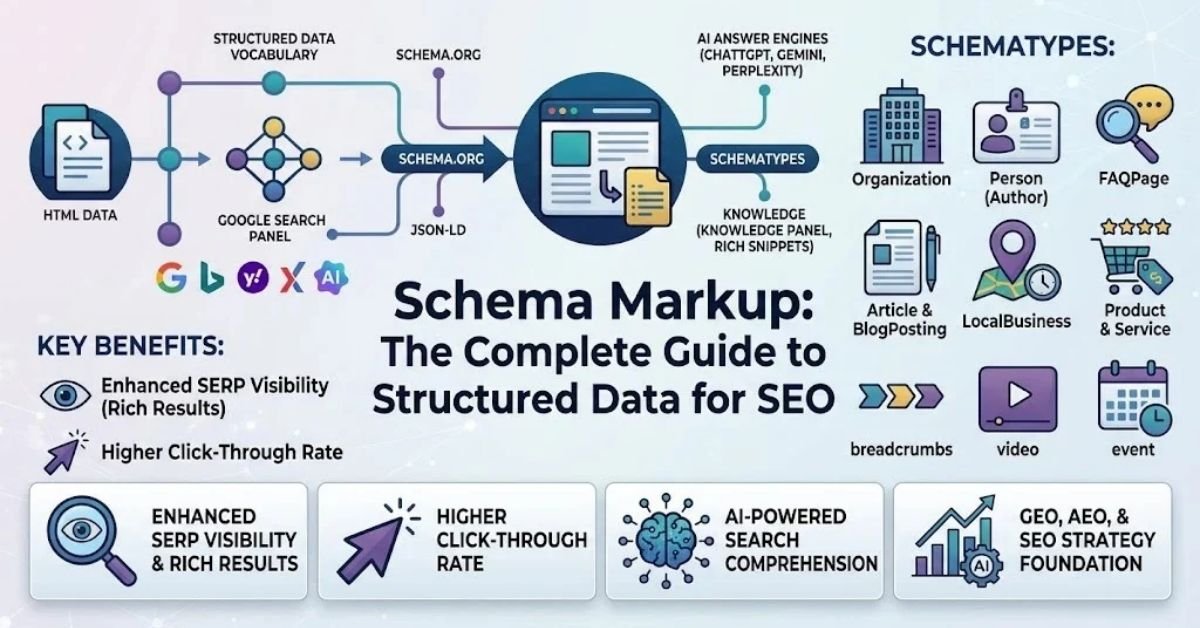
“Welcome to the ultimate schema markup guide. If your website does not use schema markup, you are speaking a language that search engines and AI platforms struggle to understand. Schema markup — the structured data vocabulary that helps Google, ChatGPT, Gemini, and Perplexity interpret your content — is one of the most underutilized yet impactful technical SEO tools available to businesses in the United States and United Kingdom. In 2026, with AI-powered search engines relying on structured data more heavily than ever, implementing schema is no longer a nice-to-have. It is a competitive requirement. Need help implementing structured data across your site? Our SEO team
builds schema markup that earns rich results and AI citations.”
Need a professional SEO strategy tailored to your business?
Get a free SEO audit from Webdo Solutionsand find out where you stand today.
What Is Schema Markup?
Schema markup is a standardized vocabulary of tags (code) that you add to your website’s HTML to help search engines understand the meaning and context of your content. Developed collaboratively by Google, Bing, Yahoo, and Yandex through the Schema.org project, it provides a common framework for describing entities like businesses, products, articles, events, people, and FAQs in a machine-readable format. Search engines use this structured data to generate rich snippets, knowledge panels, and AI-generated responses.
Why Schema Markup Matters More Than Ever
Structured data has been important for SEO for years, but its significance has grown dramatically with the rise of AI-powered search.
Rich Snippets and Enhanced SERP Visibility
Schema markup enables rich results — enhanced search listings that display additional information like star ratings, pricing, FAQ dropdowns, recipe steps, event dates, and more. These rich results command higher click-through rates than standard blue links because they are more visually prominent and informative.
Research consistently shows that rich results generate click-through rates 20-40% higher than standard listings for the same position. For businesses competing in crowded US and UK markets, this enhanced visibility translates directly to more traffic and more leads.
AI Search Engine Comprehension
When ChatGPT, Gemini, or Perplexity evaluates your content, structured data provides a clear, machine-readable map of what your business is, what it does, and what your content covers. Without schema markup, AI models must infer this information from unstructured text — a process that is less reliable and often less favorable to your brand.
At Webdo Solutions, we implement schema markup as a core component of our GEO (Generative Engine Optimization) strategy because it directly impacts how AI search engines understand and cite our clients’ businesses.
Google’s Increasing Reliance on Structured Data
Google has steadily expanded its use of structured data over the past several years. AI Overviews, featured snippets, knowledge panels, and the shopping graph all draw heavily on schema markup. Google’s own documentation increasingly emphasizes structured data as a way to help its systems “understand your content better” and present it in “useful, relevant ways.”
Types of Schema Markup Every Business Needs
Not all schema types are equally important for every business. Here are the essential types, organized by business priority.
Organization Schema
Organization schema defines your business entity for search engines and AI platforms. It is the most fundamental type of structured data every business should implement.
Key properties to include:
- name — Your official business name
- url — Your website URL
- logo — URL to your official logo image
- description — A brief description of your business
- foundingDate — When your company was established
- founder — Information about the founder
- address — Physical business address
- contactPoint — Phone numbers, email, and contact channels
- sameAs — Links to your official social media profiles
{
“@context”: “https://schema.org”,
“@type”: “Organization”,
“name”: “Webdo Solutions”,
“url”: “https://webdosolutions.com”,
“logo”: “https://webdosolutions.com/logo.png”,
“description”: “Full-service digital marketing agency specializing in SEO, AEO, GEO, and website development”,
“founder”: {
“@type”: “Person”,
“name”: “Ozair Sharif”
},
“contactPoint”: {
“@type”: “ContactPoint”,
“contactType”: “customer service”,
“availableLanguage”: “English”
},
“sameAs”: [
“https://www.linkedin.com/company/webdo-solutions”,
“https://www.facebook.com/webdosolutions”
]
}
LocalBusiness Schema
For businesses serving specific geographic areas in the US or UK, LocalBusiness schema (or more specific subtypes like ProfessionalService, LegalService, or Store) is essential for local search visibility.
This schema type tells Google Maps, local search, and AI platforms exactly where your business operates, what hours you keep, and what services you provide in specific locations. It directly influences your appearance in Google’s Local Pack and local AI-generated recommendations.
Article and BlogPosting Schema
Every blog post and article on your website should include Article or BlogPosting schema. This markup identifies the content type, headline, author, publication date, modification date, and publisher — all signals that search engines and AI use to evaluate content quality and recency.
Key properties:
- headline — The article title
- author — The person who wrote the article, with their entity information
- datePublished — Original publication date
- dateModified — Last update date (critical for freshness signals)
- publisher — The organization that published the content
- image — Featured image for the article
- description — Meta description of the content
The dateModified property is particularly important for AEO and GEO strategies. AI search engines prefer fresh content, and an updated modification date signals that the information is current.
FAQPage Schema
FAQPage schema is one of the highest-impact structured data types for both SEO and AEO. It marks up question-and-answer content, enabling FAQ rich results in Google Search and making your FAQ content easily extractable by AI search engines.
{
“@context”: “https://schema.org”,
“@type”: “FAQPage”,
“mainEntity”: [
{
“@type”: “Question”,
“name”: “What is schema markup?”,
“acceptedAnswer”: {
“@type”: “Answer”,
“text”: “Schema markup is a standardized vocabulary of tags added to website HTML to help search engines understand content meaning and context.”
}
}
]
}
Every blog post with an FAQ section should include FAQPage schema. This creates opportunities for FAQ rich results in Google and makes your question-answer pairs directly citable by AI platforms.
Service Schema
Service schema describes the specific services your business offers. For service-based businesses in the US and UK, this markup helps search engines and AI platforms understand your service offerings, pricing structures, and target audiences.
Product Schema
For ecommerce businesses, Product schema is essential. It enables rich product listings with pricing, availability, ratings, and review information. Google Shopping, AI shopping assistants, and comparison engines all rely on Product schema to surface product information.
BreadcrumbList Schema
Breadcrumb schema helps search engines understand your site’s navigational hierarchy. It generates breadcrumb trails in search results, improving user experience and click-through rates while giving search engines a clear picture of your site structure.
Review and AggregateRating Schema
Review schema displays star ratings and review counts in search results. For businesses that collect customer reviews, this markup significantly enhances SERP visibility and click-through rates. In AI search, review signals contribute to trustworthiness assessments.
How to Implement Schema Markup
There are three primary formats for implementing structured data. JSON-LD is the recommended format for most implementations.
JSON-LD (Recommended)
JSON-LD (JavaScript Object Notation for Linked Data) is Google’s preferred format for structured data. It is implemented as a script block in your page’s HTML, separate from the visible content:
<script type=”application/ld+json”>
{
“@context”: “https://schema.org”,
“@type”: “BlogPosting”,
“headline”: “Schema Markup: The Complete Guide”,
“author”: {
“@type”: “Person”,
“name”: “Ozair Sharif”
},
“datePublished”: “2026-01-15”,
“dateModified”: “2026-10-01”
}
</script>
Advantages of JSON-LD:
- Separation of concerns — Schema code is separate from page content, making it easier to manage and update
- Google’s preferred format — Google explicitly recommends JSON-LD over other formats
- Easier implementation — Can be added to templates without modifying existing HTML structure
- Dynamic generation — Can be generated server-side or through CMS plugins
Microdata
Microdata embeds structured data directly into HTML elements using itemscope, itemtype, and itemprop attributes. While functional, it is more complex to implement and maintain than JSON-LD because it requires modifying the page’s HTML structure.
RDFa
RDFa (Resource Description Framework in Attributes) is another inline format that uses HTML attributes to embed structured data. It is commonly used in enterprise environments and certain CMS platforms but is less popular than JSON-LD for new implementations.
Implementation for WordPress Sites
For WordPress websites — which power a significant portion of business sites in the US and UK — several reliable plugins simplify schema implementation:
- Yoast SEO — Automatically generates Article, Organization, and BreadcrumbList schema
- Rank Math — Comprehensive schema support with a built-in schema generator
- Schema Pro — Dedicated schema plugin with advanced customization options
However, plugin-generated schema often needs supplementation with custom JSON-LD for comprehensive coverage. At Webdo Solutions, we typically combine plugin-generated base schema with custom implementations for services, case studies, and specialized content types.
Implementation for Custom Websites
For custom-built websites, schema markup should be integrated into the development process from the start. This involves:
- Creating JSON-LD templates for each content type (pages, blog posts, services, products)
- Dynamically populating schema properties from your CMS or database
- Implementing page-specific schema (FAQPage for FAQ content, HowTo for tutorial content)
- Testing all schema implementations before deployment
Advanced Schema Strategies for SEO, AEO, and GEO
Beyond basic implementation, advanced schema strategies can significantly improve your visibility across traditional search, answer engines, and AI search platforms.

Nested Schema for Rich Entity Connections
Rather than implementing isolated schema types, connect them through nesting to create a rich entity graph:
{
“@context”: “https://schema.org”,
“@type”: “BlogPosting”,
“headline”: “Law Firm SEO Guide”,
“author”: {
“@type”: “Person”,
“name”: “Ozair Sharif”,
“jobTitle”: “Founder and CEO”,
“worksFor”: {
“@type”: “Organization”,
“name”: “Webdo Solutions”,
“url”: “https://webdosolutions.com”
}
},
“publisher”: {
“@type”: “Organization”,
“name”: “Webdo Solutions”
},
“about”: {
“@type”: “Service”,
“name”: “Law Firm SEO Services”,
“provider”: {
“@type”: “Organization”,
“name”: “Webdo Solutions”
}
}
}
This nested approach creates clear connections between entities — the author, the organization, and the service being discussed — helping AI models build a comprehensive understanding of your content’s context and authority.
Speakable Schema for Voice Search
Speakable schema identifies sections of your content that are particularly suitable for text-to-speech playback, which is valuable for voice search optimization. This is a direct bridge between AEO optimization and schema implementation.
HowTo Schema for Process Content
When your content explains a step-by-step process, HowTo schema generates rich results with expandable steps, estimated times, and required tools. This schema type has high visibility in Google Search and is frequently extracted by AI search engines for instructional queries.
ItemList Schema for Rankings and Listicles
When your content ranks or lists items (top 10 lists, best-of roundups, step sequences), ItemList schema generates numbered rich results that stand out in search and are easily extracted by AI.
Combining Multiple Schema Types
A single page can — and often should — include multiple schema types. A blog post might combine:
- BlogPosting — For the article itself
- FAQPage — For the FAQ section
- BreadcrumbList — For navigation context
- Organization — For the publisher entity
This multi-schema approach provides maximum information to search engines and AI platforms about the page, its content, its context, and its publisher.
Schema Markup and AI Search Engines
The relationship between schema markup and AI search visibility deserves special attention, as it represents one of the most impactful opportunities for businesses in 2026.
How AI Models Use Structured Data
AI search engines use schema markup in several ways:
- Entity identification — Schema helps AI models identify and categorize your business, products, and services
- Content classification — Article, BlogPosting, and HowTo schema help AI understand what type of content a page contains
- Fact extraction — Product schema with pricing, Review schema with ratings, and FAQ schema with question-answer pairs provide structured data that AI can directly reference
- Authority assessment — Author and Organization schema with credentials and associations contribute to AI trust signals
- Recency evaluation — datePublished and dateModified properties help AI assess content freshness
Schema as a GEO Foundation
For businesses implementing GEO strategies, comprehensive schema markup is foundational. Without it, your entity signals are weaker, your content is harder for AI to parse, and your visibility in AI-generated responses suffers.
Our work with clients like Lopez Law Group demonstrates this connection. The comprehensive schema implementation — including Organization, LegalService, Person (attorney entities), Article, and FAQPage schema — contributed to the firm achieving 100+ first-page rankings and a 362% increase in organic traffic. The same structured data that earned rich results in Google also strengthened the firm’s entity profile for AI search engines.
Validating and Testing Your Schema
Implementing schema is only half the equation. Validation ensures your markup is error-free and generating the expected results.

Google Rich Results Test
Google’s Rich Results Test (search.google.com/test/rich-results) is the primary tool for validating your structured data. It shows which rich result types your markup supports and identifies any errors or warnings.
Run every page through this test after implementation. Common errors include:
- Missing required properties
- Incorrect data types (using a string where a URL is expected)
- Referencing images that do not exist
- Incomplete nesting of related entities
Schema Markup Validator
The Schema.org validator (validator.schema.org) provides broader validation beyond Google’s specific rich result requirements. It checks your markup against the full Schema.org specification, identifying issues that might not trigger Google warnings but could affect how other platforms interpret your data.
Google Search Console
After deploying schema markup, monitor Google Search Console’s Enhancements reports. These reports show which schema types Google has detected on your site, how many pages have valid markup, and any errors that need addressing.
Regular Audit Schedule
Schema markup can break when websites are updated, redesigned, or migrated. Establish a quarterly audit schedule to verify that all schema implementations remain valid and functional. This is particularly important after CMS updates, theme changes, or site migrations.
Common Schema Markup Mistakes
Avoid these frequent implementation errors that can reduce the effectiveness of your structured data:
Marking Up Invisible Content
Google requires that schema markup reflects content that is visible on the page. Marking up content that users cannot see (hidden behind tabs, behind login walls, or in display:none elements) can result in manual actions from Google.
Using Incorrect Schema Types
Choosing the wrong schema type misrepresents your content to search engines. A product review page should use Review schema, not Product schema. A service page should use Service schema, not Product schema. Match the schema type to the actual content type.
Incomplete Implementation
Partial schema implementation can be worse than none. Organization schema without address information, Article schema without author details, or Product schema without pricing provides incomplete signals that may reduce rather than enhance your visibility.
Forgetting to Update dateModified
The dateModified property should reflect the last time you meaningfully updated the content. Many sites set this once and never update it, which gradually makes the content appear stale to search engines and AI platforms.
Excessive or Spammy Schema
Adding schema markup that exaggerates or misrepresents your content — like adding Review schema with fabricated ratings or Product schema on a blog post — violates Google’s guidelines and can result in penalties.
Schema Markup Implementation Checklist
Use this checklist to ensure comprehensive schema coverage across your website:
Site-Wide Schema: – Organization or LocalBusiness schema on every page – BreadcrumbList schema reflecting your site navigation – WebSite schema with SearchAction on your homepage
Content Pages: – BlogPosting or Article schema on every blog post – Author Person schema with credentials – FAQPage schema on posts with FAQ sections – HowTo schema on tutorial and process content
Service Pages: – Service schema for each service offering – Provider Organization schema linked to your main entity – AggregateRating schema if you display client ratings
Product Pages: – Product schema with pricing, availability, and descriptions – Review and AggregateRating schema for customer reviews – Offer schema for pricing and purchasing information
Location Pages: – LocalBusiness schema with complete NAP information – GeoCoordinates for physical locations – OpeningHoursSpecification for business hours
Frequently Asked Questions
What Is Schema Markup?
Schema markup is a standardized code vocabulary developed by Google, Bing, Yahoo, and Yandex that you add to your website HTML to help search engines understand the meaning and context of your content. It uses a common framework from Schema.org to describe entities like businesses, products, articles, people, and services in a machine-readable format. When implemented correctly, schema markup can generate rich snippets in search results, improve your visibility in AI-generated responses, and help search engines accurately categorize and present your content.
Does Schema Directly Improve Rankings?
Schema markup is not a direct ranking factor — adding structured data to a page will not automatically improve its position in Google’s organic results. However, schema indirectly improves rankings through several mechanisms: rich results increase click-through rates, which sends positive engagement signals to Google; comprehensive structured data helps search engines better understand and index your content; and schema contributes to entity signals that AI search engines use for citation decisions. In practice, pages with proper schema markup consistently outperform identical pages without it in terms of click-through rates and overall search visibility.
Which Schema Types Matter Most?
The most impactful schema types depend on your business type, but universally important types include Organization schema (every business), BlogPosting/Article schema (every content page), FAQPage schema (any page with FAQ content), and BreadcrumbList schema (site-wide navigation). For local businesses in the US and UK, LocalBusiness schema is critical for Google Maps and local search visibility. For ecommerce businesses, Product and Review schema drive rich product listings and star ratings in search results. For service businesses, Service schema helps search engines and AI platforms understand your specific offerings.
How Do I Add Schema to WordPress?
WordPress sites can implement schema through plugins like Yoast SEO, Rank Math, or Schema Pro, which automatically generate base schema for standard content types. For comprehensive coverage, supplement plugin-generated schema with custom JSON-LD blocks added through your theme’s header, individual posts using custom HTML blocks, or dedicated schema management plugins. The most effective approach combines automated plugin generation for basic types with manual JSON-LD for specialized schema like Service, FAQ, and HowTo. Professional website development ensures schema is implemented correctly and comprehensively from the start.
Can Schema Help with AI Search Visibility?
Yes. Schema markup is one of the most important technical foundations for AI search visibility. AI search engines use structured data to identify business entities, classify content types, extract factual information, assess author authority, and evaluate content recency. Comprehensive schema implementation — particularly Organization, Person, Service, and FAQPage types — strengthens your entity profile and makes your content more parseable by AI models. At Webdo Solutions, we consider schema markup implementation a core component of every GEO strategy.
Conclusion: Schema Markup Is Your Competitive Advantage
In 2026, schema markup is the bridge between your content and the search engines — both traditional and AI-powered — that determine your online visibility. Businesses across the United States and United Kingdom that invest in comprehensive structured data implementation gain rich results, higher click-through rates, stronger entity signals, and better AI search visibility.
At Webdo Solutions, we implement schema markup as part of every SEO, AEO, and GEO engagement. Our results — including 362% traffic growth for Lopez Law Group, 4.73 million impressions for Dallas Parrots, and number one Google Maps ranking for XO Cabs UK — reflect the compounding impact of strong structured data foundations combined with comprehensive search optimization.
Ready to implement schema markup that drives rich results and AI visibility? Get a free technical SEO audit from our team, or reach out via WhatsApp to discuss your structured data strategy.
About the Author: Ozair Sharif is the Founder and CEO of Webdo Solutions, a full-service digital marketing agency specializing in SEO, AEO, GEO, and website development for businesses across the United States and United Kingdom.