
Every day, millions of people in the United States and United Kingdom ask AI search engines to recommend products, services, and businesses. When someone types “best SEO agency for small businesses” into ChatGPT or asks Perplexity for “top web developers in the UK,” the AI generates a curated response — citing specific businesses by name. If your company is not among those citations, you are invisible in the fastest-growing search channel of 2026. AI search visibility is no longer a luxury; it is a competitive necessity. Wondering whether your business appears in AI-generated search results? Talk to our GEO specialists to find out.
Need a professional SEO strategy tailored to your business?
Get a free SEO audit from Webdo Solutionsand find out where you stand today.
What Is AI Search Visibility?
AI search visibility refers to the degree to which your business, brand, or content is recognized, cited, and recommended by AI-powered search platforms — including ChatGPT, Google Gemini, Perplexity AI, and Microsoft Copilot. It measures whether AI models identify your business as a credible, authoritative source worth referencing when answering user queries related to your products, services, or expertise area.
How AI Search Engines Generate Answers
Before you can optimize for AI search visibility, you need to understand how these platforms generate their responses. Each major AI search engine operates somewhat differently, but they share common principles.
ChatGPT and Web Browsing
ChatGPT generates responses using two primary information sources: its training data (a massive corpus of text learned during model training) and real-time web browsing through its Bing integration. When a user asks a question that requires current information, ChatGPT searches the web, reads relevant pages, and synthesizes the information into a conversational response — often citing specific sources with links.
The pages ChatGPT selects to read and cite tend to share certain characteristics: they are well-structured, contain specific factual claims, demonstrate clear expertise, and come from sources that the AI can identify as authoritative through entity signals and content quality markers.
Google Gemini and AI Overviews
Google Gemini operates within the Google Search ecosystem, generating AI Overviews that appear at the top of search results for many queries. These overviews synthesize information from Google’s existing index, meaning that traditional SEO signals play a significant role in determining which sources Gemini cites.
However, Gemini also evaluates content through an AI lens — prioritizing sources with clear, factual statements, structured data, and strong topical authority. Businesses that rank well in traditional search have an advantage with Gemini, but ranking alone is not sufficient. The content must also be structured in ways that AI can easily parse and reference.
Perplexity AI and Citation-Heavy Responses
Perplexity AI is perhaps the most citation-heavy of the major AI search engines. It actively searches the web for each query and generates responses with numbered citations to specific sources. Perplexity values factual accuracy, source diversity, and content recency, making it particularly responsive to well-optimized content.
For businesses in the US and UK, Perplexity represents a significant opportunity. Its users tend to be research-oriented, often evaluating services or products before making purchasing decisions. Being cited by Perplexity positions your business directly in front of high-intent audiences.
Microsoft Copilot
Microsoft Copilot, integrated into Bing and Microsoft 365, draws from Bing’s search index to generate AI-powered responses. Optimization for Copilot shares significant overlap with both Bing SEO and ChatGPT optimization, as both rely on similar underlying technology.
Seven Strategies to Get Cited by AI Search Engines
Based on our experience implementing GEO strategies for clients across the United States and United Kingdom, here are the most effective approaches to improving your AI search visibility.
Strategy 1: Implement Comprehensive Schema Markup
Structured data is the language AI models use to understand your business. Without proper schema markup, AI search engines may not know what your company does, where it operates, or why it is authoritative.
Essential schema types for AI visibility include:
- Organization schema — Defines your business name, logo, founding date, location, and social profiles
- LocalBusiness schema — Critical for businesses targeting specific US cities or UK regions
- Service schema — Describes each service you offer with clear descriptions and target audiences
- Person schema — Establishes author entities with credentials and expertise
- FAQPage schema — Marks up your FAQ content for direct extraction by AI
- Article/BlogPosting schema — Identifies your content type, author, publication date, and topic
Implementing this markup through professional website development ensures that AI models can accurately identify and categorize your business.
Strategy 2: Build Authoritative Entity Signals
AI models need to recognize your business as a real, trustworthy entity. Entity recognition comes from consistent, corroborating signals across the web:
Brand consistency across platforms. Your business name, address, phone number, and descriptions should be identical across your website, Google Business Profile, social media profiles, industry directories, and any other online presence. Inconsistencies create confusion for AI models and reduce your citation likelihood.
Topical associations. AI models build associative maps between entities and topics. If your business consistently publishes expert content about SEO, and other authoritative sources reference you in the context of SEO, AI models build a strong association between your brand and SEO expertise.
Third-party mentions and citations. When industry publications, client testimonials, case study platforms, and directory listings mention your business, these create corroborating signals that strengthen your entity profile. At Webdo Solutions, our portfolio of real client results creates exactly these kinds of credibility signals.
Verified SEO Case Studies & Search Console Metrics
Real performance extracts and Google Search Console proof across USA and UK markets.

Dallas Parrots
Exotic bird store in Dallas. Organic traffic expanded significantly across the entire product catalog.

Lopez Law Group
A localized topical cluster covering 25+ Texas cities and practice areas with ongoing AEO optimization.

DFW Property Remodelers
Website redesign paired with localized contractor SEO utilizing strategic city-plus-service landing pages.

XO Cabs
Letchworth Garden City taxi firm achieving top map-pack placement and 65+ page-one keyword rankings.
Author authority. Content attributed to named individuals with clear expertise signals performs better in AI search. Author bios with credentials, published works, and professional affiliations help AI models assess the trustworthiness of your content.
Strategy 3: Create Definition-First Content
AI search engines frequently need to explain concepts to users. Content that leads with clear, concise definitions is more likely to be extracted and cited.
For every topic you cover, include a definition block within the first 200 words:
Effective format: “Content marketing is the strategic creation and distribution of valuable, relevant content to attract and retain a target audience. It works by establishing topical authority and trust over time. Businesses use content marketing to generate organic traffic, build brand awareness, and nurture leads through the buying journey.”
This structure — definition, mechanism, business application — mirrors how AI models construct explanations and makes your content easy to cite.
Strategy 4: Lead with Specific Data and Statistics
AI models heavily favor content with specific, quantifiable claims over vague assertions. Compare these two approaches:
Weak (not citable): “We helped a law firm significantly increase their online presence and get many more clients through our marketing efforts.”
Strong (citable): “Our SEO campaign for Lopez Law Group, a Texas-based law practice, delivered a 362% increase in organic traffic and secured over 100 first-page Google rankings within 12 months.”
The second version contains specific entities (Lopez Law Group, Texas), precise metrics (362%, 100+ rankings), and a timeframe. AI models can extract and reference these data points with confidence.
This principle applies across all content types. When discussing industry trends, cite specific research. When explaining processes, include measurable benchmarks. When showcasing results, use exact numbers.
Strategy 5: Structure Content for AI Extraction
The way you organize content directly affects how easily AI models can extract and cite it. Optimal structuring includes:
Clear heading hierarchy. Use H2 and H3 headings that mirror common questions about your topic. AI models use headings to understand content structure and locate relevant information.
Comparison tables. AI models excel at extracting and reproducing tabular data. Whenever you compare options, features, pricing, or approaches, format the information as a table.
| Content Format | AI Citation Likelihood | Why |
| Clear definition blocks | High | Easy to extract as direct answers |
| Specific statistics with sources | High | Verifiable, trustworthy data points |
| Comparison tables | High | Structured data AI can reproduce |
| Numbered step-by-step lists | Medium-High | Process content AI references for how-to queries |
| Long-form narrative without structure | Low | Difficult for AI to parse and extract |
Numbered lists for processes. When explaining how to do something, numbered lists provide clear, extractable steps that AI models can reference in their responses.
FAQ sections with direct answers. FAQ content structured as question headings with concise answers is one of the most AI-citable content formats. Each question-answer pair functions as a standalone, extractable unit of information.
Strategy 6: Develop Deep Topical Authority
AI models assess the depth and breadth of your expertise on a topic by evaluating your entire content library, not just individual pages. A single article about a topic may rank in Google, but it is unlikely to make you a cited authority in AI search.
To build topical authority:
- Create pillar content — Comprehensive, 2,500+ word guides on your core topics that cover every major subtopic
- Publish supporting articles — Detailed pieces on specific subtopics that link back to your pillar content
- Interlink strategically — Connect related content with descriptive anchor text so AI can follow the relationships
- Update regularly — Refresh content with current data, updated statistics, and new insights
- Cover gaps competitors miss — Identify subtopics and angles that competing content overlooks, and fill those gaps
At Webdo Solutions, our integrated approach to SEO, AEO, and GEO builds exactly this kind of topical authority for our clients.
Strategy 7: Optimize for Each Platform Independently
While the core principles of AI search visibility apply across all platforms, each AI search engine has unique characteristics worth optimizing for:
For ChatGPT: Focus on content quality, entity signals, and Bing SEO. ChatGPT’s web browsing relies on Bing, so pages that rank well in Bing have a higher chance of being found and cited. Ensure your content has clear author attribution and comprehensive schema markup.
For Google Gemini: Traditional Google SEO performance is critical. Pages that already rank well for relevant queries are more likely to be cited in AI Overviews. Supplement strong rankings with structured data, clear definitions, and factual content that Gemini can synthesize.
For Perplexity: Prioritize factual accuracy, source citations within your content, and content recency. Perplexity’s citation-heavy approach rewards content that demonstrates transparency about its information sources. Publishing dates and “Last Updated” signals carry significant weight.
For Microsoft Copilot: Similar to ChatGPT optimization with additional emphasis on Microsoft ecosystem integration. Businesses with strong LinkedIn presence and Bing visibility tend to perform well in Copilot responses.
Measuring Your AI Search Visibility
Tracking AI search visibility requires different approaches than traditional SEO measurement. Here are practical methods for monitoring your presence across AI search platforms.
Manual Query Monitoring
The most direct approach is regularly querying AI search engines for your target topics and tracking whether your business appears:
- Compile a list of 20-30 queries related to your services and expertise
- Search each query across ChatGPT, Gemini, Perplexity, and Copilot weekly
- Record whether your business is mentioned, cited, or recommended
- Track changes over time as you implement optimization strategies
- Note which competitors appear and analyze their content strategies
Brand Mention Tracking
Use tools that monitor AI-generated content for mentions of your brand, products, or key personnel. While this space is still developing, several platforms now offer AI citation tracking that can identify when and how your business is referenced in AI responses.
Content Performance Analysis
Analyze which of your pages receive traffic from AI search referrals. While not all AI platforms send attributable referral traffic, some — particularly Perplexity and Gemini — do. Monitor these referral patterns to understand which content formats and topics generate the most AI-driven traffic.
Case Studies: AI Search Visibility in Action
Our client results at Webdo Solutions demonstrate how integrated search strategies that include GEO drive real business outcomes.
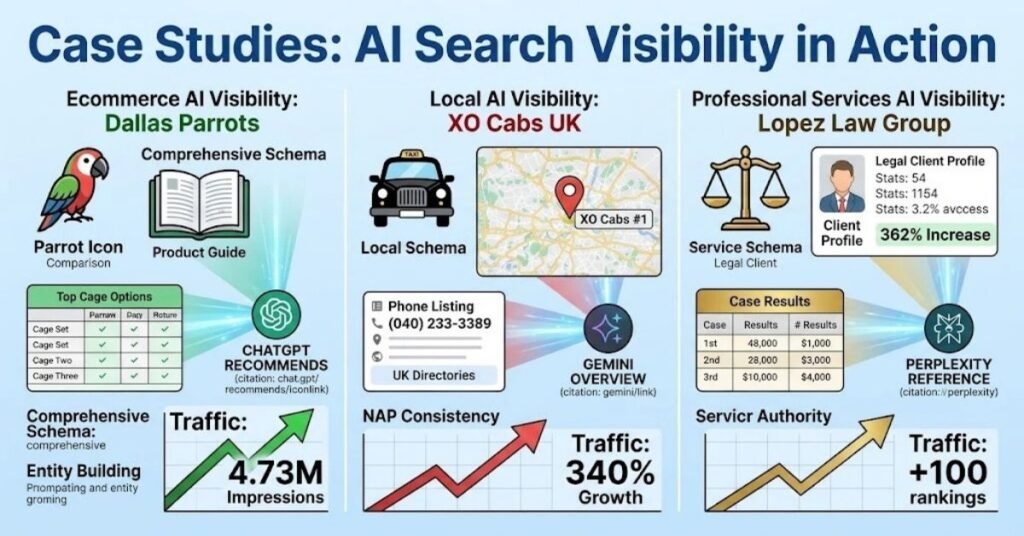
Ecommerce AI Visibility: Dallas Parrots
For Dallas Parrots, an ecommerce business, we implemented a comprehensive strategy that combined traditional SEO with GEO optimization. The results were dramatic: impressions grew from 219,000 to 4.73 million. By creating detailed, authoritative product content with comprehensive schema markup, comparison tables, and clear product entity signals, the brand became visible not only in Google Shopping results but in AI-generated product recommendation responses across multiple platforms.
Local AI Visibility: XO Cabs UK
For XO Cabs in the United Kingdom, achieving AI search visibility meant building strong local entity signals. Our strategy delivered the number one Google Maps position and 340% traffic growth. The comprehensive local business schema, NAP consistency across UK directories, and conversational content optimized for voice and AI queries positioned XO Cabs as a top recommendation in AI responses for transportation queries in their service area.
Professional Services AI Visibility: Lopez Law Group
For Lopez Law Group in Texas, our integrated approach generated a 362% increase in organic traffic and over 100 first-page rankings. The law firm SEO strategy included creating deeply authoritative legal content with specific case results, implementing comprehensive legal service schema, and building strong attorney entity profiles — all of which contributed to growing visibility in AI-generated legal service recommendations.
Common Mistakes That Kill AI Search Visibility
Avoid these frequent errors that prevent businesses from being cited by AI search engines:
Publishing Without Structured Data
Content without schema markup is harder for AI models to understand and categorize. Every page on your website should have appropriate schema markup identifying the content type, author, organization, and topic.
Using Vague, Unsubstantiated Claims
AI models cannot verify “We are the best in the industry” or “Our clients love us.” These statements are ignored. Replace them with specific, verifiable claims supported by data.
Ignoring Content Freshness
AI search engines prefer current information. Content published three years ago without updates signals staleness. Regularly refresh your content with updated statistics, current dates, and new insights.
Overlooking Author Attribution
Anonymous content lacks the author entity signals that AI models use to assess credibility. Every piece of content should be attributed to a named author with clear credentials and expertise signals.
Neglecting Cross-Platform Consistency
Your business information must be consistent across every online platform. Discrepancies between your website, Google Business Profile, social media, and directory listings create confusion for AI models and reduce citation likelihood.
Frequently Asked Questions
How Does ChatGPT Decide What to Cite?
ChatGPT selects sources to cite based on several factors: content relevance to the query, factual specificity and verifiability, source authority and entity recognition, content structure and clarity, and recency of information. When browsing the web to answer a query, ChatGPT evaluates multiple pages and selects those that provide the most clear, authoritative, and factual responses. Content with specific statistics, named entities, and clear expert attribution is more likely to be cited than generic, unattributed content.
Can Small Businesses Appear in AI Search?
Yes. AI search engines prioritize content quality and topical authority over brand size and domain authority. A small business that publishes deeply expert content about its specialty can be cited alongside much larger competitors. The key is focus: rather than competing on broad, generic topics, small businesses should establish authority in specific niches. A local accounting firm specializing in small business tax preparation, for example, can become a cited authority for that specific topic by publishing comprehensive, factual content with clear expertise signals.
How Do I Track AI Search Visibility?
Tracking AI search visibility requires a combination of manual monitoring and emerging analytics tools. Start by creating a list of 20-30 target queries and regularly searching them across ChatGPT, Gemini, Perplexity, and Copilot, recording whether your business appears. Monitor referral traffic from AI search platforms in your analytics. Track brand mentions across the web, including AI-generated content. Several specialized tools are emerging that specifically track AI citations, and this measurement space is developing rapidly. At Webdo Solutions, we include AI visibility monitoring as part of our GEO service packages.
How Long Before My Business Appears in AI Search?
The timeline varies based on your current online presence, content library, and competitive landscape. Businesses with existing strong SEO foundations and authoritative content may see AI citations within four to eight weeks of implementing GEO optimizations. Building AI visibility from scratch typically takes three to six months of consistent effort in content creation, entity building, and structured data implementation. The investment is cumulative: each piece of optimized content and each entity signal strengthens your overall AI search profile.
Is AI Search Visibility More Important Than Traditional SEO?
They are complementary, not competing priorities. Traditional SEO continues to drive significant organic traffic and remains essential for online visibility. AI search visibility represents an additional, rapidly growing channel that reaches users who may never see traditional search results. The most effective strategy integrates SEO, AEO, and GEO to ensure maximum visibility across all search channels. Businesses that invest in only one of these channels are leaving significant visibility and revenue opportunities untouched.
Conclusion: Make Your Business Visible to AI
AI search is not replacing traditional search — it is expanding the search landscape. Businesses in the United States and United Kingdom that optimize for AI search visibility now will capture first-mover advantages that become increasingly difficult to replicate as competition intensifies.
The strategies outlined in this guide — comprehensive schema markup, strong entity signals, AI-citable content, deep topical authority, and platform-specific optimization — represent a proven framework for improving your AI search visibility.
At Webdo Solutions, we have helped businesses across the US and UK achieve measurable results across every search channel, including AI. From Lopez Law Group’s 362% traffic growth to Dallas Parrots’ 4.73 million impressions, our integrated approach delivers real business outcomes.
Ready to get your business cited by AI search engines? Contact our GEO team for a free AI visibility audit, or reach out via WhatsApp to discuss your strategy.
About the Author: Ozair Sharif is the Founder and CEO of Webdo Solutions, a full-service digital marketing agency specializing in SEO, AEO, GEO, and website development for businesses across the United States and United Kingdom.