

Most landing pages are designed for one purpose: conversion. They’re built for paid traffic, email campaigns, or social media clicks — and they do that job well. But what if your landing pages could also rank organically in Google, bringing in a steady stream of free traffic without a single penny spent on ads?
That’s the promise of landing page SEO — creating pages that satisfy both search engine algorithms and human visitors. The challenge is that traditional landing page best practices and SEO best practices often conflict. Short, punchy copy works for conversions but not for rankings. Long-form content ranks well but can hurt conversion rates. The businesses winning in 2026 are the ones that have figured out how to balance both.
In this comprehensive guide, you’ll learn exactly how to create landing pages that rank on the first page of Google while maintaining the conversion power your business needs. Looking for landing pages that rank and convert? Explore Webdo Solutions’ SEO services for expert support.
Need a professional SEO strategy tailored to your business?
Get a free SEO audit from Webdo Solutionsand find out where you stand today.
What Is Landing Page SEO?
Landing page SEO is the practice of optimising dedicated conversion-focused web pages for organic search visibility while maintaining their ability to convert visitors into leads or customers. It combines traditional on-page SEO techniques — keyword targeting, content depth, technical optimisation — with conversion-centred design principles to create pages that both rank in search engines and drive measurable business outcomes.
TL;DR: Landing page SEO means building pages that serve two masters: search engines (through proper optimisation, quality content, and technical excellence) and potential customers (through clear value propositions, compelling copy, and frictionless conversion paths). Done right, these pages generate free organic traffic that converts at high rates.
Why Landing Page SEO Matters in 2026
The economics of digital marketing are shifting. Paid advertising costs continue to rise year over year, with cost-per-click increasing across virtually every industry. Meanwhile, organic search traffic remains free once you’ve earned it. Landing page SEO bridges the gap between acquisition and conversion, making your marketing budget work harder.
The Case for Organic Landing Pages
Consider the numbers:
- The average cost per click for Google Ads in the US is $2.69 for search and $0.63 for display — but in competitive industries like legal ($6.75) and finance ($3.44), it’s significantly higher
- Organic search accounts for 53% of all website traffic across industries
- Organic leads have a 14.6% close rate, compared to 1.7% for outbound leads
- A landing page ranking on page one of Google can generate traffic for years with minimal ongoing cost
For businesses spending thousands monthly on PPC, even a few high-ranking landing pages can dramatically reduce customer acquisition costs while maintaining or improving conversion rates.
Landing Pages vs Blog Posts vs Service Pages
Understanding where landing pages fit in your site architecture is crucial:
| Page Type | Primary Goal | Content Depth | SEO Potential | Conversion Focus |
| Blog Post | Educate/Inform | 1,500-3,000 words | High | Low-Medium |
| Service Page | Describe offerings | 800-1,500 words | Medium | Medium-High |
| Landing Page | Convert visitors | 1,000-2,500 words | Medium-High | Very High |
Landing pages occupy the sweet spot between informational content and pure sales pages. When optimised correctly, they can rank for commercial-intent keywords that blog posts struggle with while converting at rates that service pages can’t match.
How to Build Landing Pages That Rank and Convert
Step 1: Target the Right Keywords
Landing page SEO starts with keyword selection — and not just any keywords. You need terms that indicate commercial or transactional intent, meaning the searcher is ready to take action.
Ideal keyword types for landing pages:
- Commercial intent: “best CRM software for small business,” “top SEO agencies UK”
- Transactional intent: “hire web developer,” “get SEO audit,” “buy project management tool”
- Service-specific long-tail: “ecommerce SEO services for Shopify stores,” “law firm website design”
- Location + service: “SEO company Dallas,” “web development agency London”
Keywords to avoid on landing pages:
- Purely informational queries (“what is SEO”) — these belong on blog posts
- Head terms with ambiguous intent (“marketing”) — too competitive, too vague
- Keywords with featured snippet dominance — better served by blog content
Use tools like Semrush, Ahrefs, or Google Keyword Planner to identify keywords with commercial intent, reasonable search volume, and manageable competition. Look for keywords where the current top-ranking pages include a mix of landing pages and service pages — this signals that Google considers landing pages appropriate for that query.
Step 2: Craft a Page Structure That Satisfies Both SEO and Conversions
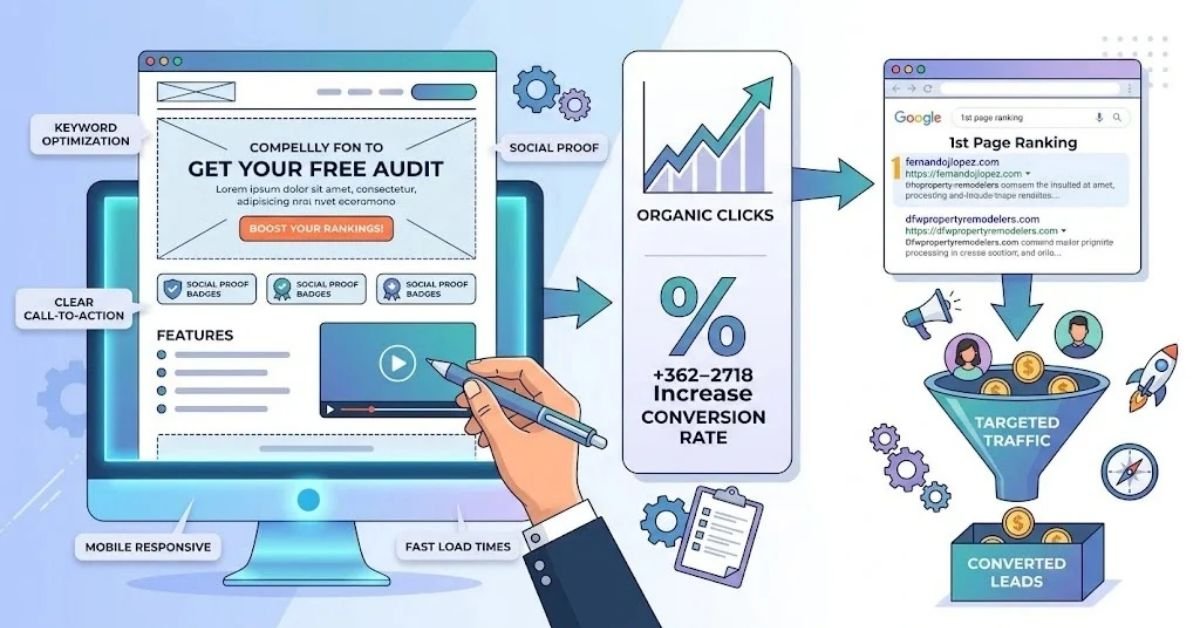
The structure of your landing page needs to balance content depth for SEO with clear conversion pathways for visitors. Here’s the framework:
Above the Fold (Hero Section): – Clear, benefit-driven headline (H1) containing your primary keyword – Supporting subheadline that elaborates on the value proposition – Primary CTA button with action-oriented text – Trust signal: client logo bar, star rating, or key statistic
Problem/Solution Section (H2): – Identify the pain point your audience faces – Present your offering as the solution – Include your primary keyword naturally – 150-250 words of compelling, scannable copy
Features/Benefits Section (H2): – 3-6 key benefits or features with brief descriptions – Use icons or visual elements for scannability – Include semantic keywords throughout – Secondary CTA after this section
Social Proof Section (H2): – Customer testimonials with names and companies – Case study highlights with specific numbers – Trust badges, certifications, or awards – Review ratings from third-party platforms
Detailed Content Section (H2/H3): – This is where your SEO depth lives – 500-1,000 words of substantive content about your offering – Address common questions and objections – Include comparison tables, process breakdowns, or detailed feature explanations – Internal links to related pages
FAQ Section (H2/H3): – 3-5 questions targeting long-tail keywords and “People Also Ask” queries – Direct, helpful answers – FAQ schema markup for rich results
Final CTA Section: – Strong closing statement – Primary conversion action with clear next steps – Alternative conversion option (e.g., “Not ready? Download our free guide”)
Step 3: Write Copy That Ranks and Persuades
Landing page copy needs to perform double duty. Here’s how to write content that satisfies search engines without sacrificing conversion power:
Headline (H1) Formula: [Action Verb] + [Benefit] + [Primary Keyword] + [Differentiator]
Example: “Get Expert SEO Services That Drive Real Revenue Growth”
Body copy principles:
- Lead with benefits, support with features. Search engines rank content that thoroughly covers a topic, but visitors respond to benefits. Structure your content so that each section leads with the benefit and then provides the detail that adds SEO depth
- Use the inverted pyramid. Put your most compelling information first — this satisfies impatient visitors while ensuring search engines crawl your most important content
- Include specific numbers. Phrases like “increased traffic by 362%” and “generated 4.73M impressions” serve both SEO (specific, citable data) and conversion (proof of results) purposes
- Write for scannability. Use short paragraphs (2-3 sentences), bullet points for lists, bold text for key phrases, and clear subheadings. This improves both user engagement metrics (which influence rankings) and conversion rates
- Address objections proactively. Common objections become great SEO content when reframed as questions: “How long does SEO take to see results?” is both an objection handler and a high-volume search query
Step 4: Optimise Technical SEO Elements
Technical optimisation is where many landing pages fall short. PPC landing pages are often built outside the main CMS, lack proper schema markup, and aren’t integrated into the site’s internal linking structure.
Technical checklist for landing page SEO:
- Page speed: Under 2.5 seconds load time. Compress images, minimise JavaScript, use lazy loading for below-fold elements. Landing pages with heavy visual elements particularly need attention here
- Mobile optimisation: Responsive design with touch-friendly CTA buttons, readable text without zooming, and properly sized tap targets
- URL structure: Clean, keyword-rich URLs — yourdomain.com/services/ not yourdomain.com/lp?utm_source=google&campaign=seo
- Meta title: Primary keyword + benefit + brand — under 60 characters
- Meta description: 150-160 characters with primary keyword, value proposition, and CTA language
- Schema markup: LocalBusiness, Service, or Product schema as appropriate, plus FAQ schema for the FAQ section
- Canonical tags: Self-referencing canonical to prevent duplicate content issues, especially if you have similar landing pages for different segments
- Internal linking: Connect your landing page to your site’s navigation, related blog posts, and service pages
- Open Graph tags: For social sharing with custom title, description, and image
Step 5: Build Authority to Your Landing Pages
Landing pages traditionally don’t attract backlinks organically — people link to informational content, not sales pages. You need to actively build authority to your landing pages through strategic approaches.
Internal linking strategy: – Link from relevant blog posts to your landing pages using descriptive anchor text – Include landing pages in your main navigation or footer where appropriate – Create supporting blog content that naturally references your landing page’s topic – Use contextual links within your most authoritative pages
External authority building: – Create data-driven or research-based content on your landing page that others might reference – Include your landing page URL in guest post author bios – Build links to supporting blog content, which passes authority to internally-linked landing pages – Leverage digital PR to earn mentions and links to your commercial pages
Step 6: Implement Conversion Rate Optimisation (CRO)
SEO brings traffic; CRO ensures that traffic converts. These elements work together on a well-optimised landing page.
CRO elements that also help SEO:
- Clear value proposition: Helps SEO by establishing topical relevance; helps CRO by immediately communicating value
- Social proof: Case studies and testimonials add unique, relevant content for SEO while building trust for conversion
- FAQ sections: Target long-tail keywords for SEO while addressing objections for CRO
- Internal links: Help search engine crawling while keeping users engaged on your site
CRO elements that need SEO balance:
- Form length: Shorter forms convert better, but a form-only page won’t rank. Balance with substantive content below the fold
- Page length: Longer content ranks better, but too much text can overwhelm visitors. Use expandable sections, tabs, or progressive disclosure
- Images and video: Great for engagement but can slow page speed. Optimise with compression, lazy loading, and proper alt text
Landing Page SEO Results: What Our Clients Have Achieved
At Webdo Solutions, we build landing pages that serve as long-term organic traffic assets while delivering immediate conversion results.
Dallas Parrots: Ecommerce Landing Pages That Scale
For Dallas Parrots, we optimised category and product landing pages with SEO-first principles while maintaining the conversion-focused elements that drive online sales. Our approach combined ecommerce SEO strategies with conversion-optimised page design:
- 219K to 4.73M impressions — a massive increase in organic visibility
- Strong conversion performance from organically-acquired traffic
- Landing pages that continued generating traffic months after initial optimisation
Lopez Law Group: Legal Service Landing Pages
Legal service landing pages face intense competition in paid and organic search. For Lopez Law Group, we developed service-specific landing pages targeting high-value legal keywords while incorporating the trust signals and conversion elements that drive client enquiries:
- +362% increase in organic traffic to core service pages
- 100+ #1 rankings including high-value commercial keywords
- Significant increase in organic lead generation
These results demonstrate the power of landing page SEO when executed as part of a comprehensive website development and SEO strategy. See more results on our portfolio page.
SEO Case Studies With Real Search Console Proof
Every number comes directly from Google Search Console, showcasing real growth for businesses in the USA and the UK.
Search Console Performance Proof

219K → 4.73M Impressions | Avg Position: 18.4 to 6.8
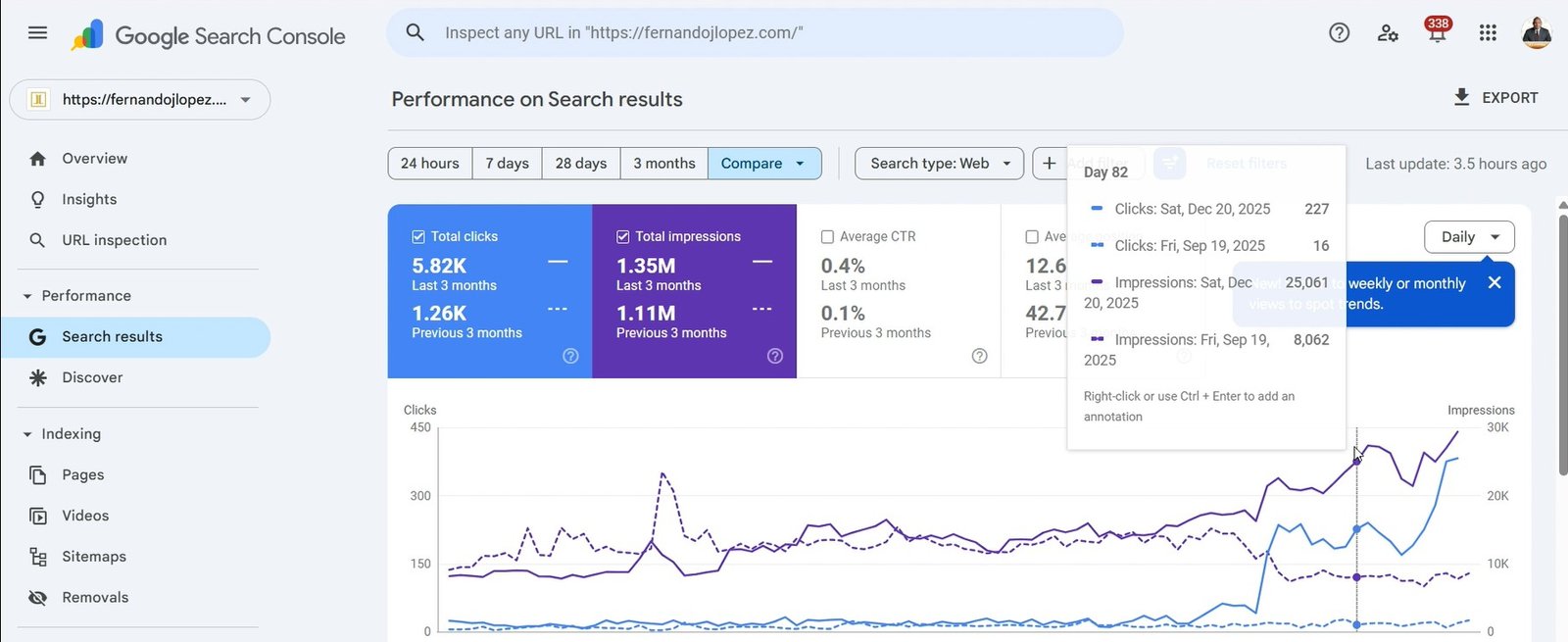
1.35M Impressions | +362% Clicks across 25+ Texas cities
SEO Before and After Results, Side by Side
| Client | Market | Metric | Before | After |
|---|---|---|---|---|
| Dallas Parrots | USA | Impressions | 219K | 4.73M |
| Dallas Parrots | USA | Average position | 18.4 | 6.8 |
| DFW Property Remodelers | USA | Clicks | Baseline | +2,150% |
| Lopez Law Group | USA | Clicks | Baseline | +362% |
| XO Cabs | UK | Traffic | Baseline | +340% |
| Hiq Furnishings | UK | Impressions (90 days) | 0 | 17K |
Common Landing Page SEO Mistakes to Avoid
Mistake 1: No-Index Tags on Landing Pages
Many marketers add no-index tags to landing pages by default, assuming they’re only for paid traffic. If your landing page offers genuine value, let search engines index it — you’re leaving free traffic on the table.
Mistake 2: Thin Content
A landing page with a headline, three bullet points, and a form won’t rank for anything meaningful. Google needs substantive content to understand what your page is about and whether it deserves to rank. Aim for at least 1,000 words of valuable content.
Mistake 3: Ignoring Search Intent
If the top-ranking pages for your target keyword are all informational blog posts, a conversion-focused landing page probably won’t rank there. Choose keywords where Google already shows landing pages, service pages, or product pages in the results — that’s Google telling you what format it expects.
Mistake 4: Duplicate Landing Pages for Each Location
Creating near-identical landing pages with only the city name changed (“SEO Services Houston,” “SEO Services Dallas”) is a doorway page strategy that risks penalties. Each location-specific landing page needs genuinely unique content.
Mistake 5: Sacrificing Speed for Design
Flashy animations, auto-playing videos, and high-resolution background images destroy page speed. Core Web Vitals directly influence rankings, and slow-loading pages have high bounce rates. Prioritise performance.
Mistake 6: No Internal Links To or From Landing Pages
Orphan landing pages — those not connected to the rest of your site through internal links — struggle to rank because search engines can’t find them or understand their relationship to your other content. Build them into your site’s internal linking architecture.
Mistake 7: Missing Schema Markup
Landing pages benefit enormously from structured data — Service schema, FAQ schema, Review schema, and Organisation schema can all enhance how your page appears in search results. Rich results significantly improve click-through rates.
Advanced Landing Page SEO Strategies
Create Content Hubs Around Landing Pages
Build a content hub with your landing page at the centre. Surround it with blog posts, guides, and resources that link back to the landing page. This cluster structure signals topical authority to search engines and guides visitors through a content journey that leads to conversion.
A/B Test Without Losing Rankings
When running A/B tests on SEO landing pages, ensure your testing tool implements proper canonical tags and doesn’t create duplicate content issues. Use server-side testing where possible to avoid JavaScript rendering issues that can affect how search engines see your pages.
Optimise for Answer Engines
Apply AEO (Answer Engine Optimisation) principles to your landing pages by including concise definition blocks, direct answers to common questions, and structured FAQ sections. As AI search engines increasingly provide commercial recommendations, landing pages optimised for answer engines gain additional visibility.
Dynamic Content for Personalisation
Some landing pages use dynamic content that changes based on the visitor’s source, location, or behaviour. Ensure that the default version of the page (what search engines see) is fully optimised, and that dynamic elements enhance rather than replace the core SEO content.
Monitor and Iterate
Use Google Search Console to track which queries your landing pages rank for, their click-through rates, and their average position. Identify opportunities to improve titles and meta descriptions for higher CTR, add content targeting queries where you rank on page two, and strengthen internal links from high-authority pages.
FAQ
Can a landing page rank on the first page of Google?
Absolutely. Landing pages can rank on the first page of Google, particularly for commercial and transactional keywords. The key requirements are substantive, unique content (1,000+ words), proper on-page optimisation, strong technical performance, and internal and external authority signals. Many service-focused businesses have landing pages ranking for their highest-value keywords.
How long should an SEO-optimised landing page be?
For landing pages targeting competitive keywords, aim for 1,500-2,500 words of total content. This doesn’t mean 2,500 words of sales copy — it means a strategic mix of persuasive content above the fold, detailed information in the mid-section, FAQs, and supporting content that provides genuine value. The content should be long enough to thoroughly cover the topic without padding.
Should I use a subdomain or subfolder for landing pages?
Always use a subfolder (yourdomain.com/landing-page/) rather than a subdomain (landing.yourdomain.com). Subfolders inherit the domain authority of your main site, while subdomains are treated as separate entities by search engines. This is especially important for landing pages, which rely on domain authority to compete for commercial keywords.
How do I balance SEO content with conversion design?
The most effective approach is a layered page design. Place your highest-conversion elements above the fold — hero section, primary CTA, and key trust signals. Put your SEO-depth content below the fold, where it adds value for engaged visitors and search engines without overwhelming those ready to convert immediately. Use expandable sections and tabs to make detailed content accessible without cluttering the visual experience.
Do landing pages need backlinks to rank?
Landing pages do need authority signals to rank for competitive keywords, but they don’t necessarily need direct backlinks. Internal links from your authoritative blog posts and service pages pass significant authority. Combined with a strong overall domain authority, internal linking alone can be sufficient for many commercial keywords. For highly competitive terms, targeted external link building may also be necessary.
Start Building Landing Pages That Work Twice as Hard
Landing page SEO transforms your most valuable conversion assets into perpetual traffic generators. Instead of relying solely on paid ads to drive visitors to your landing pages, you create pages that rank organically — delivering free, high-intent traffic that converts at premium rates.
The businesses winning in 2026 don’t choose between SEO and CRO — they engineer landing pages that excel at both. Every landing page you optimise for search is another channel of customer acquisition that doesn’t require ongoing ad spend.
Ready to build landing pages that rank and convert? Talk to Webdo Solutions about our integrated web development and SEO approach. From Dallas Parrots’ explosive impression growth to Lopez Law Group’s 100+ first-page rankings, we build pages that perform.
Get your free landing page SEO audit →
Written by Ozair Sharif, Founder of Webdo Solutions. Ozair and the Webdo Solutions team deliver integrated SEO, AEO, and GEO strategies for businesses across the US and UK. Discover our work at webdosolutions.com/projects.