


Every business wants more traffic, more leads, and more customers. But in 2026, simply publishing blog posts and hoping for the best is not a strategy — it is wishful thinking. A proper content marketing strategy is a deliberate, data-driven plan that aligns your content with what your audience is searching for, positions your brand as an authority, and guides readers toward becoming paying customers.
The businesses that win at content marketing do not produce content randomly. They research what their audience needs, create content that answers those needs better than anyone else, and distribute it through channels that maximize visibility. Whether you operate in the United States or the United Kingdom, a well-executed content strategy is one of the highest-ROI marketing investments available.
Want a content strategy that drives real results? Talk to Webdo Solutions about building an SEO-driven content plan for your business.
Need a professional SEO strategy tailored to your business?
Get a free SEO audit from Webdo Solutionsand find out where you stand today.
What Is a Content Marketing Strategy?
A content marketing strategy is a structured plan for creating, publishing, and distributing valuable content to attract, engage, and convert a clearly defined audience. It encompasses keyword research, topic selection, content formats, publishing cadence, distribution channels, and performance measurement — all aligned with business goals like lead generation, brand authority, or sales growth.
Why Content Marketing Still Dominates in 2026
Some marketers question whether content marketing remains relevant in an era of AI-generated answers, short-form video, and shrinking attention spans. The data says yes — emphatically.
Content Marketing by the Numbers
- Content marketing generates 3x more leads per dollar spent than paid advertising
- Companies that blog regularly receive 67% more leads per month than those that do not
- 71% of B2B buyers consume blog content during their purchasing journey
- Organic search drives over 50% of all website traffic across industries
The format and distribution of content has evolved, but the core principle remains unchanged: businesses that consistently publish valuable, relevant content build trust, authority, and sustainable traffic that paid ads cannot replicate.
The AI Search Dimension
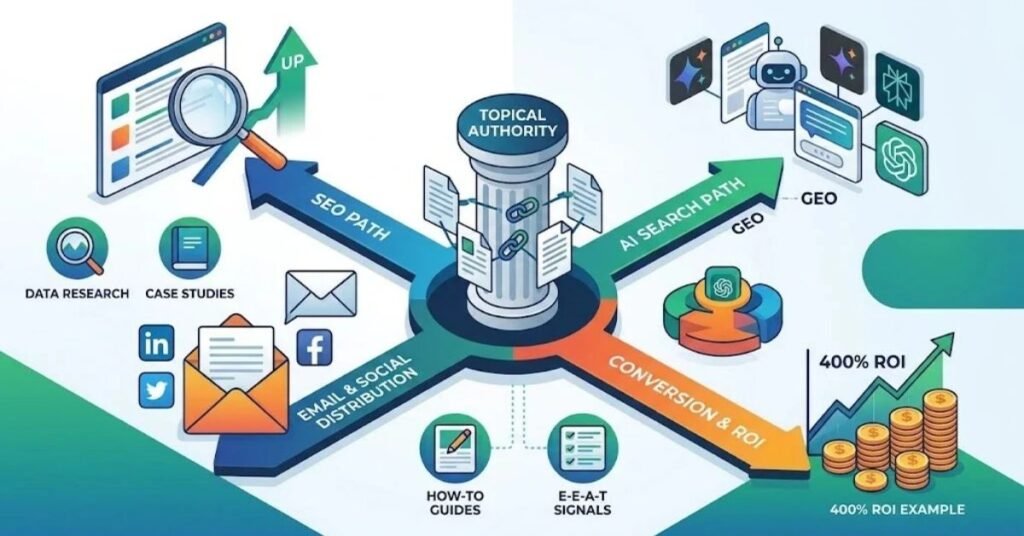
Content marketing in 2026 is not just about Google rankings. AI search engines like ChatGPT, Gemini, and Perplexity are becoming significant traffic and visibility channels. These platforms pull information from authoritative web content to generate answers. If your business publishes comprehensive, well-structured, factually accurate content, you increase your chances of being cited in AI-generated responses — a discipline known as Generative Engine Optimization (GEO).
This means your content marketing strategy now needs to serve three audiences simultaneously: Google’s traditional algorithm, AI search engines, and the human readers who will ultimately decide whether to become customers.
Building Your Content Marketing Strategy: The Framework
A successful content marketing strategy follows a systematic process. Here is the framework we use at Webdo Solutions to build content programs that deliver measurable results.
Step 1: Define Your Content Goals
Before writing a single word, clarify what you want your content to achieve. Common content marketing goals include:
- Lead generation — Attracting potential customers who fill out contact forms, request quotes, or sign up for demos
- Brand authority — Establishing your company as the trusted expert in your industry
- Organic traffic growth — Increasing the volume of visitors who find you through search engines
- Customer education — Helping existing customers get more value from your products or services
- Sales enablement — Creating content that sales teams can share during the buying process
Each goal shapes the type of content you create, the keywords you target, and the metrics you track. A lead generation strategy focuses on high-intent, bottom-of-funnel content with strong calls-to-action. A brand authority strategy emphasizes comprehensive, thought-leadership content that covers topics in depth.
Step 2: Research Your Audience
Effective content starts with understanding who you are writing for. Build detailed audience personas that include:
- Demographics — Industry, company size, job title, location (US, UK, or both)
- Pain points — What problems are they trying to solve?
- Search behavior — What questions do they type into Google? What language do they use?
- Content preferences — Do they prefer long-form guides, quick tutorials, video content, or data-driven reports?
- Buying journey stage — Are they just becoming aware of a problem, actively researching solutions, or ready to make a purchase?
For businesses serving both US and UK markets, audience research should account for regional differences in terminology (SEO vs digital marketing, solicitor vs attorney), platforms (US audiences use Yelp, UK audiences use Trustpilot), and buying behavior.
Step 3: Conduct Keyword and Topic Research
Keyword research is the backbone of any content strategy. It tells you exactly what your audience is searching for, how many people search for it, and how difficult it will be to rank for each term.
Organize your research into three categories:
Informational keywords — Questions and how-to queries (top of funnel) – “what is content marketing” – “how to create a content calendar” – “content marketing vs social media marketing”
Commercial investigation keywords — Comparison and evaluation queries (middle of funnel) – “best content marketing tools 2026” – “content marketing agency pricing” – “HubSpot vs WordPress for content marketing”
Transactional keywords — Action-oriented queries (bottom of funnel) – “hire content marketing agency” – “content marketing services near me” – “content strategy consultant UK”
A balanced content strategy targets keywords across all three categories, creating a funnel that attracts visitors at every stage of the buying journey and guides them toward conversion.
Step 4: Build Topic Clusters
Topic clusters are the modern approach to content architecture. Instead of publishing isolated blog posts, you organize content around pillar pages and supporting content that collectively establish topical authority.
How a topic cluster works:
- Pillar page — A comprehensive, long-form page covering a broad topic (e.g., your SEO services page)
- Cluster content — Blog posts covering specific subtopics that link back to the pillar (e.g., “on-page SEO checklist,” “technical SEO guide,” “local SEO strategies”)
- Internal links — Every cluster post links to the pillar page and to related cluster posts, creating a web of thematically connected content
Search engines reward this structure because it demonstrates comprehensive coverage of a subject. A website with 15 interconnected posts about SEO signals more expertise than a website with 15 disconnected posts about random topics.
At Webdo Solutions, we build topic clusters for every client. When we developed a content cluster around legal SEO for Lopez Law Group, the interconnected content structure contributed to their +362% traffic increase and 100+ first-page rankings. You can see more examples on our projects page.
Step 5: Create a Content Calendar
A content calendar transforms your strategy from a plan into an executable schedule. It should include:
- Publishing dates — Consistent publishing cadence (weekly, biweekly, or monthly)
- Topic and title — The specific piece being published
- Target keyword — The primary keyword each piece targets
- Content type — Blog post, guide, case study, infographic, video
- Funnel stage — Awareness, consideration, or decision
- Author/responsible party — Who is writing and reviewing each piece
- Distribution plan — Where and how each piece will be promoted after publishing
Consistency matters more than volume. Publishing one high-quality, well-optimized post per week delivers better results than publishing four mediocre posts per month. Quality content compounds over time — a well-written blog post published today can still generate traffic and leads years later.
Step 6: Write Content That Performs
The content itself needs to be excellent. In 2026, “good enough” content does not rank. Google and AI search engines both favor content that is comprehensive, authoritative, accurate, and useful.
Content quality checklist:
- Depth — Cover the topic more thoroughly than competing content. If the top-ranking posts are 1,500 words, yours should be 2,500+ with additional insights competitors missed
- Originality — Include unique perspectives, original data, proprietary research, or real-world case studies that no one else can replicate
- Structure — Use clear heading hierarchy (H1, H2, H3), short paragraphs, bullet lists, and tables to make content scannable and easy to read
- E-E-A-T signals — Demonstrate Experience, Expertise, Authoritativeness, and Trustworthiness through author bios, cited sources, and real examples
- AEO optimization — Include concise answer blocks (40-60 words) for key questions, FAQ sections, and structured data to optimize for featured snippets and AI search — core principles of Answer Engine Optimization
- Conversion elements — Strategic calls-to-action placed in the introduction, after proof sections, and in the conclusion
Step 7: Optimize for Distribution
Publishing content is only half the equation. Distribution determines how many people actually see it.
Organic distribution channels:
- Google search (through SEO optimization)
- AI search engines (through GEO optimization)
- Email newsletters to your subscriber list
- Social media platforms (LinkedIn for B2B, Facebook and Instagram for B2C)
- Industry forums and communities
Amplification tactics:
- Repurpose blog posts into LinkedIn articles, Twitter threads, and email sequences
- Create short video summaries for YouTube, TikTok, or Instagram Reels
- Syndicate content to industry publications and Medium
- Share in relevant Slack communities, Reddit threads, and Facebook groups
- Include in email outreach to people and organizations mentioned in the content
Content Types That Drive Results
Not all content types perform equally. Here are the formats that consistently deliver the highest ROI for businesses across both US and UK markets.
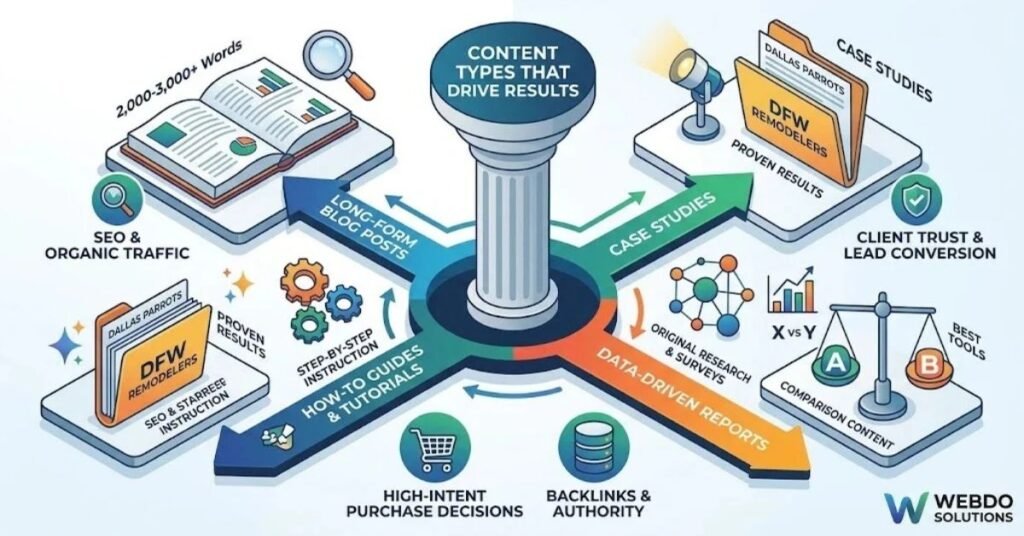
Long-Form Blog Posts (2,000-3,000+ Words)
Comprehensive guides and pillar posts that thoroughly cover a topic. These rank well on Google, earn backlinks naturally, and serve as the foundation of topic clusters. Data from multiple studies confirms that longer content tends to rank higher, earn more backlinks, and generate more social shares.
Case Studies
Case studies are the most powerful bottom-of-funnel content type. They showcase real results with real numbers, which builds trust and provides proof that your approach works. At Webdo Solutions, case studies like the Dallas Parrots transformation (219K to 4.73M impressions) and the DFW Property Remodelers growth (+8,047% impressions) directly contribute to lead conversion.
How-To Guides and Tutorials
Step-by-step instructional content satisfies search intent perfectly and is highly likely to be featured in Google’s snippets and AI search results. These also build authority by demonstrating practical expertise.
Data-Driven Research and Reports
Original data is link bait. Conduct surveys, analyze industry data, or compile benchmarks that other websites will cite and link to. This content type is difficult to produce but delivers outsized returns in terms of backlinks and authority.
Comparison Content
“X vs Y” posts target commercial investigation keywords and attract readers who are actively evaluating options. These posts convert well because they reach people who are close to making a purchase decision.
Measuring Content Marketing ROI
One of the most common objections to content marketing is that it is difficult to measure. This is only true if you are not tracking the right metrics.
Key Performance Indicators (KPIs)
Traffic metrics: – Organic sessions and pageviews (Google Analytics) – Keyword rankings for target terms (SEMrush, Ahrefs, Google Search Console) – Impressions and click-through rates (Google Search Console)
Engagement metrics: – Time on page and scroll depth – Pages per session – Bounce rate by content type – Social shares and comments
Conversion metrics: – Leads generated from organic content (form submissions, phone calls, chat interactions) – Conversion rate by content piece and landing page – Cost per lead compared to paid channels – Revenue attributed to organic content (using UTM tracking and CRM data)
Authority metrics: – Referring domains and backlinks earned – Domain authority and page authority growth – Brand mention volume in traditional and AI search
Calculating Content Marketing ROI
The formula is straightforward:
ROI = (Revenue from Content – Cost of Content) / Cost of Content × 100
For example, if you invest $3,000 per month in content (writer fees, tools, distribution) and that content generates $15,000 in new business revenue per month, your ROI is 400%.
The key is patience. Unlike paid advertising, which delivers immediate but temporary results, content marketing compounds over time. A blog post you publish today continues generating traffic and leads for months or years after the initial investment. After 12-18 months of consistent publishing, the cumulative ROI of content marketing typically far exceeds paid channels.
Content Marketing Mistakes to Avoid
Publishing Without a Strategy
Random content about random topics serves no one. Every piece should target a specific keyword, serve a specific audience, and fit within your broader topic cluster architecture.
Prioritizing Quantity Over Quality
One exceptional, well-researched article per week outperforms five thin, superficial posts. Google’s helpful content system specifically devalues content that exists solely to attract search engine traffic without providing genuine value.
Ignoring Search Intent
A beautifully written article that does not match what the searcher is actually looking for will not rank, no matter how good it is. Before writing, search your target keyword and analyze the top results to understand what type of content Google rewards for that query.
Internal Linking
Every new blog post should link to relevant service pages, pillar content, and other blog posts. Internal links distribute authority throughout your site and help search engines understand your content’s topical relationships. Our complete guide to internal linking covers this in detail.
Not Updating Existing Content
Content decay is real. Blog posts that ranked well two years ago may have fallen in rankings because the information became outdated or competitors published better content. Regularly audit and update your existing content to maintain and improve rankings.
FAQ
How often should I publish blog content?
For most businesses, publishing 1-2 high-quality blog posts per week is the sweet spot. Consistency matters more than volume — it is better to publish one excellent post per week for a year than four posts per week for three months and then nothing. Businesses with larger budgets and content teams can publish more frequently, but quality should never be sacrificed for quantity. Each post should target a specific keyword and provide genuine value to your audience.
What is a topic cluster?
A topic cluster is a content architecture strategy that organizes related content around a central pillar page. The pillar page covers a broad topic comprehensively, while supporting blog posts cover specific subtopics in detail. All cluster content is interconnected through internal links, creating a thematic web that signals topical expertise to search engines. For example, an SEO topic cluster might have a pillar page about SEO services with supporting posts about keyword research, on-page SEO, technical SEO, link building, and local SEO.
How do I measure content marketing ROI?
Measure content marketing ROI by tracking three categories of metrics: traffic (organic sessions, keyword rankings, impressions), engagement (time on page, bounce rate, pages per session), and conversions (leads generated, conversion rate, revenue attributed). Use Google Analytics for traffic and engagement data, Google Search Console for keyword performance, and your CRM to trace leads back to specific content pieces. Calculate ROI as: (Revenue from Content – Cost of Content) / Cost of Content × 100. Allow 6-12 months for a meaningful ROI assessment, as content marketing is a compounding investment.
How long should blog posts be?
There is no universal ideal length, but data consistently shows that comprehensive content outperforms thin content. For competitive keywords, aim for 2,000-3,000+ words. For long-tail or specific questions, 1,200-1,500 words may suffice. The true benchmark is coverage: your post should be the most thorough, helpful resource available for that topic. Length is a byproduct of thoroughness, not a goal in itself.
Should I create content for US and UK audiences separately?
For businesses targeting both markets, you generally do not need completely separate content. Write for both audiences within the same piece by including examples, statistics, and references from both markets. Use terminology that works in both regions, or include both terms where they differ (e.g., “solicitor (UK) or attorney (US)”). For location-specific topics — local SEO, regional regulations, market-specific pricing — separate pages may be warranted to target location-modified keywords.
Conclusion: Build a Content Engine That Drives Growth
A well-executed content marketing strategy is not an expense — it is an investment that compounds over time, generating increasing traffic, authority, and leads with every piece you publish. The businesses that commit to consistent, high-quality, strategically planned content will dominate their markets in 2026 and beyond.
At Webdo Solutions, we help businesses across the United States and United Kingdom build content strategies that rank on Google, get cited by AI search engines, and convert readers into customers. From keyword research to content creation to performance tracking, our team handles every aspect of your content marketing program.
Ready to turn content into your most powerful growth channel? Contact Webdo Solutions for a free content strategy consultation.
About the Author: Ozair Sharif is the Founder and CEO of Webdo Solutions, a full-service digital marketing agency specializing in SEO, AEO, GEO, and website development for businesses across the United States and United Kingdom.