
Google algorithm updates have the power to make or break a business’s online visibility overnight. One day your website sits comfortably on page one, generating a steady stream of leads and revenue. The next day, after a core update rolls out, your rankings drop, your traffic plummets, and you are left scrambling to understand what happened and how to fix it.
For business owners across the United States and United Kingdom, understanding how search algorithm changes work is not optional — it is essential for protecting your digital investment. Google makes thousands of changes to its algorithm every year, with several major updates that can cause significant ranking fluctuations across entire industries.
The good news? Businesses that follow sound SEO fundamentals and work with experienced SEO professionals rarely suffer lasting damage from algorithm updates. In fact, quality-focused businesses often benefit when Google refines its ability to identify and reward genuinely helpful content.
This guide explains everything you need to know about Google algorithm updates in 2026: what they are, how they work, how to recover if you are affected, and how to build an SEO strategy that thrives regardless of what Google changes next.
Need a professional SEO strategy tailored to your business?
Get a free SEO audit from Webdo Solutionsand find out where you stand today.
What Are Google Algorithm Updates?
Google algorithm updates are changes to the complex system of rules, signals, and machine learning models that Google uses to crawl, index, evaluate, and rank web pages in its search results. These updates range from minor daily adjustments that pass unnoticed to major core updates that can reshape search results across millions of queries, affecting website traffic and visibility on a massive scale worldwide.
Types of Google Algorithm Updates
Not all Google updates are created equal. Understanding the different types helps you assess risk and respond appropriately.
Core Algorithm Updates
Core updates are the most significant changes Google makes. They happen several times per year and broadly reassess how Google evaluates content quality, relevance, and authority. Core updates do not target specific sites or practices — they recalibrate Google’s overall understanding of what constitutes high-quality, relevant content.
When a core update rolls out (typically over one to two weeks), you may see significant ranking changes — both positive and negative — across your website. Pages that were undervalued may jump in rankings, while pages Google now considers less relevant or lower quality may drop.
Spam Updates
Spam updates specifically target websites and practices that violate Google’s spam policies. These updates refine Google’s ability to detect and demote:
- Link spam and manipulative link-building schemes
- Keyword stuffing and hidden text
- Cloaking and sneaky redirects
- Scraped or auto-generated content
- Doorway pages and thin affiliate content
If your website follows ethical SEO practices, spam updates should not affect you negatively. They typically benefit legitimate businesses by removing spammy competitors from search results.
Helpful Content Updates
The helpful content system, which Google has integrated into its core ranking systems, evaluates whether your content is genuinely helpful to users or primarily created to manipulate search rankings. This system asks fundamental questions about your content:
- Was it written for humans or for search engines?
- Does it demonstrate genuine expertise and firsthand experience?
- Does it provide substantial value beyond what is already available?
- Would a visitor feel satisfied after reading it?
Content that exists solely to rank for keywords — thin, repetitive, or obviously AI-generated without human oversight — is the primary target of this system.
Product Reviews Updates
These updates specifically affect review content, ensuring that search results surface reviews written by people with genuine experience using the products or services being reviewed. Affiliate content and product roundup articles are most affected.
Local Search Updates
Google periodically updates how it ranks local search results and Google Business Profile listings. These updates affect businesses competing for local visibility in Google Maps and the local pack — particularly important for service businesses targeting customers in specific cities or regions across the US and UK.
Page Experience Updates
These updates focus on technical user experience factors including Core Web Vitals (loading speed, interactivity, visual stability), mobile-friendliness, HTTPS security, and intrusive interstitial guidelines.
Major Google Algorithm Updates: A Timeline of Changes
Understanding the history of Google’s most impactful updates helps you recognise patterns and anticipate future changes.
Panda (2011)
Targeted thin, low-quality, and duplicate content. Rewarded websites with original, in-depth, well-researched content. Devastated content farms and sites with high volumes of shallow articles.
Lesson: Quality over quantity. Every page on your site should provide genuine value.
Penguin (2012)
Targeted manipulative link-building practices. Penalised websites with unnatural backlink profiles, including paid links, link networks, and excessive exact-match anchor text.
Lesson: Earn links through quality content and genuine relationships, not through schemes.
Hummingbird (2013)
Improved Google’s ability to understand natural language queries and search intent. Moved Google beyond simple keyword matching toward understanding what users actually mean when they search.
Lesson: Write for user intent, not just keywords. This laid the groundwork for what would become AEO (Answer Engine Optimization).
RankBrain (2015)
Introduced machine learning into Google’s ranking algorithm. RankBrain helps Google interpret unfamiliar queries and understand the relationship between concepts, enabling more accurate results for queries Google has never seen before.
Lesson: Topical depth and semantic relevance matter more than keyword density.
BERT (2019)
Applied natural language processing to better understand the context and nuance of words in search queries. BERT particularly improved Google’s understanding of conversational and long-tail queries.
Lesson: Conversational, natural language content that directly answers user questions is increasingly favoured.
Helpful Content System (2022-2024)
Launched as a site-wide signal evaluating whether content across your entire website is genuinely helpful or primarily SEO-driven. The system was refined through multiple updates and eventually integrated into Google’s core ranking systems.
Lesson: Every page on your site contributes to Google’s overall assessment of your content quality. A few bad pages can drag down the entire domain.
AI Overviews and Generative Search (2024-2026)
Google’s integration of AI-generated overviews into search results fundamentally changed how users interact with search. This is where GEO (Generative Engine Optimization) becomes critical — ensuring your content is not only ranked but also cited and featured in AI-generated responses.
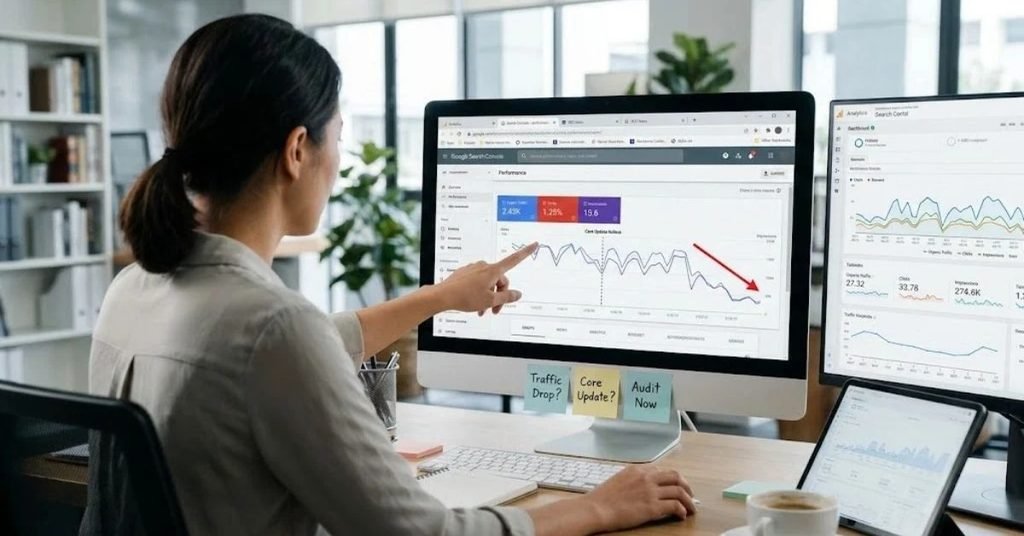
How to Know If a Google Algorithm Update Affected Your Site
Recognising the signs of an algorithm impact is the first step toward recovery.
Monitor Organic Traffic Trends
Check Google Analytics for sudden drops or spikes in organic traffic. Compare traffic patterns against known update rollout dates (published by Google on their Search Status Dashboard and reported by SEO news sites like Search Engine Journal and Search Engine Land).
Check Google Search Console
Look for changes in: – Total clicks and impressions — drops across many queries suggest a broad impact – Average position changes — multiple keywords dropping simultaneously indicates an algorithmic cause – Page-level performance — identify which specific pages lost or gained visibility – Manual actions — check for any manual penalties (rare but serious)
Rule Out Technical Issues
Before attributing traffic changes to an algorithm update, rule out technical causes: – Server downtime or errors – Robots.txt changes blocking crawling – Accidental noindex tags – SSL certificate issues – Site migration or redesign problems
A comprehensive SEO audit can distinguish between algorithm impacts and technical issues that may coincidentally align with update timelines.
Compare Against Industry Trends
Sometimes an entire industry is affected by an update. Check whether competitors and peers experienced similar ranking changes. If the entire sector shifted, the update may have changed how Google evaluates relevance for your industry’s queries.
How to Recover From a Google Algorithm Penalty
Recovery from a Google algorithm update requires a systematic approach. Here is a step-by-step recovery plan:
Step 1: Identify What Changed
Analyse which pages, keywords, and content types were most affected. Look for patterns: – Did informational content drop while commercial pages held steady? – Were older pages affected more than recent content? – Did pages with thin content or low word counts drop disproportionately?
Step 2: Audit Content Quality
Review affected pages against Google’s quality guidelines: – Does the content demonstrate Experience, Expertise, Authoritativeness, and Trustworthiness (E-E-A-T)? – Is the content original and comprehensive, or does it merely summarise information available elsewhere? – Was the content written by someone with genuine expertise or real-world experience? – Does the content answer the user’s query thoroughly and helpfully?
Step 3: Improve or Remove Low-Quality Content
For pages that do not meet quality standards: – Improve: Add depth, original insights, expert quotes, case study data, and updated information – Consolidate: Merge thin pages covering similar topics into one comprehensive resource – Remove: Delete or noindex pages that provide no real value and cannot be improved
Step 4: Strengthen E-E-A-T Signals
Enhance your site’s expertise signals: – Add detailed author bios with credentials on every content page – Include dates published and dates updated – Link to authoritative sources and cite specific data – Showcase case studies with specific results and client names (with permission) – Display trust signals: certifications, awards, industry affiliations
At Webdo Solutions, we include verifiable case study data in our content — like Lopez Law Group’s +362% traffic growth and 100+ first-page rankings — because specific, verifiable claims strengthen E-E-A-T signals that Google rewards.
Step 5: Clean Up Technical Issues
Address any technical SEO problems that may compound algorithmic impacts: – Fix broken links and redirect chains – Improve page speed and Core Web Vitals – Ensure proper canonical tags and indexation signals – Update XML sitemaps – Review and optimise internal linking structure
Step 6: Build Authoritative Backlinks
If your backlink profile is thin or contains low-quality links: – Disavow spammy or manipulative backlinks – Invest in digital PR and link earning through original research – Build relationships with industry publications for genuine editorial links – Create link-worthy assets (data studies, tools, comprehensive guides)
Step 7: Monitor and Iterate
Recovery from a core update often requires waiting for the next core update for rankings to be reassessed. Continue improving content quality, technical performance, and user experience during this period.
Future-Proofing Your SEO Strategy Against Algorithm Changes
The best defence against Google algorithm updates is an offence built on quality and user value.
Focus on E-E-A-T
Experience, Expertise, Authoritativeness, and Trustworthiness will remain central to Google’s quality evaluation. Invest in: – Content created by genuine experts – Real-world experience and case studies – Authoritative citations and data – Trust signals across your website
Create Genuinely Helpful Content
Every piece of content on your website should exist to help your audience, not to game search engines. Ask yourself: if Google did not exist, would this content still provide value to someone?
Diversify Your Search Presence
Do not rely solely on traditional organic rankings. Build visibility across: – Google Maps and local search — essential for location-based businesses – Featured snippets and rich results — AEO-optimised content captures these positions – AI-generated responses — GEO-optimised content gets cited by ChatGPT, Gemini, and Perplexity – Video search — YouTube content ranks in both YouTube and Google search – Image search — optimised images with proper alt text and context
Maintain Technical Excellence
A technically sound website ensures Google can efficiently crawl, index, and render your content, regardless of algorithm changes. Partner with a web development team that understands the intersection of design, performance, and SEO.
Stay Informed Without Overreacting
Follow reputable SEO news sources for update announcements, but avoid making dramatic changes based on every minor fluctuation. Algorithm updates create temporary volatility that often stabilises within weeks. Panic-driven changes to content or site structure can cause more harm than the update itself.
The Rise of AI Search and What It Means for Google Updates
In 2026, the algorithm update landscape extends beyond Google alone. AI-powered search engines like ChatGPT, Gemini, and Perplexity have introduced new ranking dynamics that traditional Google updates do not fully capture.
These AI engines pull from multiple data sources, evaluate content differently, and prioritise: – Clear, factual, well-structured content – Authoritative sources with strong entity signals – Content that is easily citable (specific data, definitions, structured information) – Brands with consistent presence across the web
This is why a modern SEO strategy must encompass SEO, AEO, and GEO — optimising for traditional search engines, answer engines, and generative AI engines simultaneously.
How Webdo Solutions Helps Businesses Navigate Algorithm Changes
At Webdo Solutions, we have helped businesses across the United States and United Kingdom navigate every major Google algorithm update. Our approach focuses on building sustainable search visibility that withstands algorithm changes rather than chasing short-term tactics that create vulnerability.
Our proven results demonstrate this philosophy:
- Lopez Law Group — +362% organic traffic growth built on quality content and genuine authority
- Dallas Parrots — 219K to 4.73M impressions through comprehensive ecommerce SEO
- DFW Property Remodelers — +8,047% impression growth through local SEO and content excellence
- XO Cabs UK — #1 Google Maps position through authentic local presence and technical optimisation
These results were achieved through strategies that align with Google’s quality guidelines, not through tactics that risk penalties. View our full portfolio of results.
Search Console Stats & Case Study Highlights
Real performance extracts and verified metrics taken directly from Google Search Console properties.
 LAW · TEXAS
Lopez Law Group
+362% Clicks
Local topical cluster covering 25+ Texas cities and 20+ practice areas with ongoing Entity SEO and AEO work.
- Market: USA (Texas)
- Focus: Local SEO & AEO
- Proof: 1.35M Impressions
 ECOMMERCE · USA
Dallas Parrots
219K → 4.73M Impressions
Exotic bird store in Dallas. Clicks grew 468% and average position moved from 18.4 to 6.8 across the catalog.
- Growth: +468% Clicks
- Avg Position: 18.4 to 6.8
- Proof: Verified Search Console
 CONTRACTOR · USA
DFW Property Remodelers
+2,150% Clicks
Website redesign plus local SEO for a Dallas-Fort Worth remodeler, built on strategic city-plus-service landing pages.
- Impressions: +8,047%
- Focus: Local Contractor SEO
- Proof: Verified Search Console
 TAXI · UK
XO Cabs
#1 on Google Maps
Letchworth Garden City taxi firm. Secured top of the map pack and 65+ page-1 keywords with traffic up 340%.
- Traffic: +340%
- Keywords: 65+ on Page 1
- Proof: Google Business Profile
Frequently Asked Questions
How often does Google update its algorithm?
Google makes changes to its algorithm continuously — thousands of small adjustments happen every year, most of which pass unnoticed. Major updates, including core updates, spam updates, and system-specific updates, typically happen several times per year. Google usually announces significant updates on their Search Status Dashboard and through official blog posts. Core updates typically roll out over one to two weeks, during which ranking fluctuations are common across many websites and industries.
How do I recover from a Google algorithm penalty?
Recovery from a Google algorithm impact requires a systematic approach: identify which pages and keywords were affected, audit content quality against E-E-A-T standards, improve or remove low-quality pages, strengthen expertise signals (author bios, case studies, citations), fix technical SEO issues, and build authoritative backlinks. For core updates, improvements may not be reflected in rankings until the next core update rolls out. Manual penalties (shown in Google Search Console) require submitting a reconsideration request after addressing the specific issues cited.
What was the helpful content update?
The helpful content update, first launched in 2022 and refined through subsequent updates, introduced a site-wide signal that evaluates whether content across your entire website is created primarily for people or primarily for search engines. Content assessed as unhelpful — thin, keyword-stuffed, AI-generated without human oversight, or lacking genuine expertise — can negatively affect the entire site’s rankings, not just the individual unhelpful pages. This system has since been integrated into Google’s core ranking systems.
Can I prevent algorithm updates from affecting my site?
No website is completely immune to algorithm impacts, but you can minimise risk by following SEO best practices consistently: create genuinely helpful content written by experts, maintain strong E-E-A-T signals, ensure technical excellence, build authoritative backlinks naturally, and avoid manipulative tactics. Websites that prioritise user value over search engine manipulation are far less likely to experience negative impacts from algorithm updates and more likely to benefit from them.
Should I make changes to my site during an algorithm update rollout?
It is generally advisable to wait until an update has fully rolled out before making significant changes. During the rollout period, rankings are in flux and may not reflect the final impact. Making changes mid-rollout makes it impossible to distinguish between the update’s effects and the effects of your changes, complicating any future diagnosis. Once the rollout is complete (usually one to two weeks), analyse the impact methodically and make data-driven improvements.
Conclusion: Build for Users, Not for Algorithms
The businesses that consistently succeed through Google algorithm updates share one common trait: they focus relentlessly on providing genuine value to their audience. They invest in expert content, technical excellence, strong user experiences, and authentic authority building.
Google’s mission has always been to organise the world’s information and make it universally accessible and useful. Every algorithm update moves the search engine closer to that goal. By aligning your website with that same mission — being genuinely useful to your audience — you position your business to benefit from algorithm changes rather than fear them.
Do not wait for the next update to catch you off guard. Build a search strategy that thrives in any algorithmic environment.
Ready to future-proof your SEO? Contact Webdo Solutions for a comprehensive SEO audit and strategy tailored to your business.
About the Author: Ozair Sharif is the Founder and CEO of Webdo Solutions, a full-service digital marketing agency specializing in SEO, AEO, GEO, and website development for businesses across the United States and United Kingdom.