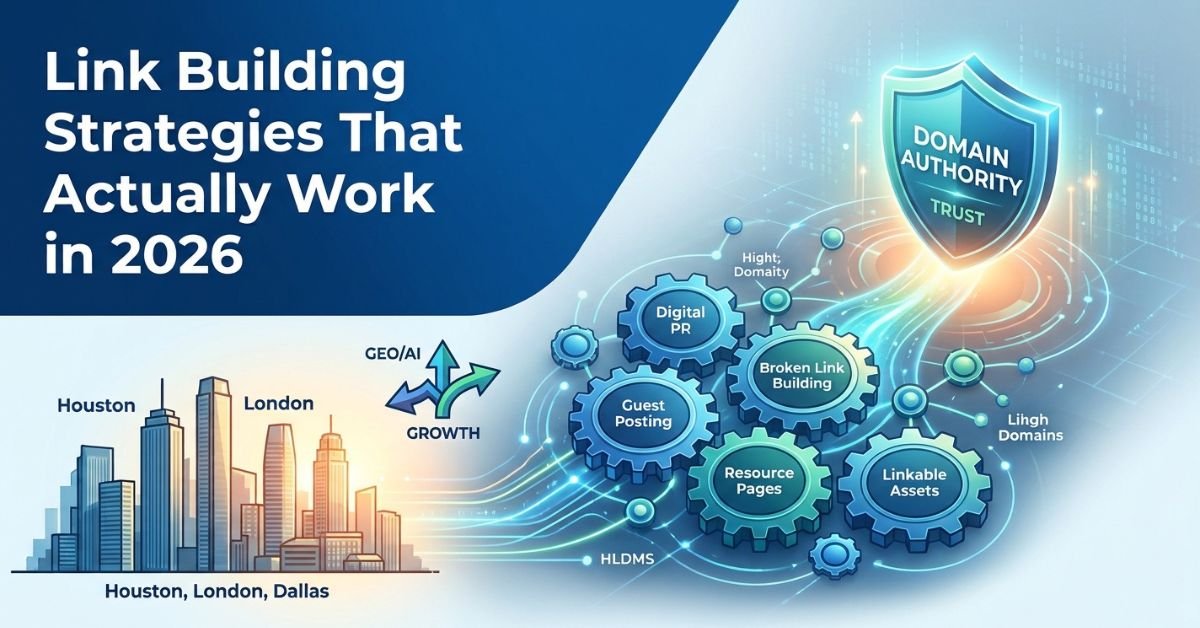
Every SEO professional knows that link building strategies remain one of the most powerful ranking factors in Google’s algorithm. Yet the landscape has shifted dramatically. The tactics that worked five years ago — mass directory submissions, blog comment spam, private blog networks — will now get your site penalized. In 2026, earning high-quality backlinks requires creativity, genuine value, and strategic outreach.
Whether you are a small business owner in Houston or a growing brand in London, the backlinks pointing to your website tell Google how trustworthy, authoritative, and relevant your content is. At Webdo Solutions, we have built link profiles that have driven transformative results — including growing Dallas Parrots from 219K to 4.73M impressions through a comprehensive SEO strategy that included strategic link acquisition. Want to strengthen your link profile? Talk to our team.
Need a professional SEO strategy tailored to your business?
Get a free SEO audit from Webdo Solutionsand find out where you stand today.
What Is Link Building?
Link building is the process of acquiring hyperlinks from external websites that point to your own website. These inbound links, commonly called backlinks, serve as votes of confidence in Google’s algorithm. Search engines interpret each quality backlink as a signal that your content is valuable, trustworthy, and worth recommending. Businesses invest in link building to improve domain authority, boost search rankings, and drive referral traffic.
Why Backlinks Still Matter in 2026
Google has made hundreds of algorithm updates over the years, but backlinks remain a core ranking signal. Here is why they continue to matter and why ignoring them is not an option.
Backlinks as Trust Signals
When a respected website links to your content, it is essentially endorsing you. Google’s algorithm interprets this as a trust signal. The more high-quality websites that link to you, the more authoritative Google considers your site. This is the foundation of Google’s original PageRank algorithm, and while the system has evolved enormously, the underlying principle remains intact.
The Quality vs. Quantity Debate
In 2026, one backlink from a high-authority news site like Forbes, the BBC, or an established industry publication is worth more than 100 links from low-quality directories. Google’s algorithm has become remarkably sophisticated at evaluating link quality. Factors that determine link value include:
- Domain authority of the linking site
- Relevance of the linking page to your content
- Placement of the link within the content (editorial links within body text are most valuable)
- Anchor text used for the link
- Follow status (dofollow links pass more ranking value than nofollow)
- Traffic to the linking page
- Freshness of the linking content
The Competitive Advantage
In competitive industries, backlinks are often the differentiator between page one and page two. If your on-page SEO, content quality, and technical SEO are comparable to your competitors, your backlink profile is what tips the scale. Businesses that invest in consistent, ethical link building outperform those that rely solely on content and technical optimization.
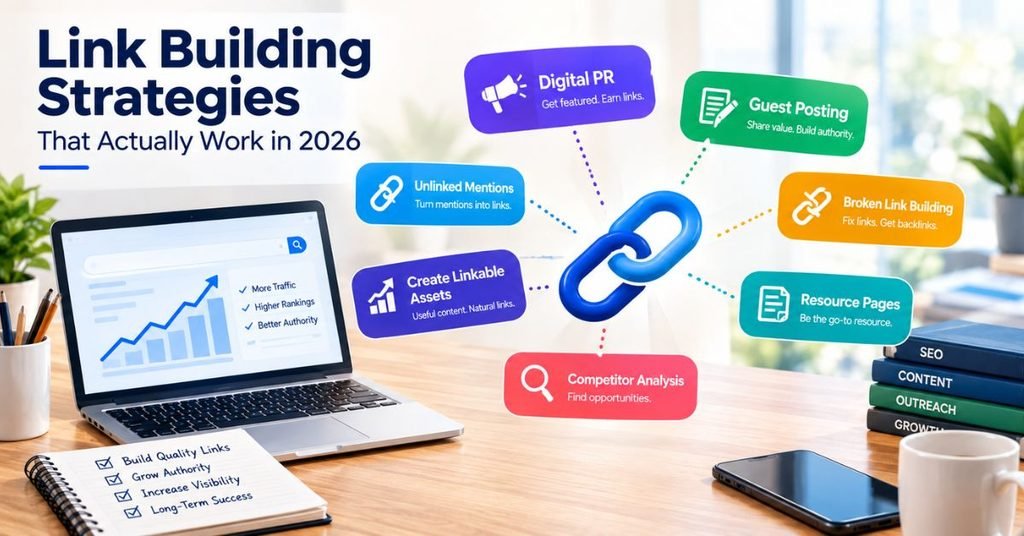
Strategy 1: Digital PR and Newsworthy Content
Digital PR is the most effective link building strategy in 2026. It involves creating newsworthy content and pitching it to journalists, editors, and publishers who cover your industry.
What Makes Content Newsworthy?
Journalists link to content that provides unique value to their audience:
- Original research and surveys — Commission or conduct a study that reveals new insights. A survey of 1,000 small business owners about marketing spending generates data that journalists can cite
- Industry reports — Compile data into a comprehensive report. Annual industry benchmarks, trend analyses, and market forecasts earn links from publications covering your sector
- Expert commentary — Offer your expertise on breaking news or industry developments. Journalists are always looking for credible sources to quote
- Data visualizations — Transform complex data into shareable infographics, interactive charts, or visual reports that publishers will embed and credit
How to Pitch Journalists
- Build a media list — Identify journalists who cover your industry. Use tools like Muck Rack, HARO (Help a Reporter Out), or ResponseSource (UK) to find relevant contacts
- Personalize every pitch — Reference their recent articles. Explain why your content matters to their specific audience
- Lead with the story — Journalists care about the narrative, not your brand. Frame your pitch around the insight, not the promotion
- Keep it concise — Your pitch email should be under 200 words. Include the key data point or story angle in the first two sentences
- Follow up once — Send one follow-up 3-5 days later. Any more is spam
Measuring Digital PR Success
Track earned media mentions, backlinks acquired, domain authority of linking sites, referral traffic from earned links, and brand search volume increases after coverage appears.
Strategy 2: Guest Posting Done Right
Guest posting has been declared dead multiple times, but strategic guest posting remains one of the most reliable link building strategies when done correctly.
The Right Way to Guest Post
The wrong way: mass-producing low-quality articles and submitting them to any site that accepts guest posts. The right way: creating genuinely valuable content for respected publications in your industry.
Identifying quality guest post opportunities: – The site has real traffic and engagement (check with Ahrefs or SEMrush) – The content on the site is high quality and editorially managed – The site is relevant to your industry or audience – The site has a domain authority of 40+ (ideally 50+) – Articles include author bios with links
Crafting guest posts that earn links: – Research the publication’s audience and content style – Pitch topics that fill gaps in their existing content – Write at the same quality level (or higher) as your best on-site content – Include data, examples, and actionable insights – Naturally reference your own content where it adds value — not as a forced promotion
Guest Posting at Scale
For businesses in the United States and United Kingdom, guest posting opportunities exist across industry publications, local news sites, business journals, and niche blogs. A structured approach involves:
- Building a prospect list of 50-100 potential sites
- Qualifying each site for authority, relevance, and traffic
- Crafting personalized pitches with 2-3 topic suggestions per site
- Writing and submitting articles on a consistent schedule
- Tracking placements, links earned, and referral traffic
At Webdo Solutions, we manage guest posting campaigns that target high-authority publications relevant to our clients’ industries, ensuring every link earned strengthens their overall SEO strategy.
Strategy 3: Broken Link Building
Broken link building is an underused strategy that capitalizes on the thousands of broken links scattered across the internet.
How It Works
- Find broken links on relevant websites — Use tools like Ahrefs’ Broken Link Checker, Check My Links (Chrome extension), or Screaming Frog to identify pages with broken outbound links
- Create replacement content — If the broken link pointed to content about “SEO best practices for small businesses,” create a comprehensive resource on that topic
- Reach out to the webmaster — Email the site owner, let them know about the broken link, and suggest your content as a replacement
Why It Works
This strategy succeeds because you are helping the webmaster improve their site. Nobody wants broken links on their pages — they create poor user experience and hurt SEO. By providing a ready-made solution, you make it easy for them to fix the issue and link to you.
Scaling Broken Link Building
Focus on resource pages, link roundups, and evergreen content pages in your industry. These pages tend to accumulate more broken links over time and have webmasters who care about maintaining link quality.
Strategy 4: Resource Page Link Building
Resource pages are curated lists of links on a specific topic. Libraries, universities, government websites, and industry associations frequently maintain resource pages that link to valuable external content.
Finding Resource Pages
Search Google using queries like: – “[your industry] + resources” – “[your topic] + useful links” – “[your niche] + recommended sites” – “inurl:resources + [your keyword]” – “intitle:resources + [your keyword]”
Getting Listed
Create content that genuinely deserves a place on the resource page. Then reach out with a brief, friendly email explaining what your resource covers and why it would benefit their audience. Resource pages often have strict quality standards, so your content must be exceptional.
High-Value Resource Page Targets
In both the US and UK, look for resource pages maintained by: – Universities (.edu or .ac.uk domains) – Government organizations (.gov or .gov.uk domains) – Industry associations and professional bodies – Public libraries – Non-profit organizations
Links from these sources carry exceptional authority due to the inherent trustworthiness of their domains.
Strategy 5: Creating Linkable Assets
Linkable assets are pieces of content specifically designed to attract backlinks. They provide so much value that other websites naturally want to reference and link to them.
Types of Linkable Assets
Ultimate guides — Comprehensive, authoritative guides on a topic. If your guide is the most thorough resource available, other sites will link to it when discussing the topic.
Original research — Data and insights that nobody else has. Original surveys, case studies with real metrics, and proprietary analyses are gold for attracting backlinks.
Free tools and calculators — Interactive tools that solve a specific problem. A mortgage calculator, a keyword density checker, or a colour palette generator creates ongoing link opportunities as people discover and recommend the tool.
Templates and frameworks — Downloadable templates, checklists, and frameworks that people use in their work. These get shared and linked to consistently over time.
Visual content — Infographics, data visualizations, and illustrative diagrams that other content creators want to embed in their own articles.
Case Study: Linkable Assets That Drive Results
At Webdo Solutions, our comprehensive case studies — like the Lopez Law Group project where we achieved +362% traffic growth and 100+ #1 rankings — serve as powerful linkable assets. Industry publications and blogs reference these real-world results, earning us valuable backlinks while demonstrating our expertise.
Strategy 6: Competitor Backlink Analysis
Your competitors have already done link building work. Analyzing their backlink profiles reveals opportunities you can replicate and improve upon.
How to Analyse Competitor Backlinks
- Identify your top competitors — The businesses ranking in positions 1-5 for your target keywords
- Pull their backlink profiles — Use Ahrefs, SEMrush, or Moz to export their backlinks
- Identify patterns — Which types of sites link to them? Guest posts? Directory listings? PR mentions?
- Find the gaps — Which sites link to your competitors but not to you? These are your immediate opportunities
- Prioritize by quality — Focus on replicating their highest-authority, most relevant backlinks first
The Backlink Gap Analysis
A backlink gap analysis compares your link profile against multiple competitors simultaneously. This reveals common link sources in your industry that you are missing and helps prioritize your outreach efforts.
Strategy 7: HARO and Journalist Queries
HARO (Help a Reporter Out) and similar platforms connect journalists with expert sources. When a journalist uses your quote in their article, they typically link back to your website.
How to Succeed with HARO
- Respond quickly — Journalists work on tight deadlines. The first quality responses often get selected
- Be specific — Provide concrete examples, data points, and actionable insights rather than generic advice
- Include credentials — State your name, title, company, and relevant experience
- Keep it concise — 200-300 words maximum. Journalists will edit down, so give them the best material upfront
- Be consistent — Respond to relevant queries daily. It is a numbers game — expect a 10-20% placement rate
UK Alternatives
In the United Kingdom, ResponseSource and JournoLink serve similar functions. UK-based businesses should monitor these platforms alongside HARO for British media opportunities.
Strategy 8: Unlinked Brand Mentions
If your brand, products, or key personnel are mentioned online without a link, that is a link building opportunity hiding in plain sight.
Finding Unlinked Mentions
Set up Google Alerts for your brand name, product names, founder name, and key phrases associated with your business. Tools like Ahrefs Content Explorer and BrandMentions can also identify mentions across the web.
Converting Mentions to Links
When you find an unlinked mention, reach out with a friendly email:
“Hi [Name], thank you for mentioning [Brand] in your article about [Topic]. I noticed the mention does not include a link to our website — would you be able to add one? Here is our URL: [link]. It would help your readers find us directly.”
This approach has a high success rate because the site has already endorsed your brand — you are simply asking them to complete the reference with a link.
Link Building Mistakes That Will Hurt Your Rankings
Buying Links
Google explicitly prohibits buying links that pass PageRank. If caught, you face a manual penalty that can devastate your rankings. The risk is never worth the short-term gain.
Using Private Blog Networks (PBNs)
PBNs are networks of websites created solely to build links. Google has become extremely effective at identifying and penalizing PBNs. Sites caught using them can lose all organic visibility overnight.
Excessive Reciprocal Linking
While some reciprocal links are natural (you link to a partner, they link to you), excessive reciprocal linking schemes violate Google’s guidelines. Link exchanges should be organic and limited.
Irrelevant Links
A link from a pet food blog to a legal services website provides no value and may even raise red flags. Focus exclusively on earning links from sites relevant to your industry, audience, or geographic area.
Ignoring Anchor Text Diversity
Over-optimized anchor text — using your exact target keyword as the link text too often — is a manipulation signal. A natural backlink profile includes branded anchors, URL anchors, generic anchors (“click here,” “this website”), and varied keyword anchors.
Building a Sustainable Link Building Process
Effective link building is not a one-time project. It requires an ongoing, systematic approach.
Monthly Link Building Calendar
- Week 1: Competitor backlink analysis and opportunity identification
- Week 2: Content creation for linkable assets and guest posts
- Week 3: Outreach — pitching journalists, webmasters, and editors
- Week 4: Follow-ups, relationship nurturing, and performance tracking
Setting Realistic Expectations
In competitive industries, acquiring 5-15 quality backlinks per month is a strong pace. In less competitive niches, 3-5 may be sufficient. The key is consistency — building 5 quality links every month for a year creates a link profile of 60+ authoritative backlinks that compounds in ranking impact.
Tracking Link Building ROI
Measure the return on your link building investment by tracking: – Total referring domains over time – Domain authority growth – Organic traffic increases correlated with link acquisition – Rankings improvements for target keywords – Referral traffic from earned backlinks
The Connection Between Link Building and GEO
As AI search engines like ChatGPT, Perplexity, and Google’s AI Overviews become more prevalent, backlinks play a new role. AI models evaluate source authority when deciding which websites to cite in their responses. A strong backlink profile signals to AI systems that your content is authoritative and trustworthy, increasing your chances of being referenced in AI-generated answers.
This is where Generative Engine Optimization (GEO) and link building intersect. The same quality signals that improve your Google rankings also improve your visibility in AI search results.
Frequently Asked Questions
How Many Backlinks Do I Need to Rank?
There is no universal number of backlinks needed to rank. The answer depends entirely on your competition. Analyse the backlink profiles of the top 5 results for your target keyword — that gives you a benchmark. In low-competition niches, 10-20 quality backlinks may be sufficient. In highly competitive industries, you may need hundreds. Quality always outweighs quantity. Ten links from authoritative, relevant websites will outperform 1,000 links from low-quality directories. Focus on building a diverse, natural-looking link profile consistently over time rather than chasing a specific number.
Are All Backlinks Equal?
No. Backlinks vary enormously in value. A dofollow link from a high-authority, relevant website within the body of editorial content is the most valuable type of backlink. Conversely, a nofollow link from a low-authority directory in a footer carries minimal weight. Factors that determine link value include the linking site’s domain authority, the relevance of the linking page to your content, where the link appears on the page, the anchor text used, and whether the linking page itself has backlinks. Not all backlinks are beneficial, either — links from spammy or irrelevant sites can actually hurt your rankings.
Is Guest Posting Still Effective?
Yes, guest posting remains an effective link building strategy in 2026 when done correctly. The key is quality over quantity. Guest posting on respected, editorially managed publications in your industry earns valuable backlinks and positions you as an authority. What does not work is mass-producing low-quality articles for any site that accepts guest contributions. Google has become adept at identifying guest post networks and devaluing links from low-quality sites. Focus on publications with real audiences, editorial standards, and domain authority above 40 for the best results.
How Long Until Backlinks Impact Rankings?
New backlinks typically take 4-12 weeks to impact your search rankings. Google needs to discover the link, crawl the linking page, evaluate the link’s quality, and recalculate your page’s authority. High-authority links from frequently crawled websites tend to be processed faster. The cumulative effect of consistent link building compounds over time — you may not notice the impact of individual links, but after 6 months of steady acquisition, the aggregate improvement in rankings and traffic becomes significant.
Should I Disavow Bad Backlinks?
Only disavow backlinks if you have clear evidence of a negative SEO attack or a previous link building campaign that used manipulative tactics. Google’s algorithm is generally good at ignoring low-quality links on its own. Over-zealous disavowing can actually remove links that were passing value. If you notice a sudden influx of spammy links pointing to your site, monitor the situation first. Use Google’s Disavow Tool only as a last resort after manual attempts to remove the links have failed.
Conclusion: Build Links That Build Your Business
Link building in 2026 is about earning trust, demonstrating expertise, and creating genuine value. The businesses that succeed are those that approach link building as relationship building — connecting with journalists, editors, and industry peers to earn links that reflect real authority.
At Webdo Solutions, we develop and execute link building strategies tailored to each client’s industry, competition, and goals. Our approach has delivered transformative results, including growing DFW Property Remodelers’ impressions by +8,047% through comprehensive SEO campaigns that included strategic link acquisition.
Ready to strengthen your backlink profile and climb the search rankings? Get your free SEO audit or reach us on WhatsApp to discuss a custom link building strategy for your business.
About the Author: Ozair Sharif is the Founder and CEO of Webdo Solutions, a full-service digital marketing agency specializing in SEO, AEO, GEO, and website development for businesses across the United States and United Kingdom.