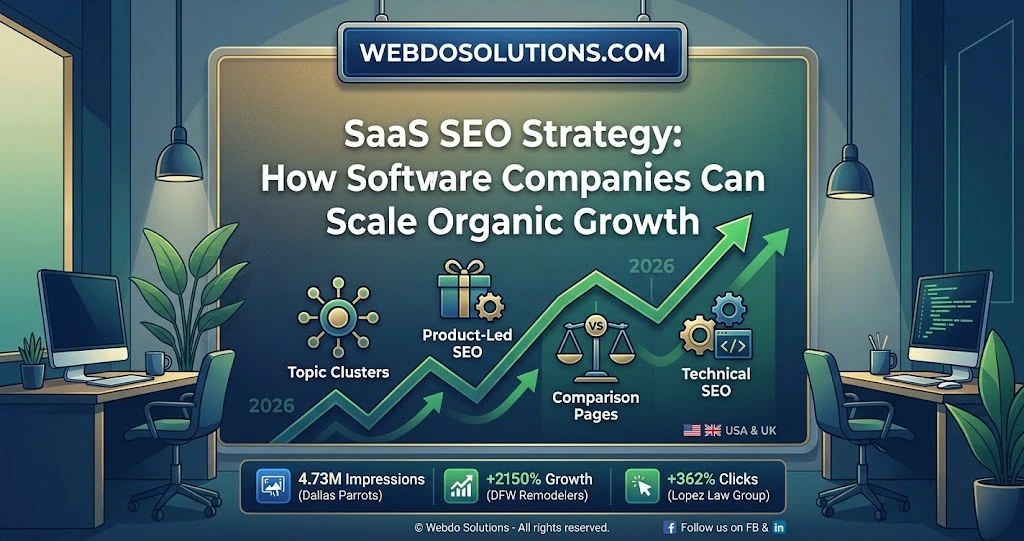
Building a SaaS SEO strategy that drives sustainable organic growth is one of the highest-leverage investments a software company can make. Unlike paid advertising that stops generating leads the moment you pause your budget, organic search compounds over time — every piece of content, every optimised page, and every backlink earned continues working for your business months and years after the initial investment.
Yet many SaaS companies struggle with SEO because the playbook that works for local businesses, ecommerce stores, or media sites does not translate directly to software. SaaS marketing requires a unique approach that maps content to complex buyer journeys, addresses multiple decision-makers, and competes in crowded markets where well-funded competitors are already dominating search results.
Whether you are a seed-stage startup in Austin, Texas, or a scaling B2B platform in Manchester, UK, this guide provides a complete framework for building a SaaS SEO strategy that drives qualified traffic, trial signups, and revenue growth. Need expert help building your software company’s organic presence? Webdo Solutions specialises in SaaS development and digital marketing for software businesses.
Need a professional SEO strategy tailored to your business?
Get a free SEO audit from Webdo Solutionsand find out where you stand today.
What Is SaaS SEO?
SaaS SEO is the practice of optimising a software-as-a-service company’s website and content to rank in search engines for queries that potential customers use throughout their buying journey. It encompasses product-led content strategies, comparison and alternative pages, technical documentation optimisation, and B2B content marketing designed to attract, educate, and convert software buyers through organic search channels.
Why SaaS Companies Need a Different SEO Approach
Software company SEO differs from traditional SEO in several fundamental ways. Understanding these differences is essential before building your strategy.
Complex Buyer Journeys
SaaS purchases, particularly in the B2B space, involve multiple stakeholders and lengthy evaluation periods. A project management tool purchase might involve a team lead researching options, a department manager comparing features, an IT team evaluating security, and a CFO approving the budget. Your SEO strategy must create content that serves each of these personas at every stage of their journey.
High Customer Lifetime Value
SaaS businesses typically have high customer lifetime values relative to acquisition costs. This means investing in content that may take six to twelve months to rank is still profitable when a single customer subscribes for years. This long-term ROI calculation justifies more aggressive content investment than most other business models.
Competitive Keyword Landscapes
Popular SaaS categories (CRM, project management, email marketing, accounting software) are among the most competitive keyword spaces on the internet. Companies like HubSpot, Salesforce, and Monday.com have massive content teams and domain authorities. Competing head-on for primary keywords is often futile for smaller SaaS companies.
Product as Content
Unlike physical products, SaaS products can become their own content engines. Free tools, calculators, templates, and interactive features can drive significant organic traffic while simultaneously demonstrating product value — this is product-led SEO in action.
Building Your SaaS SEO Strategy: The Complete Framework
Step 1: Map Your Customer Journey to Search Intent
Start by mapping every stage of your buyer’s journey to the types of searches they perform:
Awareness Stage — The buyer knows they have a problem but is not yet looking for software solutions. – Search queries: “how to manage remote teams effectively”, “why are our projects always late” – Content type: Educational blog posts, guides, industry reports
Consideration Stage — The buyer is actively researching solutions and evaluating categories. – Search queries: “best project management software 2026”, “project management tools for small teams” – Content type: Comparison articles, category lists, buyer’s guides
Decision Stage — The buyer is comparing specific products and ready to purchase. – Search queries: “[your product] vs [competitor]”, “[your product] pricing”, “[your product] reviews” – Content type: Comparison pages, alternative pages, case studies, product pages
Retention Stage — Existing customers searching for help using your product. – Search queries: “[your product] how to create a dashboard”, “[your product] integrations” – Content type: Help documentation, tutorials, webinars, feature update content
Each stage requires different content, different keywords, and different conversion goals. A comprehensive SEO strategy for SaaS addresses all four stages.
Step 2: Build Your Keyword Universe
SaaS keyword research requires categorising keywords by intent and funnel stage. Here is how to build a comprehensive keyword universe:
Bottom-of-Funnel Keywords (Highest Intent)
These are the keywords closest to conversion. Prioritise them even though competition is fierce:
- Brand comparisons: “[Product A] vs [Product B]”
- Alternative keywords: “alternatives to [Competitor]”
- Pricing queries: “[Product] pricing”, “free [category] software”
- Review queries: “[Product] reviews”, “is [Product] worth it”
Middle-of-Funnel Keywords (Evaluation Intent)
These keywords target buyers actively researching solutions:
- Category keywords: “best [category] software”, “top [category] tools 2026”
- Feature keywords: “[feature] software”, “tools with [specific capability]”
- Use case keywords: “[category] for [industry]”, “[category] for small business”
Top-of-Funnel Keywords (Educational Intent)
These keywords have the highest volume but lowest conversion rates:
- How-to keywords: “how to [problem your product solves]”
- Definition keywords: “what is [concept related to your product]”
- Strategy keywords: “[topic] strategy”, “[topic] best practices”
Step 3: Create Product-Led Content
Product-led SEO is the most powerful SaaS content strategy because it simultaneously drives traffic and demonstrates product value. Here is how to implement it:
Free Tools and Calculators
Build free tools that solve a specific problem your target audience faces. These tools attract backlinks naturally, rank for high-intent keywords, and introduce users to your product ecosystem.
Examples: – An email marketing platform creates a subject line tester tool – A project management tool creates a sprint planning calculator – An HR platform creates a salary benchmarking tool
Templates and Resources
Create downloadable templates that your audience needs for their work. Template pages rank well for long-tail keywords and generate high-quality leads:
- “Free project plan template”
- “Marketing budget template Excel”
- “Employee onboarding checklist template”
Interactive Features
Build interactive content that engages users and provides personalised value:
- ROI calculators that show potential savings from using your product
- Assessment tools that diagnose problems your software solves
- Benchmarking tools that compare user metrics to industry standards
Step 4: Build Comparison and Alternative Pages
Comparison page SEO is arguably the highest-ROI SaaS content type. These pages target buyers who are actively evaluating solutions and ready to make a decision.
“[Your Product] vs [Competitor]” Pages
Create dedicated pages comparing your product with each major competitor. Structure these pages with:
- A fair, balanced feature comparison table
- Honest assessment of where each product excels
- Use case recommendations (e.g., “Choose [Competitor] if you need X; choose [Your Product] if you need Y”)
- Customer testimonials and case study data
- Clear pricing comparison
“Best [Category] Software” Pages
Create comprehensive roundup articles for your category. While this may seem counterintuitive (featuring competitors), these pages build topical authority, rank for high-volume keywords, and position your product within the market context.
“[Competitor] Alternatives” Pages
Target users who are dissatisfied with competitors or exploring options. These pages should address common complaints about the competitor and explain how your product addresses those pain points.
Step 5: Develop Your Content Pillar Strategy
SaaS content marketing works best when organised into topic clusters. Each cluster consists of a pillar page (comprehensive overview) supported by multiple related blog posts.
Example cluster for a project management SaaS:
Pillar page: “The Complete Guide to Project Management” (targets “project management”) Supporting posts: – “Agile vs Waterfall: Which Project Management Methodology Is Right for Your Team?” – “How to Create a Project Timeline That Keeps Everyone on Track” – “10 Project Management KPIs Every Manager Should Track” – “Remote Project Management: Best Practices for Distributed Teams” – “Project Management for Small Businesses: A Practical Guide”
Each supporting post links back to the pillar page and to other relevant posts within the cluster, building topical authority that signals expertise to search engines and AI search engines alike.
Step 6: Optimise Your Product and Pricing Pages
Your product and pricing pages are your most important conversion assets. Optimise them for both search and conversion:
Product Pages
- Target feature-specific keywords in page titles and H1s
- Include detailed feature descriptions with benefit-oriented language
- Add customer testimonials and social proof
- Implement Product schema markup
- Include comparison elements showing advantages over alternatives
Pricing Pages
- Target “ pricing” keywords
- Clearly display all plan options and features
- Include FAQ sections addressing common pricing questions
- Add trust signals (money-back guarantees, free trial offers)
- Implement pricing schema markup
Step 7: Build Authority Through Link Building
B2B SaaS growth through SEO requires building genuine domain authority. Here are the most effective link-building strategies for SaaS companies:
Original Research and Data
Publish original research, surveys, and data analyses that journalists and bloggers want to reference. The cost of conducting a survey is quickly recouped through the dozens of backlinks the research attracts.
Guest Thought Leadership
Contribute expert articles to industry publications, technology blogs, and business media. Focus on publications your target audience reads, not just high-DA sites.
Integration Partnerships
Every SaaS integration partner is a potential backlink source. Create co-marketing content, integration documentation pages, and partner spotlights that earn links from partner websites.
Product-Led Link Earning
The free tools and templates mentioned in Step 3 are also powerful link magnets. Useful tools attract links from resource pages, roundup articles, and social media shares.
Step 8: Technical SEO for SaaS Websites
SaaS websites have unique technical SEO challenges that require attention:
JavaScript Rendering
Many SaaS websites are built with JavaScript frameworks (React, Angular, Vue) that can create crawling and indexing issues. Implement server-side rendering (SSR) or pre-rendering to ensure search engines can access all content.
Faceted Navigation
If your product has a directory, marketplace, or searchable database component, implement proper faceted navigation with canonical tags, noindex directives, and crawl budget optimisation.
Documentation SEO
Your product documentation can drive significant long-tail traffic. Ensure documentation pages are: – Crawlable and indexable – Well-structured with clear headings – Interlinked with related documentation – Updated regularly
At Webdo Solutions, our website development services address these technical challenges as part of every SaaS build.
International SEO
For SaaS companies serving both the United States and United Kingdom markets (and beyond), implement: – Hreflang tags for language and region targeting – Localised content for different markets (US English vs UK English, local examples) – Regional pricing pages – Country-specific case studies and testimonials.
Measuring SaaS SEO Success
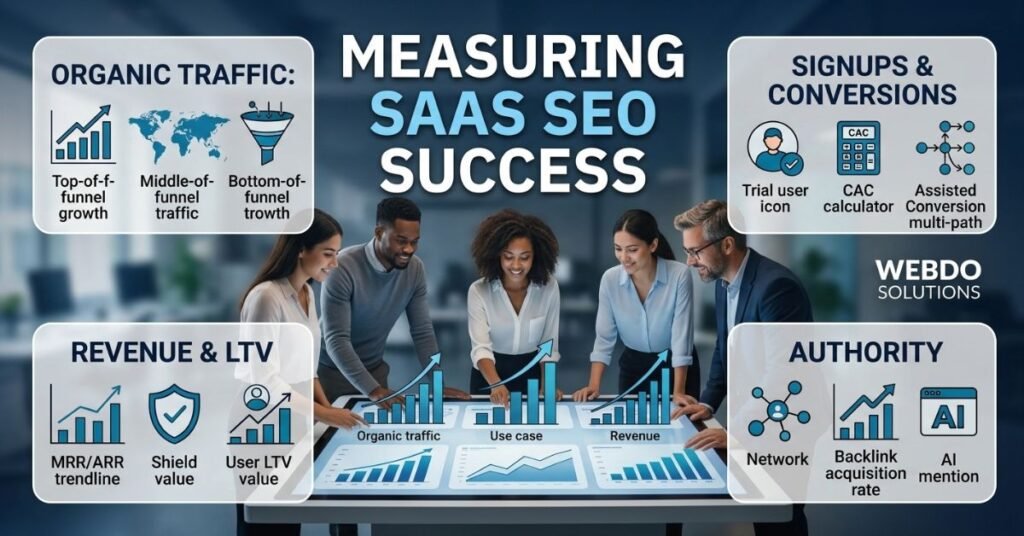
Track these SaaS-specific SEO metrics to measure the effectiveness of your strategy:
Traffic Metrics
- Organic traffic by funnel stage (awareness, consideration, decision)
- Organic traffic to product and pricing pages
- Traffic from comparison and alternative keywords
Conversion Metrics
- Organic trial signups and demo requests
- Organic traffic to signup conversion rate
- Assisted conversions (organic touch in multi-channel conversions)
Revenue Metrics
- Customer acquisition cost (CAC) from organic search
- Organic channel contribution to MRR/ARR
- Organic customer lifetime value (LTV)
Authority Metrics
- Domain authority growth
- Backlink acquisition rate
- Branded search volume growth
- AI search citations and mentions
Case Studies: SaaS and Software Company Growth
At Webdo Solutions, we work with SaaS and software companies to build organic growth engines. Our integrated approach combining SEO, AEO, and GEO has delivered remarkable results across industries.
For Dallas Parrots, an ecommerce platform, our SEO strategy grew search impressions from 219K to 4.73M — demonstrating how product-focused content and technical SEO can scale visibility dramatically.
Our work with Lopez Law Group showcased how a methodical content and SEO approach drives tangible business results: +362% organic traffic and 100+ first-page rankings. While not a SaaS client, the principles of topic clustering, authority building, and conversion optimisation apply equally to software companies.
View our complete portfolio of results to see how we help businesses scale through organic search.
Verified Search Console Performance
Real-world metrics & Search Console screenshots from Webdo Solutions portfolio data (USA & UK)
Impressions (from 219K)
Organic Clicks Growth
65+ Page-1 Keywords
Clicks across 25+ cities
 Dallas Parrots (4.73M Impressions)
 Lopez Law Group (+362% Clicks)
 DFW Remodelers (+2,150% Clicks)
| Client / Project | Market | Metric Tracked | Before | After / Result |
|---|---|---|---|---|
| Dallas Parrots | USA | Impressions | 219K | 4.73M |
| DFW Property Remodelers | USA | Clicks | Baseline | +2,150% |
| Lopez Law Group | USA | Clicks | Baseline | +362% |
| XO Cabs | UK | Traffic | Baseline | +340% |
| Hiq Furnishings | UK | Impressions (90 Days) | 0 | 17K |
| FintechZoom Official | USA | Impressions (60 Days) | 0 | 88K |
| Weight Lift Calculator | USA | Clicks | Baseline | +3,104% |
Common SaaS SEO Mistakes to Avoid
Ignoring Bottom-of-Funnel Content
Many SaaS companies focus exclusively on top-of-funnel educational content. While this drives traffic, it often does not convert. Balance your content mix with high-intent comparison, alternative, and product-focused pages.
Neglecting Technical SEO
SaaS websites built on modern JavaScript frameworks often have crawling and rendering issues that prevent search engines from indexing content. Regular technical audits are essential.
Inconsistent Content Publishing
SEO compounds over time, but only with consistent effort. Publishing a burst of content followed by months of silence undermines your strategy. Establish a sustainable publishing cadence.
Not Localising for Target Markets
If you serve customers in both the US and UK, create localised content that addresses each market’s specific needs, regulations, and search behaviors. The same topic may require different examples, terminology, and cultural references.
Copying Competitor Content
In competitive SaaS markets, creating content that merely matches competitors guarantees mediocrity. Differentiate through original research, unique perspectives, proprietary data, and deeper analysis.
Frequently Asked Questions
How is SaaS SEO different from other SEO?
SaaS SEO differs from traditional SEO in several key ways. The buyer journey is longer and involves multiple decision-makers, requiring content for every funnel stage. Keyword competition tends to be intense, necessitating more strategic targeting and stronger authority building. SaaS products themselves can become content through free tools, templates, and interactive features. And the high customer lifetime value of SaaS subscriptions justifies more aggressive long-term content investment than most other business models.
What content should a SaaS company create?
A SaaS company should create a balanced mix of content across the entire buyer journey. Bottom-of-funnel content (comparison pages, alternative pages, pricing content) drives the most direct conversions. Middle-of-funnel content (buyer’s guides, category roundups, use case pages) captures evaluators. Top-of-funnel content (educational blogs, guides, thought leadership) builds awareness and authority. Product-led content (free tools, templates, calculators) simultaneously drives traffic and demonstrates product value.
How long before SaaS SEO shows ROI?
Most SaaS companies begin seeing measurable SEO results within four to six months of consistent effort, with significant ROI typically materialising between nine and eighteen months. Bottom-of-funnel content like comparison and alternative pages often ranks and converts fastest. Top-of-funnel content takes longer to rank but builds the authority foundation that supports all other content. The compounding nature of SEO means that results accelerate over time — a twelve-month investment delivers disproportionately more value than the sum of twelve individual months.
What is the minimum SEO budget for a SaaS company?
The minimum effective SEO budget for a SaaS company varies by market competitiveness and growth goals. Early-stage startups can begin with a focused strategy covering technical SEO, five to ten comparison and alternative pages, and a content publishing cadence of four to eight articles per month. This typically requires a dedicated content manager or agency partnership. Mid-stage SaaS companies competing in established categories should invest in more aggressive content production, link building, and technical optimisation to gain ground against established competitors.
Should SaaS companies do SEO in-house or outsource?
Both approaches can work, and many successful SaaS companies use a hybrid model. In-house teams offer deep product knowledge and faster iteration, while agencies like Webdo Solutions bring broader SEO expertise, established processes, and scalability. The optimal approach depends on your company’s size, budget, and the competitive intensity of your market. Early-stage companies often benefit from agency partnerships that provide immediate expertise without the overhead of building an internal team.
Conclusion: Build Your SaaS SEO Engine Today
A well-executed SaaS SEO strategy is the most cost-effective growth channel available to software companies. By mapping content to buyer journeys, creating product-led content, building comparison pages, and consistently publishing high-quality material, you can build an organic growth engine that compounds over time and reduces your dependence on paid acquisition.
The companies that invest in SaaS SEO today will dominate their categories in search results — both traditional and AI-powered — tomorrow.
Webdo Solutions helps SaaS and software companies across the United States and United Kingdom build scalable organic growth strategies. From custom SaaS development to comprehensive SEO services, we provide everything your software business needs to scale.
Ready to build your SaaS growth engine? Contact Webdo Solutions for a free SEO audit and strategy consultation.
About the Author: Ozair Sharif is the Founder and CEO of Webdo Solutions, a full-service digital marketing agency specializing in SEO, AEO, GEO, and website development for businesses across the United States and United Kingdom.