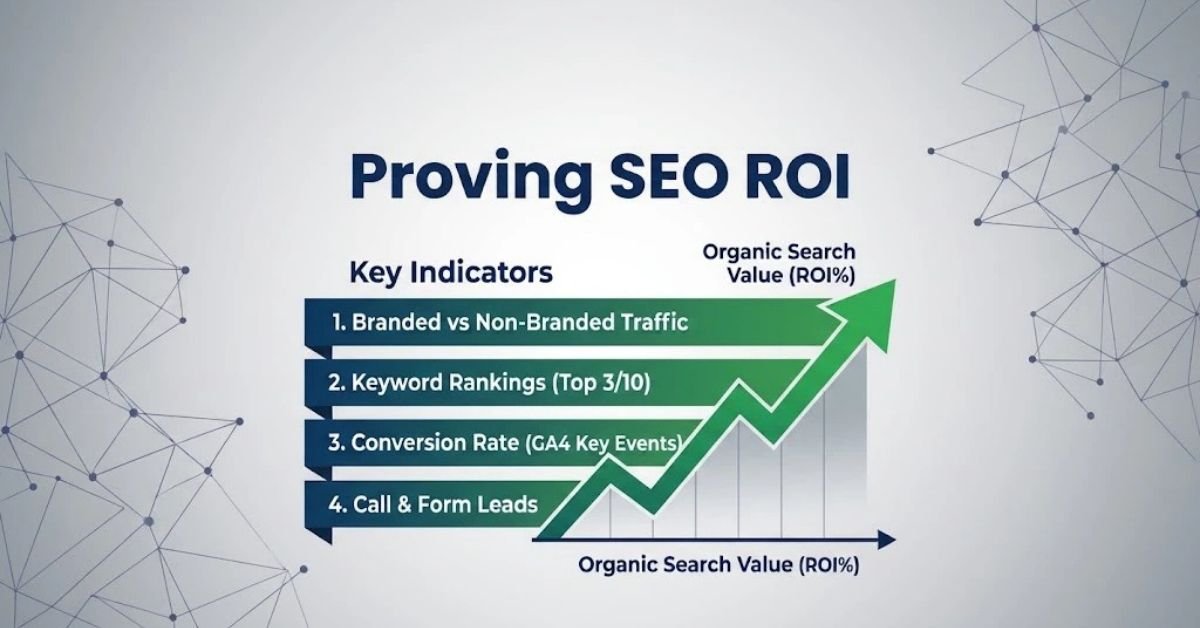
Measuring SEO ROI is one of the most important — and most misunderstood — aspects of digital marketing. Every business owner and marketing director asks the same question: is our investment in search engine optimization actually paying off? Unlike paid advertising where you can trace a click directly to a sale, organic search operates on longer timelines and involves multiple touchpoints that make attribution more complex.
Yet the businesses that master SEO metrics and reporting are the ones that continue investing in organic search while competitors cut budgets during downturns. When you can demonstrate clear return on investment, SEO moves from a discretionary expense to a strategic growth driver with predictable, compounding returns.
Whether you run a small business in Houston, Texas, or manage marketing for a mid-size company in Birmingham, UK, this guide provides a practical framework for measuring, reporting, and proving the value of your SEO investment. At Webdo Solutions, we believe in transparent, data-driven SEO — and we help our clients across the United States and United Kingdom build reporting systems that make the business case for organic search crystal clear.
Need a professional SEO strategy tailored to your business?
Get a free SEO audit from Webdo Solutionsand find out where you stand today.
What Is SEO ROI?
SEO ROI (Return on Investment) is a financial measurement that quantifies the revenue or business value generated by organic search engine optimisation activities relative to the total cost invested. It is calculated by comparing the monetary value of organic traffic, conversions, and revenue against the total expenditure on SEO services, content creation, technical optimisation, and related tools over a defined period.
Why Measuring SEO ROI Is Challenging
Before diving into the how, it is important to acknowledge why SEO ROI measurement is inherently more complex than other marketing channels.
Long Time Horizons
SEO is a long-term investment. A blog post published today might not rank on page one for six months. A technical optimisation implemented this quarter might show results next quarter. This lag between investment and return makes month-to-month ROI calculations misleading.
Multi-Touch Attribution
Rarely does a customer discover your business through organic search and convert immediately. A typical journey might involve:
- Finding a blog post through Google search (organic touch)
- Returning later through a social media link (social touch)
- Clicking a retargeting ad (paid touch)
- Searching your brand name and converting (organic touch)
In this scenario, SEO deserves credit for the initial discovery and the final conversion, but standard last-click attribution would assign all value to the last organic search.
Compound Effects
SEO builds on itself. The content you create today supports the authority that helps future content rank faster. The backlinks you earn this year continue passing value for years. This compounding effect means the true ROI of SEO increases over time, but capturing this in a simple formula is difficult.
Non-Revenue Value
Not all SEO value translates directly to revenue. Brand awareness from ranking for top-of-funnel keywords, market research insights from search data, competitive intelligence, and reduced customer acquisition costs all represent real business value that is harder to quantify.
The SEO ROI Formula
The basic formula for calculating SEO ROI is straightforward:
SEO ROI = (Revenue from Organic Search – Cost of SEO) / Cost of SEO × 100
For example: – Revenue attributed to organic search: $50,000 per month – Total SEO investment: $5,000 per month – SEO ROI = ($50,000 – $5,000) / $5,000 × 100 = 900%
While the formula is simple, accurately determining the inputs — particularly “Revenue from Organic Search” — requires a robust measurement framework.
Setting Up Your SEO Measurement Framework
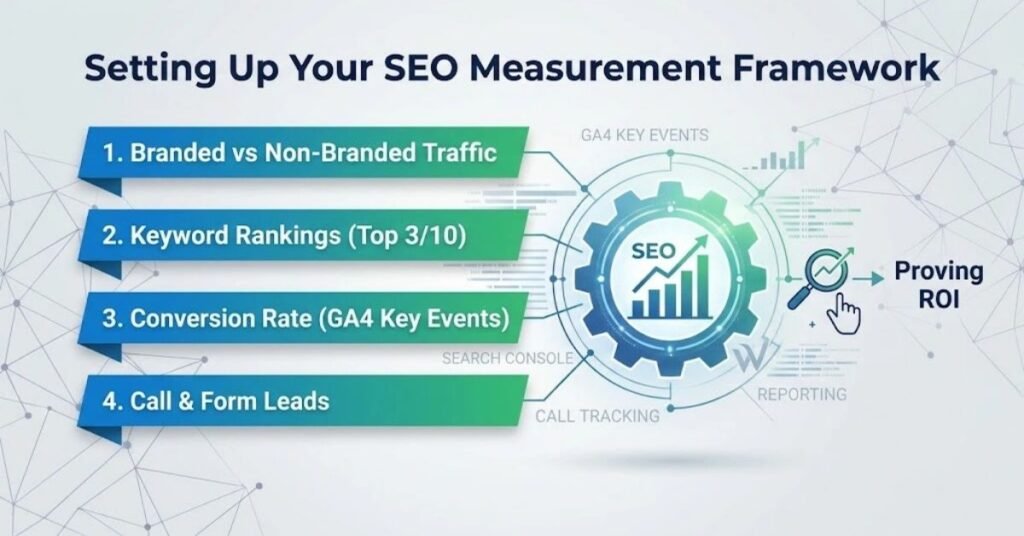
Step 1: Define Your Conversion Goals
Before measuring anything, define what constitutes a conversion for your business:
Ecommerce businesses: – Product purchases – Average order value – Revenue per organic session
Lead generation businesses: – Contact form submissions – Phone calls from website – Free audit/consultation requests – Email newsletter signups – WhatsApp enquiries
SaaS businesses: – Free trial signups – Demo requests – Account creations – Subscription conversions
Each conversion type should have a monetary value assigned to it. For lead-generation businesses, calculate this by:
Lead Value = Average Customer Value × Lead-to-Customer Conversion Rate
If your average customer is worth $5,000 and 20% of leads become customers, each lead is worth $1,000.
Step 2: Configure Google Analytics Properly
Google Analytics 4 (GA4) is your primary tool for measuring organic search performance. Ensure the following are configured:
Conversion Tracking
Set up conversion events for every meaningful action on your website. In GA4, these are configured as “Key Events”: – Form submissions – Phone number clicks – WhatsApp button clicks – Purchase completions – Checkout initiations
Revenue Attribution
For ecommerce, ensure purchase revenue is being tracked accurately through GA4’s ecommerce tracking. For lead generation, assign monetary values to each conversion event based on your lead value calculation.
Channel Grouping
Verify that GA4 is correctly categorising traffic sources. Organic search traffic from Google, Bing, and other search engines should be grouped under “Organic Search” in the default channel grouping.
Landing Page Analysis
Set up custom reports that show organic search performance by landing page, so you can identify which specific pages and content pieces drive the most value.
Step 3: Connect Google Search Console
Google Search Console provides data that Google Analytics cannot:
- Search queries — the actual keywords people use to find your site
- Click-through rates — how often searchers click your result
- Average positions — your ranking positions for target keywords
- Impressions — how often your pages appear in search results
Connecting Search Console to GA4 enriches your organic search data significantly.
Step 4: Implement Call Tracking
For businesses where phone calls are a primary conversion channel, implement call tracking software (CallRail, Invoca, or similar) with dynamic number insertion. This allows you to attribute phone call leads to specific organic search sessions, pages, and even keywords.
Without call tracking, a significant portion of organic search conversions go untracked and unmeasured.
Key SEO Metrics and KPIs to Track
Organise your SEO reporting around four categories of metrics, each telling a different part of the story.
Traffic Metrics (Volume)
These metrics measure how much organic search visibility and traffic your SEO efforts generate:
- Organic sessions — total visits from organic search
- Organic users — unique visitors from organic search
- Organic impressions — how often your pages appear in search results
- Click-through rate (CTR) — percentage of impressions that result in clicks
- Branded vs non-branded traffic — traffic from brand searches vs generic keyword searches
Non-branded organic traffic is the best indicator of true SEO growth, as branded search is influenced by other marketing activities.
Ranking Metrics (Visibility)
These metrics show your position in search results for target keywords:
- Keyword rankings — positions for target keywords tracked over time
- Keywords in top 3 — number of keywords ranking in positions 1-3
- Keywords in top 10 — number of keywords on page one
- Featured snippet ownership — queries where you hold position zero
- Share of voice — your organic visibility compared to competitors
Engagement Metrics (Quality)
These metrics indicate whether organic traffic is quality traffic:
- Bounce rate / engagement rate — percentage of visitors who engage with your site
- Pages per session — how many pages organic visitors view
- Average session duration — how long organic visitors stay
- Scroll depth — how far visitors scroll through content
Conversion Metrics (Value)
These are the metrics that directly measure business impact:
- Organic conversions — total conversions from organic search
- Organic conversion rate — percentage of organic visitors who convert
- Organic revenue — total revenue attributed to organic search
- Cost per organic acquisition — total SEO spend divided by organic conversions
- Customer lifetime value from organic — long-term value of customers acquired through SEO
Calculating the True Value of Organic Traffic
One powerful way to communicate SEO value is to calculate what your organic traffic would cost if you had to buy it through Google Ads. This metric, often called “organic traffic value” or “SEO equivalent value,” provides a tangible dollar figure that stakeholders immediately understand.
Method: PPC Equivalent Value
- Export your top-ranking keywords and their monthly search volumes from Google Search Console
- Look up the estimated cost-per-click (CPC) for each keyword using Google Ads Keyword Planner or SEMrush
- Calculate your estimated organic clicks per keyword based on your ranking position and typical CTR
- Multiply clicks × CPC for each keyword
- Sum all values for total organic traffic value
Example:
| Keyword | Monthly Clicks | CPC | Value |
| seo services | 450 | $14.50 | $6,525 |
| website development | 320 | $8.75 | $2,800 |
| digital marketing agency | 280 | $12.00 | $3,360 |
| Total | $12,685/month |
This calculation shows stakeholders that your organic presence delivers $12,685 per month in equivalent paid traffic value — traffic you would have to purchase through Google Ads if your SEO stopped working.
Building SEO Reports That Stakeholders Understand
The way you present SEO data matters as much as the data itself. Different stakeholders need different levels of detail.
Executive Summary (C-Suite / Business Owners)
Keep it to one page with four key numbers: 1. Organic revenue this month (or organic leads and their value) 2. SEO ROI percentage 3. Organic traffic trend (month-over-month and year-over-year) 4. Key wins (new rankings, traffic milestones, conversion improvements)
Business owners care about revenue impact, not keyword rankings. Lead with money.
Marketing Manager Report
Include more detail on: – Channel comparison (organic vs paid vs social vs direct) – Content performance by topic cluster – Keyword movement summary – Competitor visibility trends – Recommended actions for next period
Technical SEO Report
For web development and IT teams: – Core Web Vitals performance – Crawl statistics and error trends – Indexation status and changes – Technical audit findings and resolutions – Page speed improvements
At Webdo Solutions, we provide transparent, customised reporting for every client. Our SEO services include monthly reporting that connects organic search performance directly to business outcomes, so you always know exactly what your investment is delivering.
Real-World SEO ROI: Case Studies
The most compelling way to demonstrate SEO ROI is through real results. Here are examples from the Webdo Solutions portfolio:
Dallas Parrots
4.73M
Impressions (Up from 219K)
Lopez Law Group
+362%
Clicks across 25+ Texas cities
DFW Property Remodelers
+2,150%
Clicks & +8,047% Impressions
XO Cabs UK
#1 Maps
65+ Page-1 Keywords

Lopez Law Group
Fernandojlopez.com Search Console proof showing massive organic growth and local entity visibility.

Dallas Parrots
Ecommerce SEO performance tracking scale from 219K to 4.73M impressions.

DFW Property Remodelers
Contractor SEO result showcasing exponential click increases through geo-targeted landing pages.

XO Cabs
UK local transport SEO results highlighting top map pack positioning.
Lopez Law Group — Legal SEO
- Result: +362% organic traffic growth, 100+ first-page Google rankings
- Impact: Significant increase in qualified lead generation for a Texas law firm
- ROI indicator: Cost per lead from organic search dramatically lower than PPC alternatives in the legal industry, where cost-per-click for keywords like “personal injury lawyer” can exceed $100
Dallas Parrots — Ecommerce SEO
- Result: Impressions grew from 219K to 4.73M
- Impact: Massive increase in product visibility and organic revenue
- ROI indicator: Over 2,000% increase in search visibility translating directly to ecommerce sales volume
DFW Property Remodelers — Contractor SEO
- Result: +8,047% impression growth
- Impact: Dominated local search for home remodelling services in DFW
- ROI indicator: Organic leads replaced expensive paid advertising as primary customer acquisition channel
XO Cabs UK — Local SEO
- Result: #1 Google Maps position, +340% traffic growth
- Impact: Top visibility in UK transport sector
- ROI indicator: Local SEO investment delivered consistent lead flow at a fraction of the cost of taxi industry PPC competition
Common Mistakes in SEO ROI Measurement
Measuring Too Early
Evaluating SEO ROI after one or two months is like judging a marathon runner at the 100-metre mark. Most SEO strategies need a minimum of four to six months before generating meaningful, measurable returns. Setting expectations appropriately from the outset prevents premature budget cuts.
Ignoring Assisted Conversions
Last-click attribution systematically undervalues SEO by ignoring the role organic search plays in the early and middle stages of the buyer journey. Review assisted conversion data in GA4 to understand the full impact of organic search on your conversion funnel.
Not Accounting for Brand Building
SEO builds brand awareness that benefits all marketing channels. When organic content introduces someone to your brand who later converts through a paid ad or direct visit, SEO does not receive credit in standard reporting. Consider this halo effect when evaluating ROI.
Comparing to Wrong Benchmarks
Comparing SEO ROI to PPC ROI on a one-month basis is misleading. PPC delivers immediate but temporary results — stop spending and traffic stops. SEO delivers slower initial results but compounds over time. Compare on a twelve-month or lifetime basis for an accurate picture.
Overlooking Cost Savings
SEO reduces customer acquisition costs over time. As organic rankings strengthen, you can reduce PPC spending on keywords where you rank well organically. This cost-saving benefit should be factored into ROI calculations.
SEO ROI Benchmarks: What to Expect
While ROI varies significantly by industry, competitive landscape, and starting position, here are general benchmarks for SEO performance:
Timeline Expectations
- Months 1-3: Foundation work, minimal traffic impact
- Months 4-6: Early ranking improvements, traffic growth begins
- Months 7-12: Significant ranking gains, measurable lead/revenue impact
- Year 2+: Compounding returns, strong positive ROI
ROI Benchmarks by Industry
- Legal services: ROI of 500-1,500% (high CPCs make organic traffic extremely valuable)
- Ecommerce: ROI of 300-800% (dependent on average order value and conversion rate)
- SaaS: ROI of 400-1,200% (high LTV justifies extended investment periods)
- Home services: ROI of 400-1,000% (strong local search demand with high conversion intent)
- Healthcare: ROI of 300-700% (high patient lifetime value, regulated advertising alternatives)
These ranges assume consistent investment over twelve or more months with a competent SEO strategy.
How to Present the Business Case for SEO
When seeking buy-in for SEO investment from leadership or stakeholders, frame the conversation around business outcomes:
The Cost of Not Doing SEO
Calculate what you are currently paying for traffic through other channels and what it would cost to acquire the same volume and quality of traffic through paid advertising alone. This “cost of alternatives” approach often makes the SEO investment case compelling.
The Compounding Advantage
Unlike paid advertising where costs remain constant or increase over time, SEO costs remain relatively stable while results compound. A blog post that ranks on page one continues generating traffic and conversions for years after the initial investment in writing it.
The Competitive Risk
If your competitors are investing in SEO and you are not, they will systematically capture the organic search traffic that could be driving your business growth. Show competitor visibility trends to illustrate the cost of inaction.
The AI Search Opportunity
With the rise of AI search engines, businesses that invest in comprehensive search visibility (SEO + AEO + GEO) are positioning themselves for the next generation of search. This forward-looking investment protects against the shift in how consumers discover and evaluate businesses.
Frequently Asked Questions
What is a good ROI for SEO?
A good SEO ROI depends on your industry, competitive landscape, and the maturity of your SEO programme. Generally, an established SEO programme should target a minimum of 300-500% ROI, meaning every dollar invested returns three to five dollars in organic search value. Many businesses achieve significantly higher returns — 800% to 1,500% or more — particularly in industries with high customer lifetime values or expensive PPC alternatives. New SEO programmes may show negative or break-even ROI in the first six months before turning profitable.
How long before SEO becomes profitable?
Most SEO programmes become profitable between six and twelve months after consistent investment begins. The exact timeline depends on your website’s starting position, competitive landscape, and investment level. Websites with existing authority and content may see returns faster, while new websites in competitive markets may take twelve months or more. The key insight is that SEO profitability accelerates over time — year two is typically far more profitable than year one due to the compounding nature of organic search visibility.
What metrics should I track for SEO?
Track metrics across four categories for a complete picture of SEO performance. Traffic metrics: organic sessions, users, impressions, and click-through rates. Ranking metrics: keyword positions, top-three and top-ten keyword counts, and share of voice versus competitors. Engagement metrics: bounce rate, pages per session, and average session duration for organic visitors. Conversion metrics: organic conversions, conversion rate, revenue attributed to organic search, and cost per organic acquisition. The most important metric for business stakeholders is organic revenue or organic lead value — always lead reporting with the financial impact.
Can I measure SEO ROI for local businesses?
Absolutely. Local businesses can measure SEO ROI by tracking phone calls from organic search (using call tracking), form submissions and WhatsApp enquiries attributed to organic traffic, Google Business Profile actions (calls, direction requests, website clicks), foot traffic from map searches (where trackable), and comparing these against the total SEO investment. Local businesses often see especially strong SEO ROI because local keywords tend to have high purchase intent and local PPC costs have risen significantly in recent years.
How does SEO ROI compare to PPC ROI?
In the short term (one to three months), PPC typically delivers higher ROI because results are immediate. Over the medium term (six to twelve months), SEO ROI catches up as rankings build and organic traffic grows. Over the long term (twelve months and beyond), SEO consistently outperforms PPC in ROI because organic rankings continue delivering value without ongoing per-click costs, while PPC costs remain constant or increase. The most cost-effective approach for most businesses is investing in both channels strategically, using PPC for immediate visibility and SEO for sustainable, compounding growth.
Conclusion: Make SEO Your Most Measurable Marketing Channel
SEO ROI measurement is not only possible — when done properly, it transforms SEO from a vague “long-term investment” into one of your most measurable and predictable marketing channels. By setting up proper tracking, calculating true organic traffic value, connecting SEO activities to business outcomes, and reporting in language stakeholders understand, you can build sustained support for the organic search investment that drives lasting competitive advantage.
The businesses that measure SEO rigorously are the ones that continue investing in it — and reaping the compounding returns that follow.
At Webdo Solutions, every SEO engagement includes transparent, results-focused reporting that proves the value of your investment. We have helped businesses across the United States and United Kingdom build organic search programmes with measurable, significant returns.
Ready to see what SEO can deliver for your business? Contact Webdo Solutions for a free SEO audit and ROI projection.
About the Author: Ozair Sharif is the Founder and CEO of Webdo Solutions, a full-service digital marketing agency specializing in SEO, AEO, GEO, and website development for businesses across the United States and United Kingdom.