

Every business owner running a digital marketing strategy eventually faces the same question: should you invest in SEO vs PPC? Both channels put your business in front of people who are actively searching for your products or services, but they work in fundamentally different ways — and choosing the wrong one (or the wrong balance) can cost you thousands of pounds or dollars in wasted spend. At Webdo Solutions, we help businesses across the United States and United Kingdom navigate this decision every day. In this guide, we will break down the real differences between organic and paid search so you can make an informed choice.
Not sure where to allocate your marketing budget? Get a free search marketing audit from Webdo Solutions and we will show you exactly where the biggest opportunities lie.
Need a professional SEO strategy tailored to your business?
Get a free SEO audit from Webdo Solutionsand find out where you stand today.
What Is SEO vs PPC?
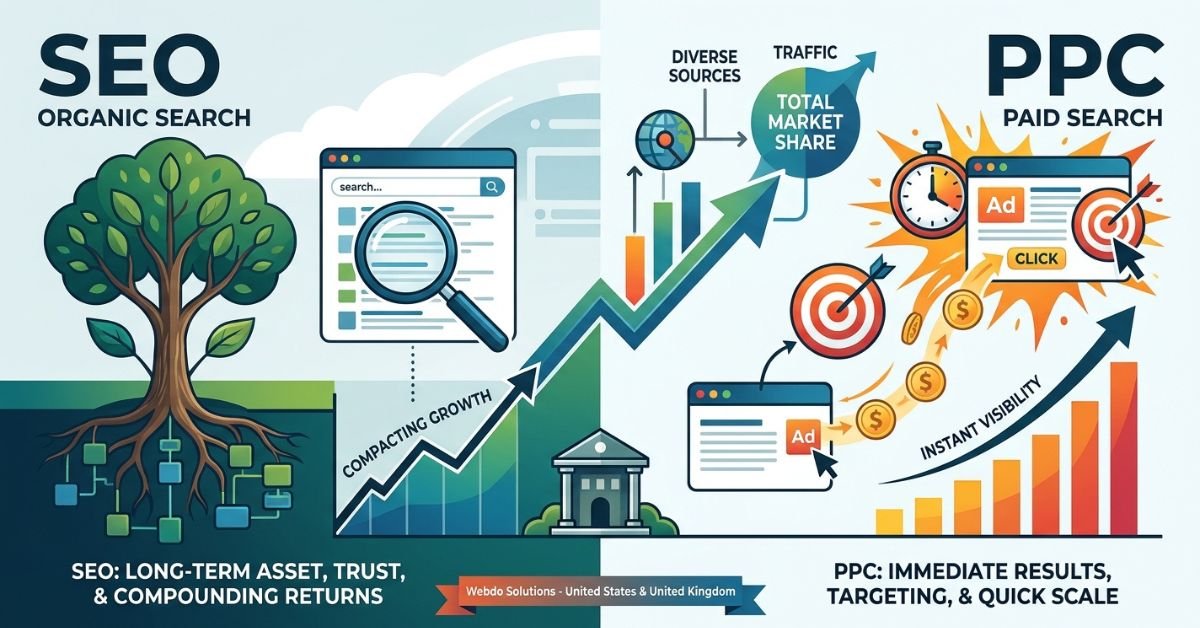
SEO (Search Engine Optimization) is the practice of optimizing your website to rank higher in organic (unpaid) search engine results, attracting free traffic over time through content, technical improvements, and authority building. PPC (Pay-Per-Click) is a paid advertising model where you bid on keywords and pay each time a user clicks your ad, appearing instantly at the top of search results. Businesses use SEO for compounding long-term growth and PPC for immediate, targeted visibility.
How Organic Search Differs From Paid Search
Before comparing ROI, it helps to understand the mechanics of each channel.
How SEO Works
When you invest in SEO, you are building assets — optimised pages, authoritative content, technical infrastructure, and backlink profiles — that earn rankings over time. The traffic you receive from organic search is “free” in the sense that you do not pay per click. However, there is an upfront investment in strategy, content creation, and technical optimization.
The key characteristics of organic search traffic:
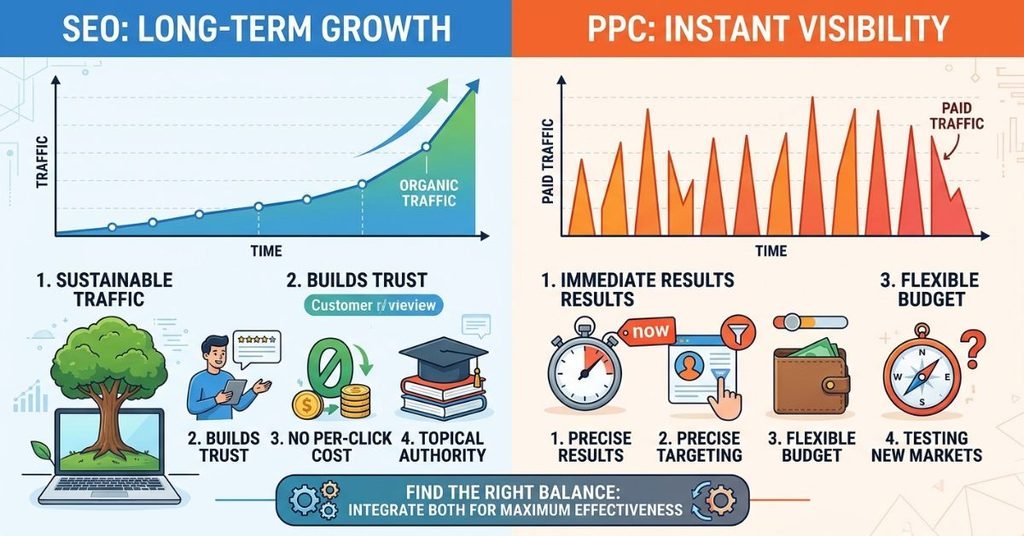
- Compounds over time — A well-optimised page can generate traffic for months or years after publication
- Builds trust and credibility — Users trust organic results more than paid ads
- Requires patience — Meaningful results typically appear within 3-6 months
- No per-click cost — Once you rank, every visitor is essentially free
How PPC Works
PPC advertising — most commonly through Google Ads — places your business at the very top of search results immediately. You select keywords, set bids, write ad copy, and pay each time someone clicks through to your site. The moment you stop paying, your visibility disappears.
The key characteristics of paid search traffic:
- Instant visibility — Your ads can appear within hours of campaign launch
- Precise targeting — Control exactly which keywords, locations, devices, and demographics see your ads
- Predictable costs — You set daily budgets and maximum bids
- No lasting asset — When you stop paying, traffic drops to zero
The Cost Comparison: SEO vs PPC in Real Numbers
One of the biggest factors in the SEO or Google Ads decision is cost. Let us look at how the numbers typically break down.
PPC Cost Reality
In the United States, the average cost per click across all industries on Google Ads is approximately $2.69 for search ads. However, this average masks enormous variation by industry:
| Industry | Average CPC (US) | Average CPC (UK) |
| Legal Services | $6.75 – $50+ | £4.50 – £35+ |
| Insurance | $15.50 – $55+ | £10 – £40+ |
| Home Services | $6.40 – $20+ | £4 – £15+ |
| E-commerce | $1.16 – $5+ | £0.80 – £3.50+ |
| SaaS / Technology | $3.80 – $15+ | £2.50 – £10+ |
For a law firm in the United States spending $10,000 per month on Google Ads at an average CPC of $25, that buys approximately 400 clicks. If their landing page converts at 5 percent, that is 20 leads per month — each costing $500 in ad spend alone. And the moment the budget runs out, the leads stop coming.
SEO Cost Reality
Professional SEO services in the US typically range from $1,500 to $10,000 per month depending on competition and scope. In the UK, equivalent services range from £1,000 to £7,500 per month.
The critical difference: that investment builds a lasting asset. Once your pages rank, the traffic is effectively free. A page ranking in position one for a keyword with 5,000 monthly searches and a 30 percent click-through rate delivers approximately 1,500 visitors per month — indefinitely.
Let us apply this to the law firm example. If their SEO campaign costs $5,000 per month and, after six months, they rank for keywords delivering 3,000 organic visitors per month at a 5 percent conversion rate, that is 150 leads per month at a cost of $33 per lead — and that cost continues to decrease every month the rankings hold.
The Compounding Effect
This is where the long-term SEO argument becomes impossible to ignore. Over a 24-month period:
- PPC at $10,000/month = $240,000 spent → approximately 9,600 clicks → 480 leads → $500 per lead
- SEO at $5,000/month = $120,000 spent → once rankings are established, potentially 30,000+ organic visitors → 1,500+ leads → cost per lead drops every month
The search marketing strategy that wins over time is almost always the one that includes a strong SEO foundation.
When to Choose SEO Over PPC
SEO is the better primary investment when:
You Are Building a Long-Term Brand
If your business plan extends beyond the next quarter, SEO is the foundation that every other marketing channel will benefit from. Organic rankings build brand recognition, establish topical authority, and create a library of content assets that compound in value. Businesses we work with at Webdo Solutions — from legal practices to e-commerce brands — consistently find that SEO becomes their most valuable channel over time.
Your Industry Has Expensive CPCs
If you operate in legal services, insurance, finance, healthcare, or any industry where Google Ads CPCs routinely exceed $10-20 per click, the ROI case for SEO is even stronger. Why pay $50 per click when you could invest that money in building rankings that deliver free traffic permanently?
You Want to Build Trust and Authority
In both the US and UK markets, consumers are increasingly sceptical of paid advertisements. Studies show that approximately 70-80 percent of users skip paid ads entirely and click on organic results instead. If your target audience values credibility — as they do in professional services, healthcare, and B2B — organic visibility carries far more weight.
You Have Patience for Compounding Returns
SEO is not a quick fix. If you understand that the first three to six months are an investment period and you are willing to let the compound effect work in your favour, SEO will outperform PPC on a cost-per-acquisition basis almost every time.
When to Choose PPC Over SEO
PPC is the better choice (or a necessary complement) when:
You Need Immediate Results
Launching a new product? Running a time-sensitive promotion? Entering a new market? PPC delivers traffic within hours. There is no waiting period, no gradual climb through rankings. If speed is your priority, paid search gets you in front of customers immediately.
You Are Testing a New Market or Offer
Before investing months of SEO effort into a new keyword cluster or product category, you can use PPC to validate demand. Run ads for a few weeks, measure conversion rates, and then decide whether the organic investment is worth making.
Your Target Keywords Are Extremely Competitive
Some keywords are so competitive that ranking organically could take 12-18 months or more. In these cases, PPC can fill the gap while your SEO strategy builds momentum. This is particularly common in industries like legal and financial services in major US cities (New York, Los Angeles, Chicago) and UK cities (London, Manchester, Birmingham).
You Have a Generous Budget and Need Scale Quickly
Well-funded startups and enterprises often use PPC to scale customer acquisition rapidly while building their organic presence in parallel. If your unit economics support a higher customer acquisition cost in the short term, PPC can accelerate growth significantly.
The Best Strategy: Combining SEO and PPC
The smartest businesses do not choose one or the other — they use both strategically. Here is how an integrated search marketing strategy works in practice.
Phase 1: PPC for Immediate Visibility (Months 1-3)
Launch targeted PPC campaigns for your highest-converting keywords while your SEO strategy is being built. This generates leads and revenue immediately, giving your business cash flow while organic rankings develop.
Phase 2: SEO Gains Traction (Months 3-6)
As your optimised content begins ranking, organic traffic starts supplementing PPC. You can begin reducing PPC spend on keywords where you are gaining organic visibility, redirecting that budget to keywords where you still need paid support.
Phase 3: SEO Dominance, Strategic PPC (Months 6-12+)
Once your SEO investment matures, organic search should be delivering the majority of your leads at a fraction of the per-lead cost. PPC shifts from a primary channel to a strategic tool — used for retargeting, brand defence, seasonal promotions, and competitive keyword gaps.
This phased approach is exactly what we implement for clients at Webdo Solutions. It is how we helped Lopez Law Group grow organic traffic by 362 percent while maintaining profitable paid campaigns during the ramp-up period. And it is how DFW Property Remodelers achieved an 8,047 percent increase in search impressions — organic growth that no PPC budget could sustainably replicate.
Want to build an integrated search strategy? Talk to our team at Webdo Solutions and let us design a plan that balances immediate ROI with long-term growth.
SEO vs PPC: A Side-by-Side Comparison
| Factor | SEO | PPC |
| Time to Results | 3-6 months | Immediate |
| Cost Model | Monthly retainer/investment | Pay per click |
| Long-Term ROI | High (compounds over time) | Moderate (stops when budget stops) |
| Trust & Credibility | High — users trust organic results | Lower — users often skip ads |
| Traffic After Stopping | Continues for months/years | Stops immediately |
| Targeting Precision | Keyword and intent-based | Keyword, demographic, device, location |
| Scalability | Scales with content and authority | Scales with budget |
| Best For | Brand building, long-term growth | Quick wins, testing, promotions |
Real-World Results: Why SEO Wins Long-Term
The numbers from our client portfolio tell a compelling story about the long-term power of SEO:
- Lopez Law Group — Grew organic traffic by 362 percent and achieved 100+ first-position Google rankings. Their cost per lead from organic search is now a fraction of what they were paying through Google Ads.
- Dallas Parrots — Went from 219,000 to 4.73 million impressions through organic optimization alone. The equivalent paid traffic would have cost tens of thousands of dollars monthly.
- XO Cabs UK — Achieved the number one Google Maps position and grew traffic by 340 percent through local SEO. For a taxi service operating in a fiercely competitive UK market, this organic visibility delivers daily bookings without a single penny spent on ads.
- DFW Property Remodelers — An 8,047 percent increase in search impressions turned a local contractor into a dominant online presence in the Dallas-Fort Worth market.
Verified Search Console Performance Data
Summary of organic growth metrics extracted directly from Webdo Solutions case studies.
| Client | Market | Core Metric / GSC Data | Before | After / Result |
|---|---|---|---|---|
| Lopez Law Group | USA (Texas) | Organic Clicks & Rankings | Baseline | +362% Clicks 100+ #1 Rankings |
| Dallas Parrots | USA (Dallas) | Search Console Impressions | 219K | 4.73M Impressions +468% Clicks / Pos 18.4 → 6.8 |
| XO Cabs UK | UK (Letchworth) | Google Maps & Traffic | Baseline | #1 on Maps +340% Traffic / 65+ Keywords |
| DFW Property Remodelers | USA (Dallas-Fort Worth) | Search Impressions & Clicks | Baseline | +2,150% Clicks +8,047% Impressions |
Each of these businesses could have spent their marketing budget on PPC alone. Instead, by investing in SEO, they built sustainable, compounding assets that continue delivering returns long after the initial investment.
How to Get Started With SEO
If you have decided that SEO should be a core part of your search marketing strategy (and it should), here is how to take the first step:
- Audit your current position — Understand where your site stands today. A comprehensive SEO audit will reveal technical issues, content gaps, and keyword opportunities.
- Research your keywords — Identify the terms your target customers use and map them to pages on your site. Focus on a mix of high-volume and long-tail keywords.
- Optimise your existing content — Before creating new pages, ensure your current content is properly optimised with the right title tags, meta descriptions, heading structures, and internal links.
- Create a content strategy — Plan a publishing calendar that builds topical authority in your core service areas. Every post should link back to your key service pages.
- Invest in technical health — Ensure your website’s technical foundation supports your content strategy. Site speed, mobile responsiveness, structured data, and crawlability all matter.
- Monitor and iterate — SEO is not a set-and-forget activity. Track rankings, traffic, and conversions monthly. Adjust your strategy based on data.
Frequently Asked Questions
Is SEO Cheaper Than PPC?
In the short term, SEO requires an upfront investment that may feel comparable to or even higher than a modest PPC budget. However, over time, SEO becomes dramatically cheaper on a per-lead or per-visitor basis. Once your pages rank, the traffic is free — there is no per-click cost. A PPC campaign costing $10,000 per month stops delivering the moment you pause it. An SEO investment of the same amount builds assets that continue generating traffic for months or years. For most businesses, SEO delivers a lower cost per acquisition within 6-12 months of sustained investment.
Can I Do Both SEO and PPC at the Same Time?
Yes, and in most cases you should. The most effective search marketing strategies combine both channels. PPC provides immediate visibility and allows you to test keywords and offers quickly, while SEO builds the long-term foundation that compounds over time. As your organic rankings improve, you can strategically reduce PPC spend on keywords where you are ranking well and redirect that budget to new opportunities or competitive terms. The combined approach — sometimes called “full-funnel search marketing” — ensures you capture traffic at every stage of the buyer journey.
Which Gives Faster Results — SEO or PPC?
PPC gives faster results without question. You can launch a Google Ads campaign and begin receiving clicks within hours. SEO, by contrast, typically requires three to six months before meaningful ranking improvements appear, and full results often take 12 months or more. However, speed is not the only metric that matters. PPC traffic disappears the moment your budget runs out. SEO traffic compounds and persists. The question is not which is faster — it is which delivers better returns over the timeframe that matters to your business.
How Do I Know If I Am Wasting Money on PPC?
Several warning signs suggest your PPC spend could be better allocated: a consistently high cost per acquisition that exceeds your profit margins, low conversion rates despite high click volumes, click fraud from competitors or bots, and diminishing returns as you scale spend. If you are spending heavily on PPC for keywords where you already rank organically in positions one through three, you may be cannibalising your own free traffic. A comprehensive audit can identify exactly where your PPC budget is working — and where SEO would be a better investment. Contact Webdo Solutions for a free analysis.
Should Small Businesses Focus on SEO or PPC?
For small businesses with limited budgets, SEO typically offers the best long-term return. While PPC can deliver quick wins, the ongoing cost can quickly consume a small marketing budget without building any lasting value. SEO, on the other hand, creates permanent digital assets — optimised pages, content, and authority — that continue working for your business indefinitely. That said, a small, targeted PPC campaign can be valuable for a new business that needs leads immediately while its SEO strategy gains traction.
Conclusion: Build Your Search Strategy on SEO
The SEO vs PPC debate is not really about choosing one over the other. It is about understanding where each channel fits in your overall marketing strategy and allocating your budget accordingly.
For businesses serious about long-term growth in the United States and United Kingdom, SEO should be the foundation. It builds trust, compounds over time, and delivers the lowest cost per acquisition of any digital marketing channel. PPC plays a valuable supporting role — filling gaps, testing markets, and providing immediate visibility when you need it.
At Webdo Solutions, we have helped businesses across both markets build search strategies that balance short-term results with long-term dominance. Our track record — from Lopez Law Group’s 362 percent traffic growth to Dallas Parrots’ 4.73 million impressions — proves that the right SEO investment delivers transformative returns.
Get your free SEO and PPC audit today → Our team will analyse your current search presence and recommend the optimal strategy for your budget, industry, and goals. Reach out via WhatsApp for a quick consultation.
About the Author: Ozair Sharif is the Founder and CEO of Webdo Solutions, a full-service digital marketing agency specializing in SEO, AEO, GEO, and website development for businesses across the United States and United Kingdom.