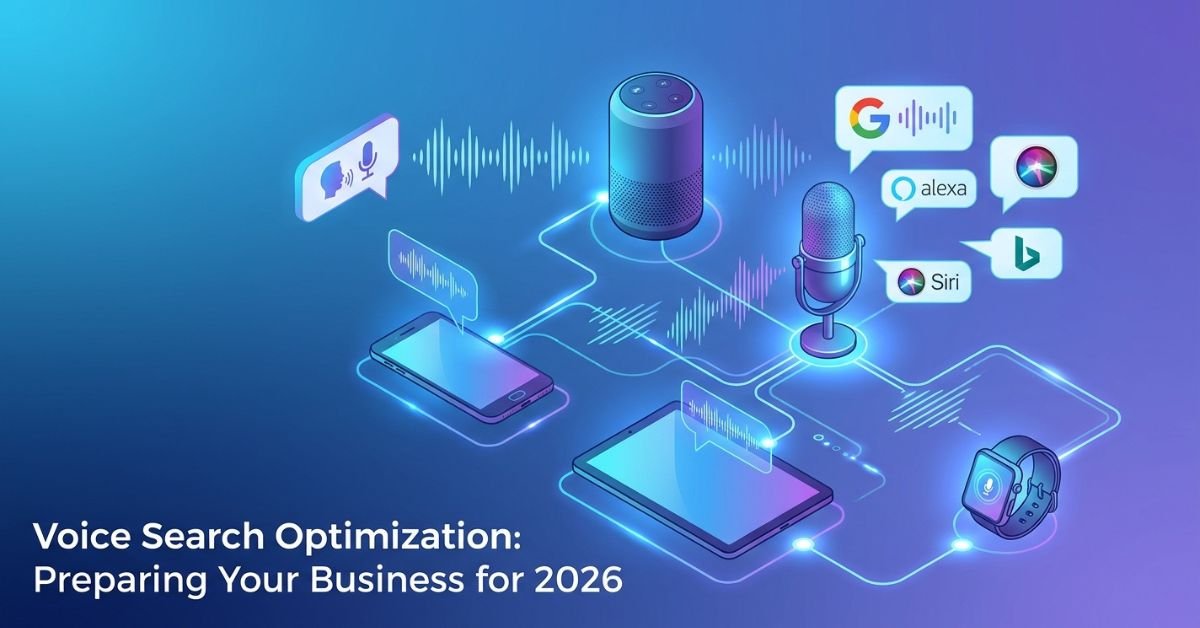
The way people search is changing, and voice search optimization is at the centre of that transformation. Across the United States and United Kingdom, millions of consumers now ask their smartphones, smart speakers, and AI assistants to find businesses, answer questions, and make purchasing decisions — all without typing a single word.
By 2026, an estimated 55% of households in the US own a smart speaker, and the UK figure has surpassed 40%. Google Assistant, Amazon Alexa, Apple Siri, and Samsung Bixby process billions of voice queries monthly. Yet most businesses have not adapted their digital presence for this reality.
Voice search is not a future trend. It is a present reality that is reshaping how customers discover and choose businesses. At Webdo Solutions, voice search optimization is a key pillar of our Answer Engine Optimization services. We help businesses across the US and UK position their content for voice-first discovery. Need to optimize for voice? Talk to our team.
Need a professional SEO strategy tailored to your business?
Get a free SEO audit from Webdo Solutionsand find out where you stand today.
What Is Voice Search Optimization?
Voice search optimization is the process of adapting your website content, technical infrastructure, and online presence so that voice assistants and AI-powered devices can find, understand, and recommend your business when users make spoken queries. It involves targeting conversational keywords, structuring content for voice extraction, optimizing for local voice searches, and implementing schema markup that helps voice systems interpret your content accurately.
How Voice Search Works
Understanding the technology behind voice search helps you optimize for it effectively.
The Voice Search Process
When a user speaks a query to their device, the following happens in milliseconds:
- Speech recognition — The device converts spoken words to text using natural language processing (NLP)
- Intent analysis — The AI determines what the user is actually asking for (informational, navigational, or transactional intent)
- Query processing — The system searches its index for the best answer
- Result selection — The AI selects a single answer (unlike typed search, which shows multiple results)
- Response delivery — The answer is spoken back to the user or displayed on a screen
This process is critical to understand because voice search typically returns one answer, not ten. If your business is not that one answer, you are invisible in voice search.
Where Voice Answers Come From
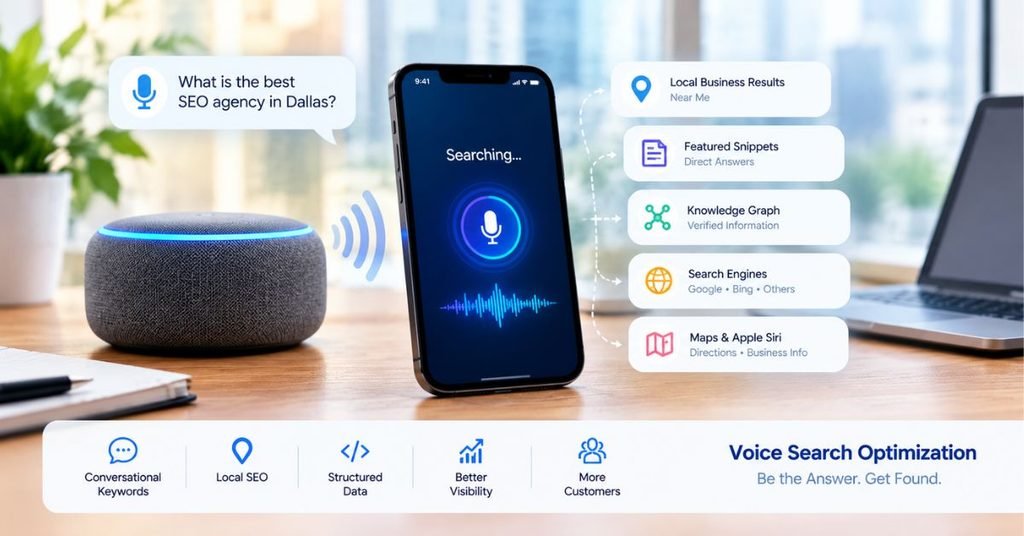
Voice assistants pull answers from several sources:
- Featured snippets — Google Assistant frequently reads the featured snippet aloud when answering a question
- Knowledge Graph — Google’s database of entities and facts, populated partly from structured data
- Google Business Profile — For local queries like “find a restaurant near me”
- Bing Search — Alexa and Cortana use Bing’s index, making Bing optimization relevant for voice
- Apple Maps / Siri Knowledge — Siri draws from Apple Maps data and partnerships with Yelp and other sources
- Direct answers — Some answers come from authoritative reference sources (dictionaries, encyclopedias, government sites)
How Voice Search Queries Differ from Typed Search
Voice search queries are fundamentally different from typed search in ways that directly impact your optimization strategy.
Conversational and Natural Language
Typed search: “best SEO agency Dallas” Voice search: “What is the best SEO agency in Dallas, Texas?”
Voice queries are longer, more conversational, and typically phrased as complete questions or sentences. Users speak to their devices the same way they speak to other people.
Question-Based Queries
Voice searches are overwhelmingly question-based. The five Ws (who, what, where, when, why) plus “how” dominate voice queries:
- “How do I improve my website’s SEO?”
- “What is the best restaurant near me?”
- “Where can I find a web developer in London?”
- “When does the nearest hardware store close?”
- “Why is my website not ranking on Google?”
Local Intent
Voice search has a strong local bias. “Near me” queries, requests for directions, business hours, and phone numbers make up a significant portion of voice searches. Users searching by voice are often on the go, in their car, or at home looking for nearby services.
Longer Query Length
The average typed search query is 1-3 words. The average voice search query is 6-10 words. This means voice search naturally targets long-tail keywords — more specific, lower competition, and often higher intent.
Voice Search Optimization Strategies
Strategy 1: Target Conversational Keywords
Traditional keyword research focuses on short, typed queries. Voice search optimization requires targeting the conversational phrases people actually say.
How to find conversational keywords:
- AnswerThePublic — Enter a seed keyword and get hundreds of question-based queries organized by who, what, where, when, why, and how
- Google’s People Also Ask — Search your target keywords and note the PAA questions. These mirror common voice queries
- AlsoAsked — Visualizes the relationship between PAA questions to help you build comprehensive content
- Google Search Console — Filter for longer queries (5+ words) to find conversational searches already triggering your pages
- Customer conversations — Listen to how your actual customers ask questions. The language they use in person mirrors how they search by voice
Implementation:
Weave conversational keywords naturally into your content. Create FAQ sections that directly mirror how people speak. Use headings that match question patterns. Write answers in natural, conversational language.
Strategy 2: Create Content That Answers Questions Directly
Voice assistants need a clear, concise answer to read back to the user. Your content must provide that answer in an extractable format.
The optimal voice answer structure:
- Question as heading — Use an H2 or H3 that matches the voice query exactly
- Direct answer — Provide a 29-word average answer (Google’s preferred voice snippet length) immediately below the heading
- Supporting detail — Expand with additional context, examples, and depth
Example:
### How Long Does SEO Take to Show Results?
SEO typically takes 3-6 months to show meaningful results,
though some improvements may appear within 4-8 weeks.
The timeline depends on competition, website authority,
and strategy quality.
[Expanded explanation follows…]
This structure gives voice assistants a clean answer to extract while providing the depth that keeps human readers engaged.
Strategy 3: Optimize for Local Voice Search
Local voice searches are booming. “Find a plumber near me,” “What is the best coffee shop in Manchester,” and “Call the nearest dentist” are common voice queries that represent high-intent, ready-to-convert customers.
Local voice search optimization checklist:
- Google Business Profile — Fully optimized with accurate business name, address, phone, hours, categories, and description. This is the primary source for local voice results
- NAP consistency — Your name, address, and phone number must be identical across every online listing. Voice assistants cross-reference multiple sources
- Reviews — Businesses with more and higher-rated reviews are preferred by voice assistants for local recommendations
- Local schema markup — Implement LocalBusiness schema with specific business type, opening hours, geographic coordinates, and service areas
- Location-specific content — Create content that mentions your service areas naturally. “We provide SEO services to businesses across Dallas, Houston, Austin, and San Antonio” helps voice assistants connect your business to those locations
At Webdo Solutions, our local voice optimization work for XO Cabs UK was a component of the strategy that achieved #1 on Google Maps with +340% traffic growth — visibility that extends to voice search on Google Assistant and other platforms.
Strategy 4: Improve Page Speed and Technical Performance
Voice search devices prioritize fast-loading pages. Google has confirmed that page speed is a factor in voice search result selection, and the average voice search result page loads in 4.6 seconds — significantly faster than the average web page.
Technical optimizations for voice search:
- Achieve a Google PageSpeed Insights score of 80+ on mobile
- Implement lazy loading for images and videos
- Use next-gen image formats (WebP, AVIF)
- Minimize JavaScript and CSS blocking render
- Enable browser caching and GZIP compression
- Use a Content Delivery Network (CDN) for global performance
At Webdo Solutions, we build websites optimized for speed from the foundation, ensuring they meet the technical requirements for both traditional and voice search.
Strategy 5: Implement Structured Data for Voice
Schema markup helps voice assistants understand your content’s meaning, context, and structure. Without it, voice systems must rely solely on parsing your text — a less reliable process.
Priority schema types for voice search:
- Speakable schema — Identifies sections of your content suitable for text-to-speech playback. This is specifically designed for voice assistants and is underused by most websites
- FAQPage schema — Marks up question-and-answer pairs. FAQ schema content can be read directly by voice assistants
- HowTo schema — Structures step-by-step instructions that voice assistants can walk users through
- LocalBusiness schema — Provides business details (hours, address, phone, services) in a machine-readable format
- Product/Service schema — Helps voice assistants answer product and service queries with accurate details
Strategy 6: Optimize for Multiple Voice Platforms
Different voice assistants use different data sources. A comprehensive voice search strategy covers all major platforms.
Google Assistant (used on Android phones, Google Nest devices, smart displays): – Pulls primarily from Google Search results, featured snippets, and Google Business Profile – Optimize through SEO, featured snippet targeting, and GBP optimization
Amazon Alexa (Echo devices, Fire TV, Alexa-enabled products): – Uses Bing as its primary search engine – Optimize for Bing SEO alongside Google – Claim your Bing Places for Business listing – Develop Alexa Skills for your brand if applicable
Apple Siri (iPhone, iPad, Apple Watch, HomePod, Mac): – Uses a combination of Google Search, Apple Maps, and partnerships with Yelp and other data providers – Ensure your Apple Business Connect listing is claimed and optimized – Maintain strong Yelp presence with accurate information and positive reviews
Samsung Bixby (Samsung Galaxy devices): – Uses Google Search and Samsung’s own integrations – Standard Google optimization covers most Bixby queries
Strategy 7: Build FAQ Pages Optimized for Voice
FAQ pages are perhaps the most natural content format for voice search. Each question-and-answer pair maps directly to a potential voice query and response.
Building voice-optimized FAQ pages:
- Research the actual questions your audience asks using tools, customer service logs, and PAA research
- Write each question in natural, conversational language
- Provide a concise answer (30-50 words) followed by an expanded explanation
- Implement FAQPage schema markup on every FAQ page
- Group questions by topic for clear organization
- Keep updating with new questions as they emerge
Per-page FAQ sections:
Beyond dedicated FAQ pages, add 3-5 relevant FAQ questions to every service page and blog post. This multiplies your voice search opportunities across your entire site.
Voice Search and E-Commerce
Voice commerce (v-commerce) is growing rapidly. Consumers are increasingly using voice to research products, compare prices, and even make purchases.
Optimizing Product Content for Voice
- Write product descriptions that answer spoken questions: “What is the best for [use case]?”
- Include specific attributes (size, weight, price, colour, material) that voice assistants can extract
- Implement Product schema with detailed specifications
- Create comparison content (“X vs Y”) that voice assistants reference for product queries
Voice Search in the Buying Journey
Voice search typically enters the buying journey at the research and consideration stages:
- Awareness: “What is the best way to improve my website speed?”
- Consideration: “Which SEO agencies in Dallas have the best reviews?”
- Decision: “Call Webdo Solutions” or “What are Webdo Solutions’ services?”
Optimizing content for each stage ensures your business is discoverable throughout the customer journey.
Voice Search Trends Shaping 2026 and Beyond
Multimodal Voice Interactions
Smart displays (Google Nest Hub, Amazon Echo Show) combine voice with visual output. Users ask a question by voice and see results on a screen. This means your content needs to be optimized for both spoken answers and visual display simultaneously.
AI-Powered Conversational Search
Voice assistants are becoming capable of multi-turn conversations. Instead of answering isolated questions, they can follow up, clarify, and dive deeper into topics. Content that covers a topic comprehensively — with clear subtopics and logical progression — performs better in these conversational contexts.
Voice Search in Automobiles
In-car voice assistants are becoming more sophisticated. Drivers use voice search for navigation, local business discovery, and hands-free information access. This reinforces the importance of local voice search optimization, especially for businesses that serve on-the-go customers.
Personalized Voice Results
Voice assistants are increasingly personalizing results based on user history, preferences, and context. While you cannot directly optimize for personalization, building a strong overall presence across multiple signals (reviews, relevance, authority, proximity) increases the likelihood of being recommended.
Measuring Voice Search Performance
Measuring voice search performance is challenging because voice queries are not separately reported in most analytics platforms. However, several proxy metrics provide useful insight.
Proxy Metrics for Voice Search
- Long-tail keyword traffic — Monitor traffic from queries of 5+ words, which likely include voice searches
- Question-based query impressions — In Google Search Console, filter for queries starting with who, what, where, when, why, how
- Featured snippet ownership — Track your featured snippet count, as these directly feed voice results
- Google Business Profile calls — Voice “call [business]” queries show up as GBP-attributed calls
- Direct/organic traffic correlation — Increased voice visibility often leads to more direct visits as users remember your brand name
Testing Voice Search Manually
Regularly test your target queries on different voice assistants: 1. Ask Google Assistant, Alexa, and Siri your key questions 2. Note which business or content they reference 3. Document the exact answer they provide 4. Identify gaps where your competitors are cited instead 5. Optimize your content to capture those specific answers
Industry-Specific Voice Search Considerations
Restaurants and Hospitality
“Find a [cuisine] restaurant near me” and “What time does [restaurant] close?” are among the most common voice queries. Ensure your Google Business Profile has accurate hours, menu information, and accepts reservations through Google.
Professional Services (Legal, Accounting, Medical)
“Find a [profession] near me” and “What does a [professional] charge?” are high-value voice queries. Ensure your service pages answer common pricing and process questions concisely. Our success with Lopez Law Group — achieving +362% traffic growth — included voice search optimization elements that increased phone call enquiries.
Home Services and Trades
Voice search is heavily used for emergency home services. “Find an emergency plumber near me” or “Who fixes boilers in [area]?” are urgent, high-conversion queries. Fast page speed, prominent phone numbers, and optimized GBP listings are critical.
Retail and Ecommerce
Voice shopping queries like “Order more ,” “Compare

Frequently Asked Questions
How Do People Search Differently by Voice?
Voice searches are fundamentally different from typed searches in several ways. Voice queries are longer (averaging 6-10 words versus 1-3 for typed), more conversational and natural in language, overwhelmingly question-based (using who, what, where, when, why, and how), and more likely to have local intent. People speak to their devices the way they speak to other people — in complete sentences with natural phrasing. For example, a typed search might be “SEO agency Dallas” while the same person would say “What is the best SEO agency near Dallas, Texas?” This difference means businesses must target conversational long-tail keywords and structure content around natural-language questions.
Does Voice Search Affect Local Businesses?
Voice search has an outsized impact on local businesses. A significant portion of voice queries have local intent — users asking for nearby businesses, directions, hours, and phone numbers. Studies show that 58% of consumers have used voice search to find local business information. For local businesses, voice search optimization is not optional — it is essential for maintaining visibility as more consumers adopt voice-first search behaviour. The businesses that optimize their Google Business Profile, maintain consistent NAP information, build strong review profiles, and implement local schema markup will capture the majority of local voice search traffic in their area.
What Percentage of Searches Are Voice?
Exact voice search percentages vary by source, but the trend is clear and significant. Current estimates indicate that 27-30% of all mobile searches globally are now conducted by voice, with higher adoption rates among younger demographics (18-34 age group). In the United States, approximately 55% of households own a smart speaker, and in the United Kingdom the figure exceeds 40%. Across both markets, roughly 1 billion voice searches are conducted each month. These numbers continue to grow as voice recognition accuracy improves, smart devices proliferate, and users become more comfortable interacting with AI assistants in daily life.
How Do I Optimize My Website for Alexa and Siri?
Alexa primarily uses Bing for search results, so optimizing for Bing is essential — claim your Bing Places for Business listing, submit your sitemap to Bing Webmaster Tools, and follow Bing’s SEO best practices (which overlap significantly with Google’s). Siri uses a combination of Google Search, Apple Maps, and data partnerships including Yelp. Claim your Apple Business Connect listing, ensure your Yelp profile is accurate and well-reviewed, and maintain strong Google SEO. For both platforms, implementing structured data (FAQPage, LocalBusiness, Speakable schema) improves content extraction accuracy. Comprehensive voice search optimization means covering all major platforms, not just Google Assistant.
Is Voice Search Optimization Worth the Investment?
Voice search optimization is one of the highest-ROI investments a business can make because it largely overlaps with other high-value SEO activities. Featured snippet optimization, FAQ content creation, local SEO, page speed improvements, and structured data implementation all benefit both voice and traditional search simultaneously. The incremental effort required specifically for voice — targeting conversational keywords, writing speakable content, testing across multiple assistants — is relatively small compared to the visibility it unlocks. As voice adoption continues to accelerate, businesses that optimize now establish a competitive advantage that compounds over time. The cost of waiting is visibility lost to competitors who invested earlier.
Conclusion: Make Your Business the Voice Search Answer
Voice search is not a passing fad — it is a fundamental shift in how people interact with technology and discover businesses. The transition from typing to talking is accelerating, and businesses that optimize for this shift will capture a growing share of high-intent, ready-to-convert customers.
At Webdo Solutions, we integrate voice search optimization into our comprehensive AEO and SEO strategies. From conversational keyword targeting to schema implementation to local voice optimization, we ensure your business is the answer — whether your customer is typing, tapping, or talking.
Get your free voice search audit today or reach us on WhatsApp to discuss how voice search optimization can grow your business in 2026 and beyond.
About the Author: Ozair Sharif is the Founder and CEO of Webdo Solutions, a full-service digital marketing agency specializing in SEO, AEO, GEO, and website development for businesses across the United States and United Kingdom.