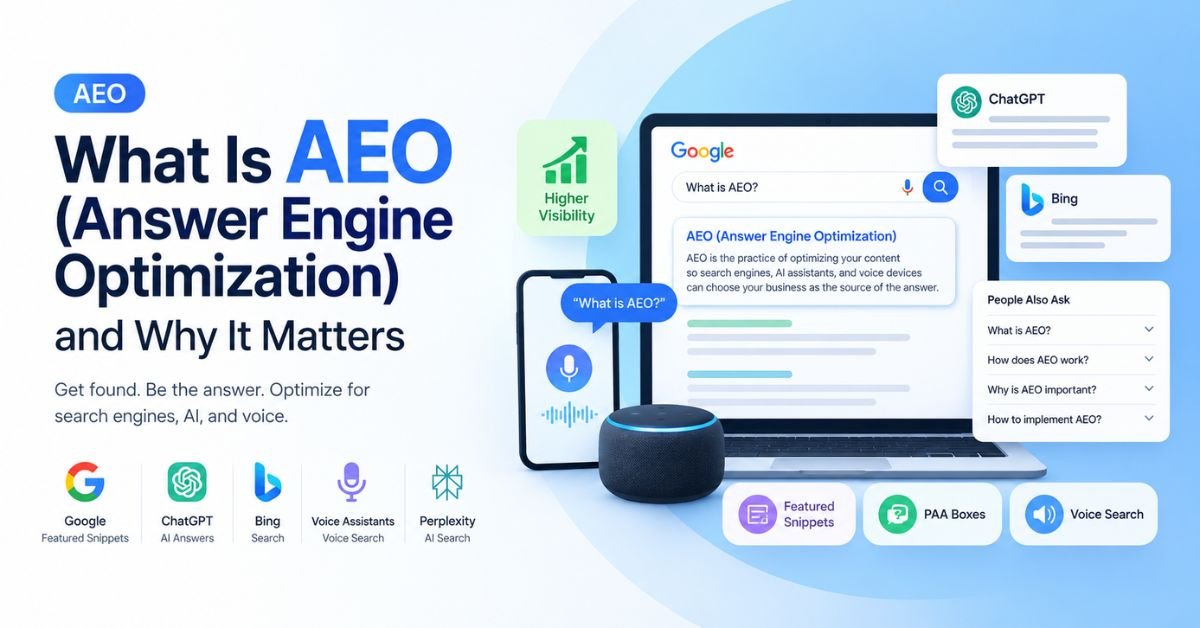
If you have noticed that Google increasingly answers questions directly on the search results page — without users needing to click through to a website — you have witnessed the rise of answer engines. AEO, or Answer Engine Optimization, is the discipline of optimizing your content so that search engines, AI assistants, and voice devices choose your business as the source of the answer.
In the United States, over 65% of Google searches now result in zero clicks. In the United Kingdom, the figure is climbing rapidly as Google rolls out AI Overviews and expands featured snippet coverage. For businesses that depend on organic search traffic, this shift demands a new approach to content strategy.
At Webdo Solutions, we specialize in AEO alongside traditional SEO, helping businesses position their content as the definitive answer across Google, Bing, ChatGPT, Perplexity, and voice assistants. Ready to future-proof your search visibility? Start with a free audit.
Need a professional SEO strategy tailored to your business?
Get a free SEO audit from Webdo Solutionsand find out where you stand today.
What Is AEO?
Answer Engine Optimization (AEO) is the practice of structuring and optimizing website content so that search engines, AI-powered assistants, and voice devices can extract and present it as a direct answer to user queries. AEO targets featured snippets, People Also Ask boxes, voice search results, and AI-generated responses. Businesses use AEO to maintain visibility as search evolves beyond traditional blue-link results.
The Evolution from SEO to AEO
To understand why AEO matters, you need to understand how search has evolved.
The Traditional SEO Era (1990s–2015)
In the early days, SEO was straightforward. Create content with the right keywords, build some backlinks, and wait for Google to rank your page. Users typed a query, scrolled through ten blue links, and clicked through to websites. Every position on page one meant significant traffic.
The Featured Snippet Era (2015–2022)
Google began pulling content directly into search results through featured snippets, knowledge panels, and People Also Ask boxes. Position zero — the featured snippet above organic result #1 — became the most coveted spot. Suddenly, Google was answering questions without users needing to visit your site.
The AI Answer Era (2023–Present)
Google’s AI Overviews, ChatGPT, Perplexity, and other AI tools now generate comprehensive answers by synthesizing information from multiple sources. Users ask complex questions and receive detailed, conversational responses. The source websites may get attribution — or they may get nothing at all.
This evolution means businesses must optimize not just for rankings, but for being the chosen answer. That is what AEO accomplishes.
How AEO Differs from Traditional SEO
AEO and SEO are complementary, not competing, strategies. Think of SEO as the foundation and AEO as the next layer.
SEO Focuses On:
- Ranking web pages in organic search results
- Driving click-through traffic to your website
- Keyword targeting and on-page optimization
- Technical site health and crawlability
- Backlink acquisition for domain authority
AEO Focuses On:
- Being selected as the direct answer in search results
- Optimizing for zero-click visibility and brand awareness
- Structuring content for extraction by AI and voice systems
- Schema markup and structured data implementation
- Conversational and question-based content formats
The critical difference is intent. SEO optimizes for the journey (getting users to your site). AEO optimizes for the destination (being the answer, wherever it appears).
The Five Pillars of AEO
Effective Answer Engine Optimization rests on five pillars. Each one contributes to your content being selected as the authoritative answer.
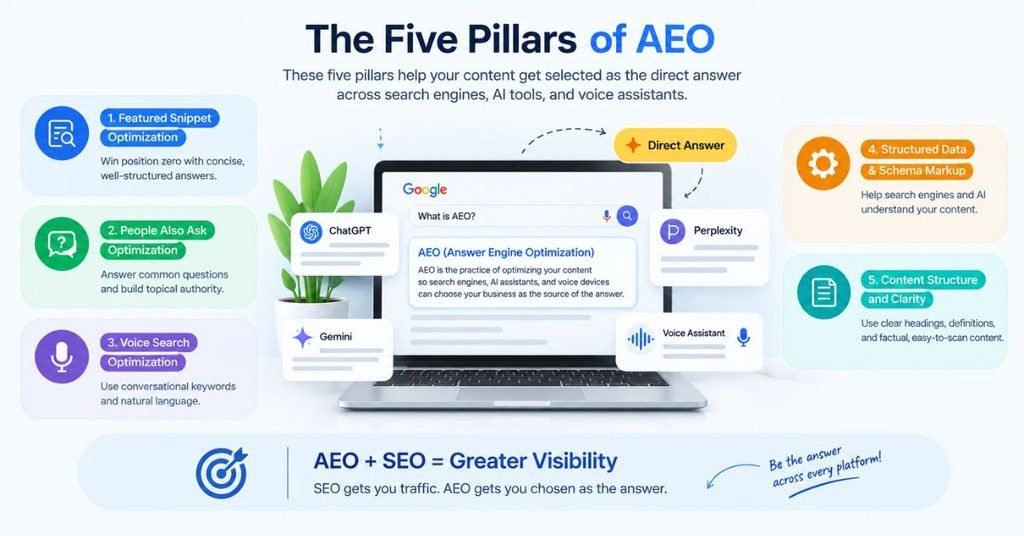
Pillar 1: Featured Snippet Optimization
Featured snippets appear at the top of Google’s search results, providing a direct answer extracted from a web page. There are three primary types:
Paragraph snippets — A block of text answering a question (approximately 40-60 words)
List snippets — Numbered or bulleted lists, often pulled from step-by-step instructions or ranked items
Table snippets — Structured data presented in a table format, commonly seen for comparisons, pricing, and specifications
To win featured snippets: – Identify questions your target audience asks (use tools like AnswerThePublic, AlsoAsked, or SEMrush) – Answer each question concisely in 40-60 words immediately after the question heading – Then expand with detailed supporting content – Use the format Google prefers for that query type (paragraph, list, or table) – Structure your content with clear H2 and H3 headings that match search queries
Pillar 2: People Also Ask Optimization
The People Also Ask (PAA) section appears in over 85% of Google searches. Each question in the PAA box, when clicked, reveals an answer extracted from a web page — along with a link to that page.
PAA optimization is one of the highest-ROI AEO activities because: – PAA questions reveal exactly what your audience wants to know – Each answered question is a separate ranking opportunity – PAA visibility builds topical authority in Google’s eyes
To optimize for PAA: – Research PAA questions for your target keywords – Create FAQ sections that directly address these questions – Use H3 tags for each question – Provide concise, direct answers (40-80 words) followed by expanded explanations – Implement FAQPage schema markup on every page with FAQ content
Pillar 3: Voice Search Optimization
Voice search through devices like Amazon Echo, Google Nest, Apple HomePod, and smartphone assistants processes queries differently than typed search.
Voice queries tend to be: – Longer and more conversational (“What is the best Italian restaurant near Covent Garden?”) – Question-based (“How do I fix a leaking tap?”) – Location-specific (“Where can I find an SEO agency in Dallas?”)
To optimize for voice search: – Target long-tail, conversational keywords – Answer questions in natural, speakable language – Ensure your Google Business Profile is optimized for local voice queries – Aim for featured snippets, as voice assistants often read these aloud – Keep answer paragraphs concise — voice assistants prefer short, clear responses
Pillar 4: Structured Data and Schema Markup
Schema markup is the technical backbone of AEO. It helps search engines and AI systems understand the meaning and context of your content, not just the text.
Essential schema types for AEO: – FAQPage — Marks up FAQ sections so Google can display them directly in search results – HowTo — Structures step-by-step instructions for rich result display – Article/BlogPosting — Identifies content type, author, and publication date – Speakable — Tells voice assistants which sections of your content are suitable for text-to-speech – Organization — Establishes your brand entity for knowledge graph inclusion
Implementing schema correctly requires technical expertise. At Webdo Solutions, we handle schema implementation as part of our comprehensive AEO and web development services, ensuring your content is machine-readable and optimized for every answer engine.
Pillar 5: Content Structure and Clarity
Answer engines extract content that is clearly structured, factually specific, and easy to parse. This means:
- One topic per page — Do not try to answer every possible question on a single page
- Clear hierarchy — H1 for the main topic, H2 for subtopics, H3 for specific questions or sub-points
- Definition blocks — Start key sections with a concise definition before expanding
- Factual precision — Use specific numbers, dates, and data points. “Increased traffic by 362%” is more citable than “significantly increased traffic”
- Updated content — Fresh content with a visible “Last Updated” date signals relevance to both Google and AI systems
AEO for AI Search Engines (ChatGPT, Perplexity, Gemini)
Traditional AEO focused on Google featured snippets and voice assistants. In 2026, AI search engines represent a massive new frontier for answer optimization.
How AI Search Engines Select Sources
When ChatGPT, Perplexity, or Google’s Gemini generate an answer, they evaluate sources based on:
- Authority — Is the source a recognized expert on this topic?
- Specificity — Does the content provide precise, factual information with numbers and data?
- Structure — Is the content organized in a way that is easy to extract and synthesize?
- Freshness — Is the content up to date?
- Citations — Does the content reference credible sources, adding to its trustworthiness?
This is where AEO intersects with Generative Engine Optimization (GEO). GEO specifically targets AI-generated search results, while AEO encompasses the broader landscape of answer engines including featured snippets and voice search.
Optimizing Content for AI Citation
To increase the chances of your content being cited by AI search engines:
- Write citable statements — Craft sentences that stand alone as factual claims. “AEO is the practice of optimizing content for answer engines, including featured snippets, voice assistants, and AI-powered search tools” is more citable than “AEO is important for your business.”
- Include specific data — AI models prefer content with precise metrics. Reference your own case study data, industry statistics, and concrete examples.
- Define terms clearly — When you introduce a concept, define it in one clear sentence. AI models frequently pull definitions verbatim.
- Use comparison structures — Tables, side-by-side comparisons, and “X vs Y” frameworks are easy for AI to extract and reference.
- Build topical authority — Create clusters of related content that cover a topic comprehensively. AI models assess topical authority when selecting sources.
AEO in Practice: Real-World Implementation
Implementing AEO on Your Website
Here is a step-by-step approach to implementing AEO on your existing website:
Step 1: Audit your current answer visibility Search your target keywords and note which queries trigger featured snippets, PAA boxes, and AI Overviews. Check whether your content currently appears in any of these features.
Step 2: Identify answer opportunities Use keyword research tools to find questions in your niche with featured snippet opportunities. Look for keywords where you already rank in positions 1-10 but do not hold the snippet.
Step 3: Restructure existing content Update your top-performing pages with AEO elements: add definition blocks, FAQ sections, structured data, concise answer paragraphs, and clear heading hierarchies.
Step 4: Create new answer-focused content Develop content specifically designed to capture answer positions. Blog posts, FAQ pages, and resource guides built around question-based queries are ideal.
Step 5: Implement schema markup Add FAQPage, HowTo, Article, and Speakable schema to your content. Validate using Google’s Rich Results Test.
Step 6: Monitor and iterate Track your featured snippet appearances, PAA inclusions, and AI search citations. Adjust your content based on what wins and what does not.
AEO for Different Industries
AEO applies across industries, but the approach varies:
Legal services — Optimize for “What is [legal term]?” queries, create FAQ pages for common legal questions, and implement LegalService schema. Our work with Lopez Law Group involved AEO strategies that contributed to 100+ #1 rankings.
Ecommerce — Optimize product pages for “best for [use case]” queries, implement Product schema with detailed specifications, and create comparison content.
Home services — Target “how to” queries related to home maintenance, optimize for local voice searches, and implement LocalBusiness and Service schema.
Healthcare — Create comprehensive health information pages with MedicalCondition schema, target symptom-related questions, and build authority through cited, fact-checked content.
Measuring AEO Success
Key AEO Metrics
Featured snippet count — How many featured snippets does your website hold? Track this with tools like SEMrush, Ahrefs, or Moz.
PAA appearances — How many People Also Ask results feature your content?
Zero-click brand impressions — Even without clicks, your brand name appearing in featured snippets and AI answers builds recognition. Track brand search volume as a proxy.
Voice search presence — Test your target queries on Google Assistant, Alexa, and Siri to see if your content is read aloud.
AI citation frequency — Search your key topics in ChatGPT, Perplexity, and other AI tools to check if your content is referenced.
AEO ROI Considerations
AEO sometimes appears counterintuitive because it can reduce click-through rates — your answer appears in the search results without the user visiting your site. However, the benefits include:
- Brand authority — Being the chosen answer establishes your brand as the expert
- Top-of-funnel awareness — Users who see your brand in featured snippets are more likely to search for you directly later
- Voice search dominance — Voice assistants read one answer. Being that answer is extremely valuable
- AI visibility — As AI search grows, being cited by AI models becomes a significant traffic and trust driver
- Competitive defense — If you don’t capture the featured snippet, your competitor will
The Future of AEO
AEO will only become more important as search continues to evolve. Expect to see:
- Multimodal answers — Google and AI tools will increasingly combine text, images, and video in answer results
- Personalized answers — AI will tailor answers based on user context, location, and history
- Conversational search — Users will engage in multi-turn conversations with search engines, requiring deeper, more structured content
- Source attribution improvements — As AI search matures, citing sources will become more standardized, creating new opportunities for optimized content
Businesses that invest in AEO now will be positioned to benefit as these trends accelerate. Those that wait will find themselves invisible in the new search landscape.
Frequently Asked Questions
What Is the Difference Between SEO and AEO?
SEO (Search Engine Optimization) focuses on ranking web pages in traditional organic search results to drive click-through traffic to your website. AEO (Answer Engine Optimization) focuses on getting your content selected as the direct answer in featured snippets, voice search results, People Also Ask boxes, and AI-generated responses. SEO aims to get users to your site, while AEO aims to make your content the answer wherever the user is searching. The two strategies are complementary — a strong SEO foundation makes AEO more effective, and AEO success reinforces your SEO authority.
How Do I Optimize for Featured Snippets?
Optimizing for featured snippets involves structuring your content to directly answer specific questions. Start by identifying questions your audience searches for using tools like AnswerThePublic or SEMrush. Place each question as an H2 or H3 heading, then provide a concise 40-60 word answer immediately below the heading before expanding with detailed supporting content. Use the format Google favours for that query — paragraph snippets for definitions, numbered lists for processes, and tables for comparisons. Implement FAQPage schema markup and ensure your page already ranks on page one for the target query, as Google almost always pulls featured snippets from top-10 results.
Does AEO Replace SEO?
No. AEO does not replace SEO — it builds on top of it. Traditional SEO fundamentals like keyword optimization, technical site health, quality backlinks, and user experience remain essential. AEO adds a layer focused on how your content is presented and extracted by modern search features. Without strong SEO, your pages will not rank high enough for Google to consider them for featured snippets or AI answers. Think of SEO as the foundation and AEO as the next floor. At Webdo Solutions, we implement both strategies together because they reinforce each other.
How Does AEO Affect Website Traffic?
AEO can both increase and change the nature of your website traffic. Featured snippets and PAA appearances often increase click-through rates for the pages that hold them, despite the zero-click concern. However, some queries will be fully answered in the search results, meaning fewer clicks. The key is that AEO dramatically increases your brand visibility and authority. Users who see your brand consistently providing answers develop trust and are more likely to search for you directly, visit your site for more complex queries, and ultimately convert. The overall effect for most businesses is positive — AEO increases total visibility, maintains or grows traffic, and improves the quality of visitors who do click through.
What Tools Do I Need for AEO?
Effective AEO requires a combination of keyword research tools (SEMrush, Ahrefs, AnswerThePublic, AlsoAsked), structured data tools (Google’s Rich Results Test, Schema Markup Validator), tracking tools (SEMrush Position Tracking with SERP features, Ahrefs Content Explorer), and content optimization tools (Clearscope, Surfer SEO, MarketMuse). For monitoring AI citations, regularly test your target queries in ChatGPT, Perplexity, and Google’s AI Overviews. No single tool covers every aspect of AEO, so building a toolkit that covers research, implementation, and measurement is important for ongoing success.
Conclusion: Position Your Business as the Answer
The shift from search engines to answer engines is not coming — it is here. Businesses that optimize for AEO today are capturing the featured snippets, voice search results, and AI citations that will define search visibility for the next decade.
At Webdo Solutions, we combine SEO, AEO, and GEO into a unified search strategy that ensures your business is visible wherever your customers are searching — Google, Bing, ChatGPT, Perplexity, Alexa, or Siri.
Get your free AEO audit today or contact us on WhatsApp to learn how we can make your business the answer.
About the Author: Ozair Sharif is the Founder and CEO of Webdo Solutions, a full-service digital marketing agency specializing in SEO, AEO, GEO, and website development for businesses across the United States and United Kingdom.